Showing posts with label urbanism. Show all posts

Thursday, July 9, 2015

In the hood


So it seems like again there is a certain duplication of efforts in Stockholm and Madrid: at the same time as the blogpost of surrealist walking as militant enquiry, Emilio Santiago of the Madrid group published an "investigacion surrealista del imaginario de un barrio" of the Móstoles area in the recent Salamandra #21-22 (as revealed in the pdf version). There is, like in the material from Spain in Hydrolith #2, a wealth of articles about urban and suburban (and here also maritime) phenomenology. And a very beautiful picture of two windows with branches. Also a bunch of articles on the concept of "Poetic materialism", including one on "scientific method and poetic materialism".


Tuesday, June 3, 2014

New York, editorial note

Those interested will probably have discovered it by now, but during the last year one of the more prominent resources of information on historical as well as contemporary surrealism online has been Paul McRandle's Surrealist NYC blog. Starting out as a documentation of surrealist activities in New York in the 1940s, it soon broadened into contemporary international surrealist notes, and more importantly, to occasional posts from the editor's own walks, discoveries and reflections through New York (I'm waiting eagerly for more of that kind). That step was absolutely necessary, moving from giving the impression that "Surrealist New York City" is identical with the New York experienced by European refugees in the 40s, to the pertinent questions of what "Surrealist New York City" is on the whole; what aspects of the life and phenomenology of that exceptional city that could be identified as the surrealist city, the ghost structure connecting different neighborhoods, different historical anecdotes, different future anecdotes now perceived merely as distinct impressions of possibilities, according to the psychogeography of poetry rather than of discipline, habit, business, commerce, or tourism...
    The way European surrealists experienced New York in the 40s may provide interesting clues to this city of course, but native surrealists just as much, and certain other currents moving in the environment for the purpose of a nonconformist and poetic sense of experimentation, community and exploration without very strong ties to surrealism historically.
    Surrealist New York City is a city which is distinctly there but which remains to be uncovered. All good luck in this task and others to Paul McRandle and other New York surrealist comrades!

Your City, part 1

- the technical aspects

Psychogeography consists of drifting-exploring and mythologisation-reenchantment, and if you will of detailed empirical studies. Mythologising your city is a basic poetic task and a task which is usually carried on spontaneously anyway, but emphatically the surrealist tradition holds a few emphases and distinctions which makes its view particular.
    Spontaneous mythologisation has two parts: One is the acknowledgment of historical charging: places of anecdotes about one's predecessors. The other is the rememberance of autobiographical charging: places of anecdotes about oneself.
    These are used by everybody, but there is a huge difference as to how selectively and sensibly they are used.
    A third mechanism, also in general use, but more sensible in its essence, is the exerting of geographical sensibleness itself: recognising places where it feels like something is going to happen, something weird or fantastic or horrible or just unknown, or might be happening if you're only looking the other way, or might have happened and is bristling with eagerness to tell about it.
    But first, let's go back to historical charging. Historical charging is dependent on documentation, and on population size, and on accumulation of madmen, intellectuals, revolutionaries, artists, philosophers etc. The general pattern (with abundant exceptions) would be that small cities often have very little of it, metropolises often have an overabundance, which may even be overwhelming and/or numbing. It is also a matter of the length of the history record itself; so that European cities have more than American cities, south European cities more than north European cities, etc. Length of documented history often goes hand in hand with age of physical artifactual elements too, and as everybody knows, as a rule of thumb old architecture more easily speaks to us than younger, and crude old city planning allows for more excitement than modern city planning. Of course, in some places this means that an "old town", a historical city center with remaining old buildings and street plan, will seem like a thick pastry with immediate atmosphere, layers of anecdotes, and often enough more like a museum than a real environment. This is the trivial level of historical charging.
    Autobiographical charging and sensibility are far less varying than historical charging between sites in terms of absolute conditions; it is of course more a question of where one has been hanging around to make some interesting experiences (of course, very often there is a sharp difference between where one spends most time and where one gets the more interesting experiences).
    Concerning both, from the surrealist viewpoint, selectivity and sensibility are crucial terms. There is no point in becoming a tourist guide. The importance of a thorough historical-geographical investigation is not in listing all the places where something as occurred as items on a list or fetishes, but making them available as suggestions of sites to look for atmospheres and connections. It is not a question of recognising places where things have happened because of the things that have happened there, only because of what objective potential of the place those anecdotes are revealing, what still unrealised parts they suggest, what local charging and what contrast to utilistic use and to surrounding areas it has. What manifest atmosphere of potentiality a place has, as revealed by its anecdotes. Thus it is about the actual spirit of the actual places. Selectivity is not primarily up to your own opinions.
    But, it must be emphasised, it is also a part of your own assuming a prehistory, placing yourself in a tradition. When you actively do that, the places that your precursors have rummaged become an integrated part of your own psychogeographical landscape. In smaller cities, there might be just one or two examples of local poets, revolutionary sects, imaginative criminals and old wizards to build on. There it seems important to investigate every such instance of odd/nonconform usage of the place and its sense of place. In larger cities, there is often the experience of an old surrealist group and perhaps some other objectively affiliated movement to assimilate, various old insurrections, romanticists, symbolists, occultists, alchemists, utopists, etc etc. There is easily lore available for a full "alternative" version of the official history. On top of this, many people with quasireligious and/or unrestrainedly nerdy interests readily allow themselves to get trapped in amazement at the simple fact that freemasonry, occultism, utopianism, various brands of christian, jewish and islamic mysticism all have played a major part in the imaginary structures of those intellectuals or rich guys who have thought out the city planning. In order not to get overwhelmed, it is important to choose particular threads that attach to the associative tentacles of one's own projects, enquiries and sensibilities. This quantitative overload then is a major problem in Paris and Prague, a bit of a problem in London and Berlin, hardly a problem in Stockholm and New York, not at all a problem in Helsinki and Leeds.
    But then there is the third aspect mentioned, that of geographical sensibility, which is the more important. Beyond the spontaneous occasional recognition of this, surrealists have developed methods of actively investigating this and also of experimentally invoking it. This is the strategy of surrealist walking, and of various games involving spatial movement. This is a vast field and a series of essays in itself.

Conceptualising surrealist walking


Spontaneously, it makes sense to regard surrealist walking as militant investigation. I was recently invited to talk in a connection implying this consideration, even though it was, luckily, not an event of conceptual analysis but a discussion trying to suggest the points of, and invoke and examplify the process of, surrealist walking.

(Conceptually, since this is one of those places that do that: the concept of "militant investigations" as developed in Italy in the 60s by Romano Alquati and friends, is a dynamic and inspiring concept regardless of how widely one accepts currently available items in the margin as instances thereof.
 And the practice of surrealist walking is a continuingly rewarding practice which is not dependent on legitimation in political or philosophical terms to be meaningful.
 "Militant investigations" is the systematical practice of mapping everyday lives, conflicts and desires so as to reveal new patterns and new openings on a substantially empirical basis. Very often it is used to reveal real conflicts and real needs on workplaces, but just as fundamental is the organisation of everyday life. And the area of relevance benefits from being widened from the spheres of organising household labor and consumption to all aspects of everyday life.
 Conceptually: "everyday life" includes the area of play, love, sleep, dream, idling and fun, and "real needs" includes all needs of stimulation and provocation including intellectually, emotionally and poetically, and "social relationships" include all the potential unexpected encounters, love affairs, etc. Militant investigations in a wide sense are the empirical investigation of social reality and everyday life, with an aim to transform. Eleventh Feuerbach thesis, you know.
 Social reality is the sum of all social relationships, and the radical transformation of social reality equals social revolution.
 Specifically, militant investigations works in assuming that people's everyday experiences that are often disregarded as meaningless are part of meaningful patterns that reveal something which can be used in order to challenge the social order. It works by highlighting the invisible, and it works by discovering which contradictions that make sense in everyday life.)

Readers of this blog may know surrealist walking. Typically you just wander spontaneously, usually in the urban environment, alone or in a group, but trying to stick to the special kind of availability than distinguishes betweens urges of habit, laziness, cowardice or least resistance, and urges of discovery, curiousness, desire, inner necessity, and poetry. Being in a group easily provides release from certain utilistic constraints: one needs no idea of direction, and can always assume (if it is difficult not to worry) that someone else is leading. But there are also far more systematic approaches which are easily available to a single individual too, and indeed very often call for a splitting up of the group into divergent excursions and later reassembly for comparing notes. As surrealists, we typically arrange such driftings as games, focusing on a particular method of moving or of interpretation or a particular theme or sphere of association. Or a plethora of methods, and the autonomous movement of a living entity of which the individuals are merely parts.
 

Surrealist walking investigates the environment (typically the urban environment) in a transformational sense: moving as vagrancy, moving without authorisation, moving beyond utilistic transport; moving through a "sea of signs" (making oneself available to emergent patterns of meaning amidst the vast flow), through a "forest of symbols" (discovering the layering of patterns of meaning, the hiddenness of certain poles of intense meaning) , through a "succession of ambiances" (clear domains of tangibly different fields of possibilities inspiring different kinds of thoughts, actions, fantasies and interactions), through a "web of encounters" (bouncing from one intersection point between trajectories to another in a sequence that generates an adventure); demasking, opening up and generating meaning as it goes. It is indeed the successive revealing of "another city", which overlaps with the one on the official maps, but through a gestalt switch instead structured in accordance with desire and sensibility, a network of ambiances and surprises. It is about the reenchantment of lifespace. Making the city a liveable place by disenveloping the undervegetation in plain sight, and let our relationship with the place and our spatial movement be as meaning-generating as it would be.
A crucial aspect of this seems to be the "suspension of metaphysical judgment". A direct contrary to the miserabilist approach of no-nonsense "common sense" which aggressively assumes that things that coincide are necessarily random and have no connection, that things that speak to you actually spoke about something else and have nothing to tell you; surrealists tend to assume that coincidences make sense, that what you meet is relevant in connection with your present adventures and worries, that what you find is a response to what you are looking for, as a way of rebuilding a meaningful world, not as if it was all expressions of some particular fate or hidden will, not in the manner of the clinically paranoid as something that you need to obey or escape for otherwise you will get hurt, but simply as an inevitable part of life, as an expression of the ways by which meaning is generated. Messages speak, associations abound, interesting connections are preferred, doubts arise, hidden patterns emerge, insights awake, worlds in which the imagination enjoys to work claim space.

Of course a lot of this general manner of drifting and interpretative movement is codified by some of the surrealists' successors, the lettrists and situationists, and its inception into radical movements today very often as distinct post-situationist interpretations with different proportions of anarchism, poststructuralism, heterodox marxism, desire philosophy and live-role-playing in their foundations. Through this part of tradition, there is an increasing tendency to focus on the dynamics and disregard the ambiances; attentive to factors that facilitate movement in one direction or another but less likely to exert a sensibility to the places themselves and acknowledge their spirit. Such drifting is typically fuelled, and attracted or repelled by, the spirit of places but without recognising it and questioning it. Modern activists are well aware of the contradiction between free availability and imposed control over space, and sometimes may have a tendency to interpret all available signs as signs of this particular conflict (at worst seeing the landscape only as a massive bulletin board for signs of exclusion and the occasional scattered stickers with shouts for freedom). But signs of what you were already looking for are not signs in the sense of free movement and in the hope of discovering hidden patterns, it is necessary to move beyond the preconceived conflicts to see other potential conflicts arising, and especially the utopian suggestions, be they already put into practice or just feral hunches.

The conflicts in the urban environment are thus not just the ones in terms that are perhaps conventionally targetted by militant investigation (conflicts between access and exclusion, free popular use and controlled use) but also conflicts between actual use and possible use (in terms of playful, poetic, wild or utopian use) and conflicts in atmosphere and directionality which surrealist methods may perhaps be specifically useful for finding (conflicts in emerging patterns of meaning, but also conflicts in categories and implications of found objects and material association chains). The transformation invoked is both the change already implied in the investigation, rendering the environment meaningful, readable, savourable, and the direct changes of slight disturbances as well as the opening up of paths through the urban landscape, and the change suggested by conceptualising new use of places, including the various forms of exchange and alliances with other people encountered there.


MF


Wednesday, July 7, 2010

A few possible tasks for a surrealist group in Wien (Vienna) if there will ever be one


* The Donauinsel (Danube island) appears to be an obvious center of the city. An enormously long and mostly very narrow land tongue between two Donau (Danube) arms, apparently largely covered with a mosaique of parkland and worthless places. Try to get lost at the Donauinsel (really a challenge at such a narrow piece of land). Divide it into a random number of segments; investigate one by one in a series (or by different players); fuse the results cadavre exquise-wise; and then shuffle them, place them in random order and see what story is being told; then rearrange them in accordance with their inner logic. It's easy, just like repaginating a book where the course of events has been distorted to conform to linear rationalisations rather than to inner logic. Or pick a spot and gaze out the river, notice every larger object flowing with it and interpret each object as a dream.


* The Rote Wien (Red Vienna) part of the city's history is largely unexplored from a surrealist viewpoint. A furiously active workers movement struggling to organise every single aspect of life in an integrative radical whole (there appears to have been workers societies and collective solutions for everything), and simultaneously of course to integrate and mute the more impatiently radical wings of the movement (apparently in a less hostile manner than in other burgeoning social democratic power nexuses?), and all of this in the presence of the world headquarters of the blossoming psychoanalytical movement. There is a vast range of failed experiments to reexamine (and sometimes retry) here.


* The fin-de-siecle aesthesticism of Wien raises several critical questions about imaginational phenomenology and surrealist perspectives on art. As romanticism-getting-stale and decadent-classicism were venturing continuously further into the absurd and the poetic, which historic aesthetic contradictions played any role whatsoever? If the grand figure of Hans Makart obviously was the Salvador Dalí of his time, does that refer merely to his grandiose-excentric-commercial-megalomanic aspects and painting skills, or also to the part of real groundbreaking investigations into the imagination? If Gustav Klimt turned to the more decorative style for which he is best known by the critical rebuffal of his groundbreaking Fakultätsbilder, was that a major retreat also in terms of the advancement of the investigation of the imagination, or did he luckily hit new solid poetic ground when trying to be uncontroversial? Etc.


* The absence of organised surrealism in Wien is remarkable. The few organising efforts in the 40s need to be scrutinised, and also to clearly demarcate when these transformed into a school of painting, "der Wiener Schule des phantastischen Realismus" (fantastic realism) which at best covers a few detached individual aspects of surrealism. On the other hand, quite other aspects of a possible surrealist spectrum were addressed in a spectacular and often ignorant way in Wiener Aktionismus (actionism). It is important to snatch back the concepts of communal living and sex radicalism, especially in their combination with artistic creation, from their failed local applications. Correspondingly, it is important to emphasise how visions of "fantastic realism" will imply a confrontative radicalism, on the intellectual, spiritual and social levels rather than on the aesthetic. Simply, to demonstrate how surrealism provides a framework that puts the constructive achievements of fantastic realism and actionism both into perspective.


* try regular meetings at the Café Hegelhof


* have a surrealist exhibition at the Sigmund Freud Museum


* make the Sigmund Freud Park more ambiguous


* try furious dérives through tram-surfing


etc


a tale of a few cities

Just having returned from Wien (Vienna) I am somewhat enchanted by the surrealist possibilities of that city. With surrealism's perspectives on urbanism (note for exemple one or another sketch previously posted here), "the surrealist possibilities of a city" is not just the case of differentiated personal sensibility towards the spirit of the place. It is that to some extent, but it is also concretely manifested in the degree of condensation and contrast, spatial and social heterogenity, signs of expectation, overlayering, dynamism of spatial phenomenology, and overall ambiance. Of course, pursuing a collective surrealist activity is fundamentally about revealing the surrealist qualities of your immidiate environment; any surrealist grouping will enhance and make explicit the process of disenveloping the surrealist sense of the city they are in. So this is not quite what I am talking about here. I am talking about which places will offer a temporary visitor the most distinct signs and ambiances suggesting this particular sense of possibilities. In this sense, my personal favorite candidates for surrealist cities in Europe are Wien, Berlin, Budapest and Helsinki. Of course they are cities that appeal to me personally, but I do think that they all have a specific objective sense of suggesting hidden possibilities that is central to surrealist urbanism.


And I have to contrast this against the perpetually cited surrealist aspects of Paris, Paris which many people consider as the Capital of Surrealism mainly because surrealism originated there and it has for long times been an important organisational center. Of course, if you live in Paris, and Paris is where you take your daily and nightly strolls, your drinks with friends, your intoxicated trajectories, your everyday conflicts and wonders, you will necessarily see and disclose surrealist aspects out of that psychophysical environment.


But it is another thing for visitors. Many people come to Paris to experience a surrealist city. Indeed, most neighborhoods in Paris do carry a load of anecdotes in surrealist historiography and mythology. There are memories of Breton's walks with Nadja, of the surrealist group's interventions and experiments for many decades, there are all kinds of souvenirs of things integrated into surrealist mythology such as the rich traditions of alchemy, of late 19th century occultism, of early 20th century popular culture, of dada, lettrism, situationism, pataphysics, etc; there are souvenirs of the french revolution, of the Paris commune, of May 68, etc. Not only did these things actually occur right there, but they have also been commemorated, giving names to streets and squares, cafés and statues, etc. The shops, galleries and museums are full of actual references to our chosen heroes. Placenames will be easy to associate with titles of well-known works, and the poetic aura of these names will be lying near at hand since, for us outsiders, so much of the french we know is primarily associated with this poetry and these works rather than with any everyday use. Anywhere you go, if you find a square with a remarkable ambiance, you will very often learn that André Breton already mentioned it in a poem, and if you see a strange gargoyle, you will very often learn that Man Ray or Brassaï already photographed it. The place is so abundantly colonised with anecdotes, with reified pieces of history, and then on top of that seasoned with an overflow of empty references, that it is far more a museum of surrealism than a surrealist city. It gives rise to a feeling that there is nothing to discover, it's all written out for you. It might be possibly to indulge in this, in some cases of recently arrived enthusiastic young surrealists who are happy to see traces of real surrealism recognised as real in the official world and the physical environment, and who will anyway just use them not as pillars in a lithified tradition but as glowing suggestions and hints that make stepping-stones in their own appropriation of surrealism as a shared and personal mythology – for those people, traditional surrealist Paris might still make sense. And of course anyone who is attentive could eventually make some original observations revising or adding to the already almost map-filling color-coding of surrealism-codified corners of Paris. But most of those who hail surrealist Paris are external surrealismophiles (academic, arty, or fellow travellers) who will find this abundance of references to surrealism o so blissful, and whose appreciation of such references might stand in exact proportion to their own inability to discover the surrealist aspects of things for themselves. Preferring the pre-labelled surrealist city before having to exercise any imagination and enterprise any investigation of ones own. Often a certain surrealismophilia of that tinge will prove to be nothing but culture-loving nostalgic francophilia in general, nicely arranging the facets of classic modernism into the big history of western society's art, with a certain predilection for the picturesquely radical and romantic - which is all clearly the opposite of the thorough radical departure and nonconformism central in surrealism itself. But worse for us, it will also be the form in which many of our most eager sympathisers will be happy to consider and consume surrealism as something titillating and even deeply felt – but only not dependent on ones own creative, demanding and risky participation and reinvention.


If we go back to my personal quartet of suggested surrealist cities, Wien, Berlin, Budapest and Helsinki, it is striking that neither of them has ever had a proper surrealist group in spite of a rich presence of avantgarde and radical movements in general. It is also, perhaps, notable that they all lie east of a line dividing Europe in halves. (And indeed, if we would extrapolate from this crude geographical division, we could try to count in Bucuresti, Praha, Brno, Bratislava, Beograd and Athina in this eastern axis, most of which have had a strong (brief or enduring) surrealist presence historically, and one of which (Praha) is indeed often cited as emblematic for surrealist urbanism along with Paris. I don't know. The only place of these that I've visited – so far – is Bucuresti, and I certainly don't mind recognising a particular surrealist potential of that city. And what would become of the western axis? it would also include London and Bruxelles, which are another two of surrealism's historical capitals, which most people would agree are largely boring cities, as well as Madrid, Barcelona and Lisboa, about which there are probably very conflicting views available. But no, I do not want to make a big issue out of these axises, it was just a simple thought experiment.)


I would just like to advocate discovering surrealist aspects of cities rather than consuming surrealist aspects of cities. (And I dream of eventually becoming a satellite member of surrealist groups of these four cities so as to be able to explore these surrealist aspects of the cities more substantially than a casual visitor may.)


M Forshage


Thursday, November 5, 2009

On the shoulders of giants

I always figured that the old scholastic notion of "standing on the shoulders of giants" was a way to describe accumulated learning and express an indebtedness towards tradition. On closer inspection, though, there is no lack of written sources that belie this metaphorist interpretation. Isidore of Sevilla - to name only one - informs us that "just as, in individual nations, there are instances of monstrous people, so in the whole of humankind there are certain monstrous races, like the Giants, the Cynocephali, the Cyclopes, and others." In his Etymologies, in which he attempts to collect all the knowledge of his age, we find peoples in the most varied sizes with organs redistributed in the most striking fashions. Faces on the stomach, a one legged people habitating distant parts of the world, asians without noses - the variations of medieval man shames the monotony of the contemporary human body. And to still think in metaphors? What a cretinizing way of turning flesh into mere words.


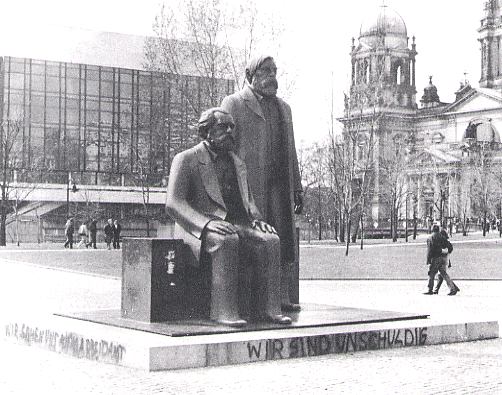
East Berlin worked as an important corrective to such lifeless abstractions. During our trip, M and me went to visit the Marx-Engels Platz and were confronted by the gargantuan stature of earlier generations of men. Standing on M's shoulders, I still would not be able to reach the head of Engels. One of the virtues of socialist realist art is how it expresses material truths through scientific-aesthetic techniques. Instead of "translating" Marx and Engels into men of a present-day size, it lets us experience the wonder of human variation. The finger nail of a 19th century man is the size of my palm! His feet like my thighs and his torso the thickness of a recycling igloo. Instead of trying to comfort us by making dwarves of giants, the sculptor forces us to take stock of both a historical distance and the slumbering possibilities within our present, cookie cut limbs.


Confronted by these statues of the labor movement's great thinkers - as well as by the nameless workers of a similar height that surround the Platz - one understands the urgency which must have inspired works such as "The Housing Question" and the investigation of the living conditions of English workers in that island's great industrial cities. I cannot begin to fathom how those early-industrial giants managed to fit into apartments smaller than those we live in today. After a 12+ hour working day, they had to crawl their way through narrow corridors only to be forced into fetal position, packed like herrings in what passed for a home. The ever new editions of Swift's Gulliver's Travels (a perspective that is often lost sight of today) - what a clever intervention into the great 19th century struggles over social space. The books - no larger than today - must have been the perfect size for a worker to build his own coat library.


But however remarkable the size difference is, what really got our attention was the variations in the actual composition of the human body that the statues hinted at. Specifically: the genitalia of giants.


Concerning the crotches of giants


Socialist Germany apparently tried to make a clean break with bourgeois sexual morals, at least when it came to the variations of genitalia over time. I was aware of how the introduction of a "two-sex" system replaced an aristotelian performative-misogynist theory of sex with a biological-misogynist one in the early-modern period. But just as the political ideology of the day tends to reduce (political) history into a teleological story about the progressive realization of representative democracy, I have taken for granted that today's sexual organization has been present - at least biologically - throughout human history with only slight variations. Changes, even revolutions, in sexual practices, family structures and theories of reproduction and pleasure - sure! But the biological "substrate", the actual genitala, has always seemed to be an invariant which the purely social variations connects and disconnects to in different ways.


The findings of historical materialism tell us otherwise. Because the German artists where not held back by prejudice or political agendas, they could represent the genitalia of our predecessors without resorting to mystifications. The representations, limited to Marx and Engels, are however very limited. I only wish that they had been accompanied by Luxemburg or some other woman - if that is not an altogether too inexact expression - so as to give some kind of hint as to the extent of the variety of genitalia (and other organs) in those early days of the labor movement. With this limited selection in mind, this is what I managed to observe and deduce about the genitalia of giants:


Marx' genitalia corresponds closely to what is referred to as a "penis" today, at least as far as I can tell. The artists, though working with scientifically developed techniques, were not primarily interested in early capitalist anatomy but in creating a homage to two very important theoreticians of the labor movement. Thus, they are both clothed. I do however get the feeling that the sculptor is making a point of the mentioned correspondence by giving the author of Capital a slight erection that shows through his cast iron pants. Apart from his extraordinary size and immense muscles, he is eerily similar to you or me. (A small note: Marx is depicted as sitting, which hints at the possibility that the "boils" that he presumably got as a result from long hours at the British Museum might be a code of sorts.)


At first glance, Engels seems to completely lack sexual organs. But as you move closer, you see fine silver threads extending from his absent crotch towards other parts of the statue as well as to its immediate surroundings. The "web" hosts a number of small black and brown organs that only connect to the main body by those thin milk-like threads. The organs have eight jointed appendices. As far as I can tell, their function is to allow the organs to move along the libidinal strings when the slightest vibration signals the presence of a potential "sexual goal" (to borrow a term from Freud). One of the organs seem to limit its movement to a triangle formed by Engel's ear, collar and shoulder. The threads in the triangle are particularly plentiful, and the density allows one to spot certain patterns in the seemingly anarchic way in which the lines of communication are drawn. Recording and shivering at the slightest tremble in the strings (they are made from some kind of extremely elastic bodily fluid), the organ moves back and forth in the triangle but always to return to a site at the statue's ear lobe. From this base of operation it whispers into the seemingly attentive hollow just above it.


It would be easy to see a certain tragic dimension in this neverending murmur into the ear of a mere representation of man, and the connected rythm of frantic activity and motionless wait of these caressing-communicating organs awake a suspicion: they may not be part of the statue at all. What if this residue of sexual organizations wiped out by the enforced primacy of reproduction ("normality" in the technical sense defined by Dr Freud) somehow managed to survive, attempting to form symbiotic bonds with new bodies? Trees, signposts, window panes, dreaming animals and humans? It must have encountered several difficulties: the unresponsive window pane which refused to stir even when told about the most delicious connections made, the animal suddenly awake - unaware of the perverse possibilities offered - might shrug, move a bit too violently and undo an entire night's labor of love.


But to find tragedy would likely be no more than a relapse into anthropocentrism. It would be presumptous to assign consciousness to such organs, at least any remotely similar to our own. Rather than a project leaving a trail of heart breaking disappointments, it might be better defined as a constant attempts to attach and calibrate itself to more than a century's worth of potential hosts. Then, finally hitting on the very forms and proportions of the host it has attempted to replace, it finds a certain functional "contentment" in the replica of a man. In a reversal of the way that the dreamer's hand searches for and finds its crotch, the organs searches for and find their resting place.


Freud may have kept clear of biology when formulating the object of his science for obvious both practical and theoretical reasons. The "limit"-concept of "drive" is a practical demarcation necessitated both by differences in method and the actual structural conditions of the psychic apparatus (which appears to be dissimilar to those of biological science). This construct of strings and miniscule organs seems to allow for sexual activity in the forms of caressing, strangling, exploring, corresponding. Such functions are not unknown to psychoanalysis: on the contrary, they are perverse elements present in all kinds of sexual organizations and the building blocks of the pregenital configurations. What is striking though, is that the variation of sexual organizations that today are confined to the psyche are here given an immediate, physical form. Engels' libidinal web is highly original in both its relative autonomy towards any given body (both in its ability to make and maintain connections and structures whose connections with a body can be disconnected and reconnected according to chance and optimizations of functionality - and in its ability to if necessary change host) and in the functional, more or less immediate correspondence between biological and sexual organization. While the tongue or the dick or the cunt today varies its significance according to the demands of the psyche (within the material boundaries given by its physical shapes and capabilities), the libidinal web might be proof of a period in human history when this variation rather than shifting significances and practices was actively remolding and reforming organs according to the demands of desire.


This obviously has a great significance for the historical validity of both anatomical studies and the present configuration of the psychic apparatus. A more modest area of research might be to analyze in what ways these arcane strings and organs of Engels' are connected with his great communicative efforts in the service of the labor movement. Is there a connection between his immense web of correspondents and confidants and his immense web of delicate, ever growing milky lines? Or between this elastic secrete and his preoccupation with proteins in his Naturdialektik and Anti-Dühring?


PS. It might be noteworthy that the sculptor's arrangement with a sitting Marx and a standing Engels is reminiscent (or possibly the other way around) of Max Ernst's Capricorn (also present in Berlin at the time); compare ME & M&E.

PS 2. We might owe much more than is readily apparant to our gigantic forefathers. Take wages for example: Marx himself tells us that the wages of the working class tend towards a level where it can simply pay for that which is necessary to reproduce its labor power. But he also tells us that that which is considered "necessary" is to some extent decided by the culture and traditions (and demands of capital) in any given society. This "inertia" coupled with the likely very rapid shrinking of man during the few generations leading up to the 20th century might very well have produced a favorable situation for a number of generations. The level of wages was decided with the physical needs of immense bodies in mind. So, as the bodies shrank, an ever greater part of the wage could be used for other purposes. Imagine the riches available to a working class the size of rats!


Appendix 1: City planning as class struggle in the sphere of anatomical science.


Living on Rosa Luxemburg Strasse, we visited her Platz in the belief that we would find a place of a similarly thought provoking nature. What we found was at first glance very disappointing - the most boring kind of conformism. The genitalia is as present in the activities of the city planners of Berlin as in the preoccupation of artists: it might have permeated the whole intellectual life of those days and produced unforseen effects in the most diverse fields of work. But the contradictory ways in which we find it at Rosa Luxemburg Platz might force us to reevaluate the perhaps all too one-sided, positive way in which we appraised the tendency's presence in regards to Marx-Engels Platz. For where the artists seem to have made a clean break with narrowminded prejudice, the city planners seems to be trapped in it. This should be obvious from a schematic overview of the place: a triangle, and under it two orifices. And as an unwelcome bonus: in the triangle (representing pubic hair) an advertisement for a "Hooters" restaurant near the Zoo. Thus, the present rulers of Berlin try to humiliate the dead, as if to say: "Go ahead workers, suck on the teets of the dead sow of insurrection." Depressing, really, until M points out that their order might very well be built on quicksand - or paving-stones.


For in contrast to the surrounding streets, the triangle is made of cobble stones of a size suitable for throwing. Having thus exorcised the feelings of defeat, we realize that just as the triangle differs from what you might find on a police woman so too does the orifices. Not only eggs, urine and shit, but a whole system of tunnels spanning a city of millions. One might be tempted to make use of one of the pet problems of Trotskyism: how do we define the "socialist countries": As "degenerate workers' states"? As "state capitalism"? And what forms do class struggle assume in such social formations? A triangle and two subway entrances may give us an idea of how one aspect of this struggle took shape in the fields of urbanism and anatomical science. Within the confines of the given order, the primacy of reproduction and sexual conformism is mutated; someone (perhaps a sleeper agent from Sex Pol? Hard to imagine that Reich's comrades would all just disappear or abandon their common project) makes pubic hair take part in the preparations for a renewed insurrection, and develops the two-way street logic of orifices into a ever-growing series of possible destinations. And, ironically enough, enlists the unaware city planners of today in forever expanding and modifying these series.


Appendix 2: Die Toten Mahnen Uns: Michael Jackson, the Paris Commune and the Beach Volley Ball of Reaction.


(to be added)


/Erik Bohman

Monday, September 7, 2009

towards the solidification and relativisation of atopos theory

Erik Bohman & Mattias Forshage

(from forthcoming international surrealist journal Hydrolith)


Surrealists as urbanists

Nothing could fool us to think that the city is a familiar place. Urbanity is a system of the dynamism of cramping things together, and its most interesting parts will remain that which grows in its interspaces, buds off from its inner limbs, remains its difficultly charted characteristics. There are, of course, all-too-familiar patterns and all-too-obvious conscious motives, of those who want to control the others and those who just want to be left alone. But the unknown always remains a distinct possibility in urbanity's collaging of people, physical and mental environments and thus of social relations in general. And where the unknown emerges, there is always the potentiality of poetry.

Early surrealist investigations into urban flow led to the development of concepts such as objective chance. But most of the arsenal of methods, games and perspectives was never systematised into a particular theory. It was to a large extent up to the surrealists' prodigal children the situationists to cast it in pseudo-academic terms with the theory of the dérive and the theory of psychogeography. These were later recuperated into surrealism, and the surrealists' own investigations of urban environments were refuelled. In this new wave of exploration, additional new perspectives and concepts emerged.

One concept which gained some distribution in the previous decade was that of worthless places (atopoi or atoposes, literally meaning non-places - atopoi being the greek plural which the Leeds surrealist group insisted on, atoposes the ridicule-anglification first utilised by the Stockholm group who introduced the term). It was used in print first in the "Geografi" issue of Stora Saltet (1995). A brief summary of the subject by MF from the "Upphittat" (found objects) Stora Saltet was subsequently published in english in Manticore (as "The poetry of worthlessness"), in spanish in Salamandra and in czech in Analogon. Recently another piece, putting the concept to concrete work, was printed as "Explorations of absence" by the Leeds surrealists in Phosphor #1 (2008). (In the meantime we had found some Plato quote including the term, and not too distantly Roland Barthes had called love an atopos; only recently however it was pointed out to us that in greek it is the common word for something absurd in the mathematical-logical sense. There has also been some internal debate whether the concept was closely related to Foucault's idea of heterotopia, but its affiliations on a purely theoretical level is not of particular importance for a concept we now address as an analytical tool.)

Other surrealist groups pursued their geographical investigations in other directions. The Paris group maintained focus on objective chance and analogical geography in the "Géographie passionelle" issue of S.U.RR., the Madrid group together with individuals elsewhere developed the concept of "exteriority" for epiphanic experiences of sensory presence at certain border locations. Some of these groups were never particularly interested in, or impressed with, the concept of worthless places. This is of course conditioned by differences in direction and local traditions, but a certain role could also be assigned to differences in conspicuousness and function of the locally available such sites.

In this text, we would like to sketch some of these differences in conditions while restating the basic background of organising urban space, and restating, perhaps even forwarding, some principles and perspectives for surrealist investigations into urban geography.


Recognition of worthless places

The emergence of worthless places in urban environments depends on several conditions. Their recognition typically focuses on either of three approaches.

a) that of poetic phenomenology - keeping up the vigilance towards spots conveying a distinct feeling of being out of control and having a distinct diffuse potential (if such a seeming contradiction is excused), of having a hidden history, a hidden usage or a hidden future in the realm of collectivisation and realisation of desires. This is straightforward to apply, but not in a strictly intersubjective way.

b) that focusing on usage (in terms of sociology, ethnology or behavioral ecology) - tracing spots which are generally used in a non-regulated way for activities not at all intended by owners, city planners, entrepreneurs, architects - which people individually or collectively snatch and exploit for various needs. This is obviously the most difficult criterion to apply, since we have no particular interest in acknowledging thousands of semi-secluded spots where males sometimes urinate... we want perhaps to be able to distinguish between using the same spot for a wellbehaved rendezvous or consumption of drinks and entertainments offered on one hand, and on the other hand a non-regulated nothing-buying hangout... and we would possibly like to be able to somehow define non-usage, abandoning to spontaneous decay, as a special category of unintended usage...

c) that of economic history, which allows for the most rigorous definitions - recognising spots of non-productivity in economic terms in the middle of a generally high-productive city-planned area. Being a formal and not a qualitative distinction, this criterion has the advantage of pointing out unexpected and inconspicuous places. On the other hand, it will also cover phenomena which don't interest us in themselves. Still, the determination will then sometimes require vast knowledge in local history and economy, and in practice, even with this criterion, the most obvious instances are diagnostically spotted via one or several of the following:

1. poetic suggestions in accordance with the first approach above,

2. artifacts giving a clear indication of popular usage: such as displaced chairs and sofas, toys, abandoned clothes, notes and drawings, porn magazines, condoms, bottles and beercans, abundance of cigarette butts or garbage in general, etc,

3. an abundant flora of fast-growing, easy-dispersing, more or less globalised, ruderal plants, indicating that no one manages or tidies the spot.

It should be remembered that within surrealism, such a concept with a rigorous definition, is a mere tool for poetic investigation and not something interesting in itself. The gap towards academic cultural geography is still wide. The point here is not refining the concepts, comparing it with other concepts, and debating its merits and failures, the real question is to what extent it actually sharpens our vigilance for the active contradictions and poetic possibilities in the urban environment.

There is a certain correlation between the explanatory power of a concept and how discriminately it is applied. Therefore we here stress certain objective characteristics of atopoi, insisting that the concept will not be obviously applicable to the same extent on a global scale, and that local factors will make it more or less interesting.


Value production in urban settings
- In the lapses of accumulation


The decisive regularities conditioning the distribution of sites of value in the capitalist city give us a methodological starting point from which we can approach the question of the spatial distribution of worthlessness. Here the object is not one of exploration, for which such a method would prove all too general and lacking in inspiration. Rather, it lets us avoid a couple of not-so-productive interpretations of atopoi and their relationship to the capitalist city, culture or whatever might strike the fancy of anyone prone to thinking in abstracts and unmediated totalities. We are prepared to posit the existence of a certain break between the patterns of distribution (or production by chance) sketched herein and the unlikely but constantly reoccurring product. This break is not to be understood along the lines of those pairs of opposites that pretend to say something very profound while hiding difference, particularity or reserving room for them squarely on one side of the opposition. The critique of civilization that proceeds from the a priori positioning of "culture" and "nature" teaches us nothing and substitutes experience with moralist still-lifes. Not in opposites but in living contradiction do we hope to find those sparks of wonder that illuminate the fragility of the present order of things.

The capitalist city is by and large determined by the processes of accumulation and the contradictions inherent in these processes. These imply a tendency towards general urbanisation while effecting local processes of de- and re-urbanisation and a (more or less) dynamic redistribution of people and sites of value according to the needs and limits of accumulation. The ability of capital to impose an urban dynamic governed by its voracious appetite for surplus value is checked by the continual struggle waged in a variety of forms between those who are its agents and those who suffer its consequences. The immense number of contradictions arising from the conditions of the modern city are breeding grounds of the marvellous.

The capitalist city is a structure made out of a number of heterogenous elements. Its development is not a one way street, neither does it develop in a smooth frictionless manner. The tendencies and countertendencies that give rise and direction to the deployment of urban spaces can only result in an uneven development. Just as the global economy simultaneously accumulate massive material wealth and an even more glaring (spiritual, material) poverty, so does the city.

The atopos might be defined negatively as a place that doesn't lend itself to a) production of commodities, b) circulation of commodities, c) reproduction of labour power or d) the reproduction of those apparatuses necessary to secure the conditions of accumulation on the level of society (police, state initiatives, etc). A purely negative definition this far - as a place devoid of value, a lapse in the circuits of accumulation. Such a definition stops short of the aims of surrealist investigation and leaves the place itself a blank, since the same concepts that lets us grasp the patterns of distribution have nothing or very little to say about it. We can go one step further: the definition will rather give us hints as to where and under what conditions one can expect the emergence of atopoi.

The creative destruction through which city development unfolds have an almost inevitable tendency to produce temporal lapses just at those places where economic growth is most apparent, such as in the process of gentrification.

Typically in a modern city there will be a dynamism of worthless places which can be decribed in foucauldian-autonomous terms: on the one hand gentrification and various urban development schemes; the infinite struggles to increase profit, utilising any old and new means of disciplining, exclusion and appropriation; on the other hand popular usage, countering and competing with gentrification by way of various non-regulated non-commercial useless usages. This should preferrably be studied empirically, but it can be assumed that there are always struggles occurring. Places will fall out of order and be reintegrated at a certain pace, which will be different in different cities and different parts of the cities at different times. Acknowledging worthless places a little too publicly will usually lead to their reintegration (if not for direct exploitation then for the ideological exploitation resulting from open recognition of their eventual picturesque qualities). Few largescale triumphs for the popular side are possible within the given socioeconomic order (and will probably often count as steps in a social revolution), but the struggle is perpetual and will produce a variety, at any given moment, of worthless places for leisure and play, indicating the impossibility of total control, inspiring surrealist usage of urbanity and the dreaming of yet unknown senses of urban life.

We recommend some of our enthusiastic friends of the ultraradical variety some caution: city planning cannot be monolithic and is usually not pursuing a hidden agenda. City planning is the chaotic outcome, suboptimal from all viewpoints, of compromises between various concerns and interests; fulfilling a function that is - among other things - disciplinary on the whole largely because this is the involuntary sum of the competetive commercial, political and popular interests. A lot will be about facilitating work and work transports, and offering occasions for entertainment and isolation, based on the joint interests of the capitalists of reproducing labor power and of the people of having at least some fun and getting left in peace to at least some extent. There are always conflicts of usage but also conflicts of planning, and thus small and large spots which fail to conform to intentions or where intentions fail to resolve themselves - the city is a dynamic arena and this has always been obvious to its surrealist users. There are not so few good intentions in some of the political planning, which is then always implemented in a coopted and coopting way but which may simultaneously allow for independent popular possibilities. In fact, various philanthropic and social-liberal ambitions are at least as historically important in city planning as the all-too-often cited examples of purely repressive concerns. Hausmann's avenues and the metaphor of Bentham's Panopticon should at least be accompanied by the various utopian-socialist, early-ecologist, radical-egalitarian, mystic-esoteric etc traces. Sometimes these could challenge the limitations of philanthropic liberalism when taken literally.


Parameters of worthless places

Several types of conditions govern first the emergence and maintenance and second the recognition of worthless places in different parts of the world. Both are very dependent on 1) the general degree of urbanity, 2) the general level of order and orderliness, 3) current local land prices and other market particulars and exploitation conditions.

The general degree of urbanity conditions the availability of worthless places. The denser and more heterogenous the population, and the larger the overall accessability via sidewalks and public transport, the more opportunities for an atopos to emerge, and new social practices.

For example, many North American cities have such a lack of urban density that the concept often will appear to lack application there. Whenever a city is planned under no shortage of land, and driving a car is the normal way of moving in the city rather than walking or using public transport; there will be an abundance of interspaces between all things and no obvious contrast between useful and useless land. When such a concentration is lacking, the flow of messages and chance encounters central to surrealism's appreciation of urbanity, is often decreased to non-urban levels. That certain places are put to popular perverse/detourning usage when decaying under such circumstances too is obvious nevertheless, and proven for example by some of the places found and photographically documented by Eric Bragg in the northern California countryside, but they may perhaps not be best described with the term atopoi or best understood in the framework of urbanity.

Order and orderliness is a crucial factor, but primarily on the level of conditions for discovery of such places. In a city where city planning is partly chaotic, where land market is relatively anarchic, where a major segment of the population lives in poverty or outside conformist lifestyles, where cleaning, public order, construction and renovation tasks are slower or less ambitious, where general mentality is less orderly: worthless places will probably be more abundant but far less conspicuous. And as much of their surrealist function lies in their contrast action they will also often be less interesting.

Market particulars are also crucial for the abundance and the conspicuousness of worthless places. Growing populations of course promote higher land prices, but exploitation rate is also dependent on general income, living standards and the availability of resources for exploitation, and on particular characteristics of entrepeneurs and landlords (oligarchies, mafia, superstitions, political and transnational economical involvment etc). Where the economy and thus the physical shape of the city is more "dynamic"; the worthless places will be less stable, quicker to emerge (drop out of control) but also to disappear (become reintegrated).

This is even more important when it comes to cities in the southern hemisphere or where very large parts of the population is poor: the pressure on available space is great but the capacity to pay for it is low, putting market mechanisms out of use and accentuating social contradictions, and creating a situation where whole neighborhoods and sometimes even whole parts of countries can assume the characteristics of worthlessness. Or the contrast will be organised along other scales or parameters than that of surface area.

There is also the remarkable particulars of for example the great stalinist cities of East Europe, where a certain megalomanic totalitarian regime has been replaced by regimes with distinctly other primary mechanisms of disciplining and social control. These huge squares and avenues, which made ideologic sense and were practically used for propagandistic parades (and for good old hausmannian riot control), have now become senseless. And in the instances there is no capital available for new exploitation of them, they remain basically remain; vast, often ghostly, worthless.

The mapping of such differences will increase our understanding of the fundamental and local differences in possiblities connected with organising of space, (and might facilitate communication between surrealist activities in different places).


The surrealist perspective

Surrealist interventions both theoretical and practical in the area of urban investigations are parallelled by those of others. There are tendencies among academics (in cultural geography, sociology, anthropology, economic history, human ecology, etc etc), subacademics (postmodernists, the art world), activists (struggles for "new commons" and against commercial/policiary control, auto-reduction, squattings etc), subactivists (postsituationists, post-live-role-players) and common boyish adventurers ("urban exploring", parkour), which may be more or less identical in single approaches. The surrealist project might be characterised primarily by the concern for the poetic experience and its phenomenology AND the insistence that this poetry is not primarily subjective, "pure" or religious in nature but dynamic and immanent. On the other hand, surrealists insist on the significance of considering circumstances giving rise to poetic phenomena, to acknowledging several concerns (including the psychological, mythological, scientific, utopian, political, historical) and their mutual conditioning. In this case, if anyone need formulae easy to memorise, we could say we insist on the Empirical, Epistemological and Emancipatory concerns of surrealism.

It is necessary empirical in its focus on poetic experience, but also in letting this experience emerge more distinctly by giving the possibly relevant circumstances in a documentary or (as Breton liked to evoke from Freud) clinical way. This documentation and curiosity for paraphernalia will allow for many new connections and spontaneous criticisms as well as for letting anecdotes take part in larger patterns, unlike those accounts which immediately - spontaneously or laboriously - transforms concrete experience into intoxicated fairytales.

Surrealist perspective is fundamentally directed towards producing new knowledge, not seeking to merely confirm preconceived views. It adresses the unknown in a manner which trusts its productivity, and does not treat it religiously as if it was something fragile. Systematically, ludically and/or intuitively it raises new questions, devises new methods and introduces experimental alterations. It could not be satisfied by our own emotional responses themselves, savouring ambiances like the kick-seeking youth or the sensible dandy flaneur, or by quasitheoretical efforts making up names for phenomena without defining them by any other criteria than this emotional response, or the arbitrary applicability of abstract opposites (such as in the art sphere, the new age sphere, popular psychology, poor structuralism etc). It could also not be satisfied by the repetitive formulation of fundamental questions, as typical for postmodernism, conceptual art in general, and most of contemporary so-called political art, which claimes to critise things by merely thematising them, and repeating the very same questions over and over again. They stop short of ever devising a methodology for actually investigating the thing. This particular antimethodological stance of always formulating questions in an "eternal", unanswerable way is one of the many obvious strategies of pure obscurantism within those dominant sectors of art which are unable to adress the unknown in a more substantial, creative, actually exploratory way.

In fact, the atopos theory as naïvely conceived could be formulated in scientific terms as resting on the assumption that there is a negative correlation between the economic productivity and the poetic productivity of a place. And as this is empirically testable it is not just an assumption but a hypothesis, even if its rigorous testing is not among surrealism's first concerns. It does relate back to something fundamental within the concept of the poetic. However, we are not so sure that this hypothesis is very useful. Instead of that correlation we are inclined to suggest a tentative positive one: Poetic productivity will, on a statistical level, be postiively correlated with local steep gradients in economic productivity. Along these slopes come tumbling, and accumulating, not only various discarded objects (mostly all kinds of garbage but also antiquities and utilitarian objects detached from context) as well as perspecuted persons, plants and animals, and repressed behaviors, stories and contradictions. The friction in such movements will create sparks illuminating the atmosphere of possibilities concentrated at such sites.

Finally, the surrealist perspective is based within the demarcation line introduced in Marx's famous eleventh Feuerbach thesis, interpreting the world with the overall objective of transforming it. This is both in immediate terms, planting seeds of radicalising social exhange with such a place as a nexus, and communicating-challenging individual poetic experience with ludic means, and in the long term, as one area of investigation and intervention among many pointing towards future realisation of generalised poetry in radically changed and self-governed social circumstances.

Thursday, October 16, 2008

note on urbanity and travelling

from a central european travelogue contributed to this year's SLAG surrealist game festival

/.../Travelling receives a difficult status in surrealism, since surrealism has developed a certain sense of nivellation, not in the sense of global modernisation or of early civilisation effort, that everything is expected to adapt to an enlightened standard, but quite the opposite since surrealists apply a sense of generalised exotism and expect strange and alien things to emerge even in their own home quarters. So what is then remarkable about travelling? As long as you remain in cities, the most remarkable thing is perhaps how great the similarities are. Well, different cities have different things to offer, but more or less the same methodologies can be applied in all of them, and similar spectrums of encounters and ambiances are available in all of them (with significant local specialities). Major european cities, which is the ground which surrealism sprung from, can be mistaken for one another, and are each loveable in this anonymity-specificity. Just like friends./.../

(and we will soon post a text "towards the solidification and relativisation of atopos theory")

MF

Friday, November 30, 2007

In what sense is surrealism urban? (sketch)

Surrealism is indeed a fundamentally urbanistic endeavour, not at all in that it would be inconceavable in a rural setting or uninterested in extraurban environments (as the situationists tended to be), far from it, but in that some urban attitudes lie at its core.

1. Urban identity
Based on flow, overflow, absurdity, on both fast variations and real ambiguities concerning responsibility versus irresponsibility, and loneliness and company. Fundamentally urban is that more or less dynamic notions of cosmopolitanism-humanism-liberalism-individualism-selfrealisation replace the static notions of kin, trade and caste and “place in the order”. Family is distinctly inurban, freedom of association/ organisation exclusively urban; only in an urban setting can nonconformism, radicalism, divergence and refusal be a point of departure and not have a fulltime defensive occupation!

2. Fundamental heterogenity
a) of people in terms of demographics (age, origins, occupations, attitudes & behavior)
b) of environments, architecture and atmospheres (from luxurious and/or official to shabby/decomposing or unstructured/wild along different axises)
c) of supply of commodities, entertainments, information and signs
The urban environment provides not just a wide variation but is dependent on a deeper sense of heterogenity in a lot of factors (many of these are occasionally empirically weak, which is experienced as distinctly inurban and smalltownish (which is a personally important to me as I am working in a horrible narrowminded-conform conservative university small-town, parading as Sweden’s fourth largest city but lacking all sense of urbanity).

3. Abundance
a) of signs (nivellation of signs)
b) of encounters (flexibility, anonymity, abundance of encounters)
c) of possibilities (chaotic patterns, unpredictability, abundance of signs)
providing a ceaseless and in itself meaning-generating flow, within which we make associations and selections making up poetry and chance phenomena, and eventually situations (in the sense of the situationists), opportunities where the usual inauthentic habits and reactions obviously not are valid anymore and the field of possibilities therefore suddenly vastly opens, which might be socially explosive.

4. Mobility
The city provides a concentration not only of people and messages but also of structures (architecture and city planning), all of which makes a unique background for psychological mobility and dynamism. The possibility to move between different spheres of heterogenity, which is the hedonistic pleasure of all urban walkers, and provides the basic psychogeographical data for anynone interested in such questions. As an experimental setting, this is incredible: any random walk will provide you with a chain of messages (anarchistic knowledge) and potentially make you lose your way (with some sense of danger but usually not mortal danger). There is a text about this (walking and happiness from a surrealist perspective) which the author has been trying to translate for quite some time but just never got enough time…
The city is also the only environment where we have trustworthy public transport, making it possible to extend this mobility, go far on sudden associations and clues, into surrounding areas and ambiances; in a convenient form which itself provides exposure to new people, new possibilities, new atmospheres to savour and/or interpret.

Three fundamental negative corrollaries of surrealist urbanity:
* No family
* No regular hours fulltime job
* No car for regular transport
(Having to deal with only one of these factors, it is very often possible to design a personal compromise that makes many aspects of urban lifestyle still available, but anyone leading a life circumscribed by more than one of them usually finds himself/herself excluded from embodying true urbanity)

Or is surrealist urbanity/walking just bachelor bohemic?
No, I don’t think so. Isn’t bachelorism an individualistic organisation of comfort? Isn’t this opposed to flexibility and true curiosity? Isn’t bohemism primarily the absence of planning and commitment? Aren’t both opposed to any systematic experimentation, and thus the very opposite of surrealism?

MF

Tuesday, December 5, 2006