Showing posts with label mythology. Show all posts

Friday, December 23, 2016

If others start playing the game


I
Popular culture picks its topics not randomly but nevertheless rather unpredictably. We’ve read two books utilising the history of classic surrealism as a topic. Of course, there are elements of sensationalism and mystification in all of popular culture’s exploits, but it is hardly more exploitational than academic recuperation of the same themes, no, in a substantial sense far less, at least for a large number of examples.

Some of you will have heard about China Miéville’s ”Last Days of New Paris” (2016). (A discussion from the surrealist viewpoint by Jason Abdelhadi turned up at the Peculiar Mormyrid blog.)  China Miéville is a British writer of popular genre fiction, one of many ex- or quasi- political activists turned literary hacks, and for anyone who doesn’t mind entertainment literature, his various novels, which are basically each an experiment in a separate subgenre of genre fiction in the general area of fantasy, are extremely entertaining and contains nice sparks of a vivid imagination (perhaps especially in ”Kraken” and ”The City and the City”). ”Last Days of New Paris” is a fantasy about what would have happened if the allies didn’t win the war, and Nazi Germany still had Paris under siege, countered by surrealist resistance cells (and others) but above all by walking surrealist juxtapositions.

Fewer will have heard of Robin D Laws (we hadn’t before), a Canadian writer within the subculture of gaming. His ”Le livre des fourmis - the Book of Ants” (2014) is a guidebook to accompany one of a legion of post-Lovecraftian games called ”Trail of Cthulhu”. The idea is that the hypnotic spells and sometimes the regular dreaming of the early surrealists made several of them converge in visiting a particular, continuous and vast, dreamland.


No, not these books of ants


II
The books are, from a certain angle, remarkably similar.

They both deal with classic surrealism. Laws with an earlier focus and Miéville with a somewhat later. They both have studied a limited number of accurate sources and cannot be accused of any gross historical mistakes (hardly even any striking small ones). Dealing with classic surrealism is perhaps problematic, in that it is a vehicle of nostalgia, or possibly that it might contribute to rendering contemporary surrealism invisible; but nevertheless most of us do it every now and then.

They both deal with alternative histories. If it is attractive but problematic to follow Benjamin’s emphasis on the losers of history, we can still link the contemporary popular imagination’s obsession with alternative timelines to the surrealist insistence on the possible in its full, real and unreasonable width. The historically manifested, especially in hindsight, is indeed just one of a vast number of possibilities and not necessarily the most interesting one. In a lot of mainstream comics and SF, alternative timelines has become less a vehicle for imagination than a standard way of rationalising various inconsistencies, duplications of persons, premature deaths, and incongruent chronologies, which wouldn’t necessarily need rationalising… Here it has regained its ”utopian” function of encouraging the imagining of a world which is different to ours in some particular crucial way. Or maybe not.

Both have their own universe (imaginary world) which they connect with historical surrealism. Indeed historical surrealism borders to a number of other possible worlds, but probably the more dynamical ones are rather available through the surrealist imagination than through the nostalgic aura of the major historical figures and their historical circumstances, right?

Then come the highly significant differences between the two books.

III
The world which Laws has the surrealists tap into is a game world. Through automatic writing and hypnotic experiments, several members of the surrealist group gain access to the dreamlands. But not a dreamland of any recognisable old ”surrealist landscape" variety, but rather the forbidding-fragile-alien feudal expanses of Lovecraft’s dream cycle of fantasy stories. With its classic fantasy characteristics of feudalism, many of the surrealists unsurprisingly plot for revolts in that world.

Whereas Miéville conjoins various popular notions of postapocalypse, steampunk, and nazi fantasy into a deteriorating Paris where Germany won the war. Or rather, where the second world war still rages on but the Nazis still have the upper hand. Banal boyhood resistance fantasies are united with more modern fantasy theme of a war between two mythological races: but one of them is creatures from surrealist paintings and surrealist fantasies (called ”manifs”), and the other one is manifestations that the Nazis raise against them through a combination of sorcery and technology.

Especially against a WWII backdrop, it is pleasant to see the idea of plotting the surrealist irrational against the nazi irrational. That theme can be investigated on many levels, and this is definitely one of them. Back in the 30s, it was a regular item in Communist rhetorics (mostly but far from only Stalinist) to point out that surrealism was ”objectively” allied with Nazism because both emphasised the irrational. (There was even the famous incident where Bataille suggested it from an appreciative viewpoint, jealous of how effectively Nazism seemed to have mobilised mythology…) In spite of the obvious absurdity of the faith in the rational, in spite of Trotsky’s and many later Marxists recognition of the importance of free creativity, and in spite of Marxist intellectuals from Horkheimer & Adorno on emphasising the sinister rationality of Nazism itself, it is unfortunately not completely unusual to hear stubborn activists reinvent the sterile argument that the irrational equals totalitarianism over and over again.

So if we set up the surrealist irrational and the nazi irrational facing each other, an obvious difference is that the nazi irrational would be obsessed with circumscriptions, sifting a few ”authentic” themes from the vast width of possible themes, most disregarded as frivolous and unimportant, or even as perverted and decadent. These select themes are all focused on origin, on homogenising, on identity, on dualisms, on hierarchy and on an exclusive sense of unity. Whereas of course the surrealist irrational more focuses (though not exclusively!) on transformation, heterogenity and the unexpected.

But the most important difference is of course that the nazi irrational is utilistic: it is there for a purpose only, for providing a depth to ideology, breeding the required sense of inner unity, of xenophobia, and of faith in the ruling powers, but with a mythological dimension. The surrealist irrational is useless, or rather uninterested in its partial usefulness, not accepting it as a criterion. In Miéville’s novel, this is amusingly shown in how the nazi monsters of imagination are there to obey orders (which they, interestingly, are rather bad at), while the surrealist monsters are on a constant rampage of irrational behavior. The obvious self-contradiction that these free and useless surrealist monsters were raised specifically to fight Nazis, and that the main character in a novel can at least approximate lead one on a leash, has not been explored as a problem within the story.


No, not these New Parises


IV
The thing that connects as well as distinguishes ”The book of ants” and ”Last days of New Paris” might be the game. Both books are written by tabletop roleplayers, and both books seem to be quite connected to different aspects of gaming. Laws’ book is written to facilitate gaming: It is a handout created as an ingredient for structured make-belief. It is something that beckons you to join in. Miévielle’s book has the character of a result, a report on a game that has already taken place. This is the artifact the author is left with after posing the question "How many surrealist paintings and poems can I work into an alt-history narrative?" And it suffers from it, in the same way that many surrealist game results gain and lose imaginary power depending on whether or not the reader or viewer has been caught up in the same game or not. Or perhaps: It suffers from it, because the game result without the game presentation separates it from the games that we play, where anyone can join in. Or perhaps: It is a bit too much of an in-joke and too little of an invitation to come out and play.

Then, Laws seems to repeat some popular prejudice about surrealism and specifically against Breton (some impulsive leadership moves, some weird behavior in love relationships, homophobia and a degree of stiffness). But then, in the mouths of those whom he has saying it, it is all reasonable and historically accurate. Yes, Breton did those things, which might give a very different impression if you have a partly more detailed picture of the background and the implications of the framework of surrealism, but which for some contemporaries affected by them no doubt would be (and were) described like this.

Our only serious objection, and doubt as to historical accuracy, is how Laws sticks to his suboptimal sources in not allowing much space to women in the group. All the major players are male, and women are either there as girlfriends (occasionally diligent girlfriends) or they are invisible or absent, except for Gala, who has a larger role in her demonic fatale function that has perhaps been nagged enough about. So what about Simone Breton’s work in the group, what about Denise Levy, Fanny Beznos, Renée Gauthier, Elsie Houston, etc? One might possibly argue that this too is a case of ”accuracy” sticking to the probable prejudices of contemporary agents. But it is an area where historical knowledge has advanced and current fashionable standpoints also in academia allow us to see more of the female personages, both those who are difficult to discern in the sources and those who are in plain sight there but equally long belittled or ignored by historiography.

Miéville is slicker and voices less opinions which are controversial to either the surrealist or the academic historian. Except when he has the mysterious occultist engineer Parsons (inventor of the S-bomb) consider the surrealists in Marseille ”nothing /…/ fops and artists” whose parlor games and poems are ridiculous pseudoresistance in the face of real problems – which is indeed a common opinion among political militants of the more macho kind, and perhaps of magicians. Nevertheless, in this story Miéville does admit a certain kind of revolutionary potential to the surrealist imagination and indulges in a mythologisation of the movement and many of its personnages, works and themes. Though only a certain kind of revolutionary potential, because it is only the products of surrealist imagination, not that imagination itself, which fuels Parsons’ bomb of irrationality.

V
Indeed, the most crucial difference between the two is, we think, that Laws focuses on surrealist personages, surrealist experiences, surrealist method, and surrealism as a social environment, whereas Miéville focuses on surrealist works. The latter is of course a far more distant, far more commodified, recuperated way. Miéville writes in a situation where surrealism is utterly distant and approachable mainly through the old artifacts it has left us, where the world where surrealism maintains its relevance is an alternate world with no specified relationship to our own. Representing surrealism by a few of its manifested images is a superficial approach. Even if many of them indeed are powerful, and imagining them made flesh is stimulating, surrealism of course always had a tendency to downplay its artifacts in favour of its atmosphere, its method and its state of mind: the basic pillar that poetry and fascinating images are not rare, precious and difficult to attain but are in fact easily available, in large quantities and on the spot, just by sidestepping censorship and aestheticism. It is in this respect that holding forth certain grand surrealist works becomes somewhat antisurrealist. Recognising a selection of remnants invites them into the sphere of the grand museum of achievements in Western Culture, far from the radical revision of value hierarchies and traditional cultural forms that surrealism aimed at and still aims at…

Since Laws focuses not on available products but on methods and experiences, surrealism is much more alive in his book. Of course he says nothing whatsoever about surrealism after the 30s, but through methods, themes and experiences it is immediately practicable in the present and has a more timeless relevance. Maybe we could even say that Laws examplifies a kind of contemporary relevance for surrealism through its timelessness whereas Miéville considers the very notion of contemporary relevance for surrealism a fascinating and entertaining laborious thought experiment. So why is it for him apparently still too far-fetched to imagine that it could possibly have a post-war relevance in this timeline?

VI
So, Laws’ approach seems to allow for a larger relevance of surrealism than Miéville’s, but in the end the major difference is probably that while both are deeply rooted in popular culture, Laws is a more modest character and his book is intended as a tool to be used rather than a work of art to be admired. Miéville’s perspective could be interpreted as either highly unresolved or directly hypocritic about this: he places himself explicitly in the popular culture framework with its sets of standards, but with a certain kind of elegance and concern for style, disposition and personal smartness, his ambitions are nevertheless literary and he seems to aim to please the critics even in this popular form.

We should be generous enough to be able to applaud a popular mythologisation of historical surrealism, as long as this is a mythologisation that serves the imagination and resistance and brings surrealist elements into new contexts where they can develop new emancipatory meanings and connections.

The major question is whether these instances of digging up surrealism encourages imagination or just manifests stereotypes and cement prejudices for some more or less ideological purpose. Superficial treatment of surrealism in the academic world and even more in the world of art criticism and literary criticism, and various smart intertextual recontextualisations and allusions in contemporary art is clearly in the latter sphere: reducing surrealism to a nostalgic sign, a strawman to step on for the critic’s selfendowment, that ”punching ball and milking cow” as Guy Ducornet phrased it. When for example Hollywood, including Woody Allen, occasionally raises some dead old surrealists, it is in such a banalising vein. They do not come to life, they are talking mannequins repeating textbook phrases. Nothing has happened in the imagination and nothing will happen.

When surrealists turn up in Laws’ book, and to some extent in Miéville’s, this is more of an actual mythologisation, something coming to life, acting in a partly unexpected way facing unpredicted situations, not stereotypical or mechanical. It is scraps of imagination displaced into a new context where they sprout new stalks, new imaginary routes, branching out to ever new possibilities.

So let’s not necessarily take stands about historically right or wrong, or use a rigid predetermined standpoint to see how bad and evil a recuperative initiative this is, and instead recognise it as an attempt to use surrealist experience (as handed through history books) as elements in current popular forms of playing which are different from but have points of connection with our own. Please, anyone, feel free to contribute to the unleashing of the potential of the rich flora of images and ambiances that we keep dancing with or leaving as a trail in our wake, and then for anyone, playing games seems to be one of the obvious routes to get going.

MF & EB

Thursday, June 23, 2016

Surrealist bestiary


The surrealist bestiary is not an old tome trying to account for the fauna of a lost continent.

If animals and especially certain animals are common in surrealism yet surrealists rarely want to make a big issue of this fact, this is because we hope to make other use of them. Some types of animals have assumed poetic associations from several surrealists and become part of a tradition of surrealist animals. Sometimes we describe such selected animals as “totems”, often when they represent a creative, spiritual or emblematic focus for the individual, or a sign of shared affinity among comrades. But on the collective level, they may start acquiring a “mythological” sense, being part of a life-world of hopes, values and fantasies shared between those who collaborate in the particular spirit, but also spanning over geography and history to those who work, have worked or will work within the same framework under other circumstances. And it is in the sense of real, active mythology in the hands of a movement that I am using the world “bestiary”. A shared imagery is a diffuse and largely objective or unconscious part of such a mythology, which nevertheless keeps being mobilised in minor struggles and perhaps also in major ones.

The major point with a surrealist bestiary is the extent to which it is and promises to be a force in the arsenal of ”miraculous weapons”, as Césaire said, and he was already at the time referring, no doubt, to something that emphatically included his own fiery invocations of close and exotic animals as living imaginative defiers of racist western civilisation and all obstacles to the exploration of the unknown and to the freedom of the imagination. Why would anyone want to be human anyway? There might be reasons. It's just a sad and lonely position, unless you know where to look for accomplices. Or you don't know at all, and therefore might start finding them.

Kenneth Cox: Canal Creature


A compendium that addresses the preliminary conditions for such a bestiary and collects element in an obsessed yet unbelievably sober taxonomy is now available through the bonegarden page or directly here.

Ika Österblad: Rabbit Fairytale


Thursday, July 9, 2015

Closet decades and flowerpot vikings


In February, CO Hultén passed away. At this time, he was the last surviving member of the Imaginisterna (imaginists) group that was crucial in surrealist painting and networking in Sweden in the 40s and 50s. Less than a year ago, Gudrun Åhlberg (-Kriland, -Holmstedt) and Bertil Gadö had left us, as did their initial ”secretary” Helmer Lång, and only few years ago Anders Österlin.

Hultén was a very active painter, sharpminded and opinionated, up to a remarkably high age, and he is sadly missed. For such a long time, Imaginisterna was the closest thing to a proper surrealist group that had existed in Sweden. Nevertheless, it must be noted that this was still a mere painter group for mutual help, networking, publishing and exhibiting, and thus far from a surrealist group in the full sense. But such are groups are not only rare on the geographical scale, in Sweden, but it should also be noted that in fact the 50s surrealist organisation was at its lowest ebb globally.


For most of its history, Hultén was the prime motor of the Imaginisterna group, but its origins were a joint effort by Hultén and Svanberg, and the disagreements between the two play a crucial role in the early years of the group. And since Svanberg is the more famous painter, in the world, in the country, and in surrealism alike, Hultén’s role has sometimes gone unnoticed. Instead of writing another Hultén obituary, I will here take the opportunity to talk a bit more about surrealism in the 50s, both specifically as regards the case of Svanberg, and concerning degree of organisation.

C O Hultén (1916-2015)


Invisible international: surrealism in the 50s
The remarkable upsurge in surrealist activity in the second half of the 40s, the number of surrealists and surrealist group and groupings and the number of countries where it was present, very quickly ebbed. The surrealist coordination office Cause had failed to establish itself, very many of the new groups and initiatives had coordinated themselves either in opposition to or in willing isolation from the main movement. The stabilisation of the political and social situation after a precious few years of unsettled questions after the end of the war involved the instalment of a more or less open dictatorships and other repressive regimes in a number of countries, and a climate of ideologically triumphant rationalist-consumerist liberal democracy in others. Surrealist activities in Romania and Egypt had been effectively suffocated, members going into exile or simply quitting; surrealist activities in Czechoslovakia and Portugal went clandestine and maintained radio silence; surrealist activities in England, Canada and USA simply stopped. Contacts with Japan and the whole of Latin America were sparse and activities informal and/or isolated. Only in Belgium there were, like in France, a confusing diversity of groupuscules claiming surrealism’s heritage and occasionally bantering with each other, but in Belgium they were all more or less ”post-surrealist” and more or less no one defended surrealism wholeheartedly and kept up international collaborations in its name.

In fact, there wasn’t a single ”surrealist group of NNN” outside Paris during this whole decade, except for a few shortlived and fairly isolated experiments! The surrealist group in Paris was indeed alone. It had a number of friends scattered all over the world, and André Breton together with others (notably Etienne and Pierre) were still struggling to find the new artists that provided new revelations of the spirit – often successfully, but typically in the form of single exceptions.

While such an experimentation went on on a collective level in the networks that had more or less branched off from official surrealism in the organisational decantation processes in the late 40s; the various (interlocking) networks of cobraists and postcobraists, informalists and lyrical abstractionists, automatists and nuclearists, imaginists and bauhaus-imaginists, etc… Through the 50s, it was Jaguer’s new network Phases that gathered and connected the largest number of nodes, and most of the most still relevant to surrealism, of them. Others were gathered in the Situationist International in a more sectarian, spiteful and hyperradical vein. And we could acknowledge the Popular Surrealist Tendency (TPS) as a more isolated rallying point. And the Pataphysical College as a more diluted and non-committal one.

The surrealist group in Paris, the persevering keepers of the flame as organisational center and pole of continuity of surrealism itself, was more isolated than it had ever been since surrealism started spreading over the world in the second half of the 20s. The French surrealist journals of the 50s typically have news bulletins when they have received word from surrealists in another country, and this is not very often. So it looks fairly obvious, but was not openly acknowledged, that the truce or close collaboration between the surrealist group and Phases in the late 50s and early 60s, was a fairly desperate move from the surrealist group to become international and connect with whole circles and groupuscules of people rather than the single individual exceptions that showed up at the local café or in art galleries in the local neighborhood. Phases was in fact the loose structure organising circles of surrealists and perhaps-surrealists in Argentina, Brazil, Sweden, Denmark, Italy, Germany and Poland…

Well, it sort of worked eventually and surrealism rejuvenated itself with a number of new groups in the 60s and a regained sense of internationalism and a sense of radicalism which was not only in opposition to the current times but also in connection with some of its forth-bursting undercurrents. But here, let’s dwell some more in the more bleak, isolated and secret-society-like 50s…

The surrealisation of Svanberg: invention of the surrealist viking culture
Another thing that characterised surrealism in France in the 50s was how surrealism’s inherent lack of love for Judeo-Christian values and Greco-Roman civilisation led to a distinct fad for the old Celts. Celtic mythology and Celtic art were praised, the group established relationships with scholars of bronze-age Celtic culture, there were even rather farfetched attempts to connect specifically the Celtic spirit with the other big fad of the times, lyrical abstraction in painting. But there was also painting with a more mythological, naive, and if you will ”primitive” spirit that perhaps went more easily with the very old aesthetics, both in the unprofessional art brut sphere and in the post-Cobra professional art sphere.

Max Walter Svanberg seemed to fit right in there when he first exhibited in Paris in 1954. The surrealist group in Paris just loved him, and adopted him as one of the movement’s principal new painters immediately. This is well-known and often repeated. Not as often is the other half of the background acknowledged.

Svanberg’s exhibiting in Paris in 1954 was part of an Imaginisterna group show, but Svanberg had in fact just left the group after a final quarrel with Hultén about the direction of the group. They disagreed about the sense and content of imaginism and about the attitude towards surrealism. They had all rejected the cheap aestheticising Dalí-ism (in Sweden represented by the Halmstad group). But Svanberg identified imaginism with his own splendid mythological vision, and strongly opposed this to surrealism. Hultén (along with the others in the group) on the other hand were busy with trying old and new methods of gestural automatism and pretty much in line with contemporary lyrical abstraction; far less eager to keep up a demarcation towards surrealism.

So this well illustrates how the Paris surrealist group at this time was so much more interested in establishing contact with the isolated exceptional visionary than with the collective stratum that was part of a movement specific to the times. And of course, Svanberg’s universe is a powerful statement in itself, it is entirely visionary, and it combines a sense of the archaic and the naive with preciosity and with fetishisms and obsessions that many surrealists can easily recognise as their own. So this selective affinity is not unwarranted or strange.

What is strange is how it is expressed and motivated. All the major texts by Breton and Pierre about Svanberg emphasise that they interpret Svanberg’s vision as reborn Viking mythology. This is a bold trajectory, a fantasy, clearly without any knowledge about Viking culture, and it is difficult to find anything specific in Svanberg’s pictures to suggest this. The archaic-style naive figuration with a mythological directness, and the love of ornamentation, glitter and the golden colour, yes even some specific patterns, may suggest Bronze Age art, but probably far more some kind of Byzantine-exoticising aesthetics. The Bronze Age-suggesting elements surely made the French think of their own variety in their beloved Celtic heritage. And the traditional exoticising boreophilia in France seems to be still focused on the dramatic stories of the Vikings, so they saw no need to make pedantic distinctions in Nordic history between the Bronze Age and the far later, far less aesthetically productive, Viking age… So since Svanberg was a denizen of the Frozen North, then it was easy to project first their own love of Celtic aesthetics onto Viking culture, and then to project this Viking culture as a setting for Svanberg’s vision. It is arbitrary or very prejudiced, but so weirdly so that it is remarkable, it is even contagious, once the establishment has been made, you start seeing connections…

And it also shows Svanberg’s flexibility in the sense that sure, he was opposed to surrealism, but if the surrealists liked him, even if they strangely called him a viking, then who was he to criticise them? (This could be termed openmindedness, or narcissistic opportunism, depending on where you’re coming from.)


 * * *

So, the 50s Paris surrealists preferred an isolated Martian whom they could make into a sandbox Viking shaman to a struggling collective who were keeping a sense of surrealism alive in the late avantgarde. ”Official” surrealism at the time was pretty much under ”occultation”, a small band of devoted believers keeping the flame alive, in opposition to major contemporary historial trends of course but also at a distance from all the groupings and epicentra that represented more or less of an equivalent of surrealism in a lot of countries all over the world. A secret society. Until things changed in the 60s.


MF

Tuesday, June 3, 2014

Your City, part 1

- the technical aspects

Psychogeography consists of drifting-exploring and mythologisation-reenchantment, and if you will of detailed empirical studies. Mythologising your city is a basic poetic task and a task which is usually carried on spontaneously anyway, but emphatically the surrealist tradition holds a few emphases and distinctions which makes its view particular.
    Spontaneous mythologisation has two parts: One is the acknowledgment of historical charging: places of anecdotes about one's predecessors. The other is the rememberance of autobiographical charging: places of anecdotes about oneself.
    These are used by everybody, but there is a huge difference as to how selectively and sensibly they are used.
    A third mechanism, also in general use, but more sensible in its essence, is the exerting of geographical sensibleness itself: recognising places where it feels like something is going to happen, something weird or fantastic or horrible or just unknown, or might be happening if you're only looking the other way, or might have happened and is bristling with eagerness to tell about it.
    But first, let's go back to historical charging. Historical charging is dependent on documentation, and on population size, and on accumulation of madmen, intellectuals, revolutionaries, artists, philosophers etc. The general pattern (with abundant exceptions) would be that small cities often have very little of it, metropolises often have an overabundance, which may even be overwhelming and/or numbing. It is also a matter of the length of the history record itself; so that European cities have more than American cities, south European cities more than north European cities, etc. Length of documented history often goes hand in hand with age of physical artifactual elements too, and as everybody knows, as a rule of thumb old architecture more easily speaks to us than younger, and crude old city planning allows for more excitement than modern city planning. Of course, in some places this means that an "old town", a historical city center with remaining old buildings and street plan, will seem like a thick pastry with immediate atmosphere, layers of anecdotes, and often enough more like a museum than a real environment. This is the trivial level of historical charging.
    Autobiographical charging and sensibility are far less varying than historical charging between sites in terms of absolute conditions; it is of course more a question of where one has been hanging around to make some interesting experiences (of course, very often there is a sharp difference between where one spends most time and where one gets the more interesting experiences).
    Concerning both, from the surrealist viewpoint, selectivity and sensibility are crucial terms. There is no point in becoming a tourist guide. The importance of a thorough historical-geographical investigation is not in listing all the places where something as occurred as items on a list or fetishes, but making them available as suggestions of sites to look for atmospheres and connections. It is not a question of recognising places where things have happened because of the things that have happened there, only because of what objective potential of the place those anecdotes are revealing, what still unrealised parts they suggest, what local charging and what contrast to utilistic use and to surrounding areas it has. What manifest atmosphere of potentiality a place has, as revealed by its anecdotes. Thus it is about the actual spirit of the actual places. Selectivity is not primarily up to your own opinions.
    But, it must be emphasised, it is also a part of your own assuming a prehistory, placing yourself in a tradition. When you actively do that, the places that your precursors have rummaged become an integrated part of your own psychogeographical landscape. In smaller cities, there might be just one or two examples of local poets, revolutionary sects, imaginative criminals and old wizards to build on. There it seems important to investigate every such instance of odd/nonconform usage of the place and its sense of place. In larger cities, there is often the experience of an old surrealist group and perhaps some other objectively affiliated movement to assimilate, various old insurrections, romanticists, symbolists, occultists, alchemists, utopists, etc etc. There is easily lore available for a full "alternative" version of the official history. On top of this, many people with quasireligious and/or unrestrainedly nerdy interests readily allow themselves to get trapped in amazement at the simple fact that freemasonry, occultism, utopianism, various brands of christian, jewish and islamic mysticism all have played a major part in the imaginary structures of those intellectuals or rich guys who have thought out the city planning. In order not to get overwhelmed, it is important to choose particular threads that attach to the associative tentacles of one's own projects, enquiries and sensibilities. This quantitative overload then is a major problem in Paris and Prague, a bit of a problem in London and Berlin, hardly a problem in Stockholm and New York, not at all a problem in Helsinki and Leeds.
    But then there is the third aspect mentioned, that of geographical sensibility, which is the more important. Beyond the spontaneous occasional recognition of this, surrealists have developed methods of actively investigating this and also of experimentally invoking it. This is the strategy of surrealist walking, and of various games involving spatial movement. This is a vast field and a series of essays in itself.

The Inhabitants of Mythology

- part 1 in a triptych february 2014

People we meet seem human. In fact, they are often the best approximations we have of human beings. Ourselves? Not so much. We'll never know if we are monster, god, illusion, parasite, host, world, "creative nothing"... ("They say I'm human. That surprises me." "Je est un autre")
    Usually, people we meet act autonomously. They do interact with us, so we can (in a wide sense) manipulate them, but their actions are partly unpredictable. They act partly out of chance and objective necessity, and partly out of something called "free will"; their groping self-understanding and self-rationalisation, strategical (usually careerist) "life choices" and various narcissistic needs for achievements, revenge and acknowledgment/confirmation.
    Sometimes they invade our imaginary world. One notices in dreams and reveries. There, they don't act out of their own shortsighted motives. They act partly out of our needs, but mostly out of the inner dynamics of their character. They have a particular meaning and a particular striking potential.
    In our imaginary world they tend to become part of mythology.
    Still, this population have particular problems. Especially since the relationship between the biographical person and the imaginary person is underdetermined. The imaginary person is separate, has a life of its own, but since it is based on a largely intuitive assessment of the potential of the biographical person, then increased knowledge about the biographical person, as well as real changes in relationship brought about by the biographical person, may either be integrated into a revision of the potential and actually change the imaginary person, or it may be considered irrelevant to that potential and ignored.

Perhaps the most widespread "method of mythologisation" consists of looking for and developing mythological implications of the people met. Under dramatic circumstances in life this is remarkably easy, and indeed people will very willingly act out their "hidden identities" as gods and witches and vampires and secret agents; this is one of the basic mechanisms in paranoia and accessible to everyone. Fantasy stories based in the contemporary world very often rest on this idea, and ETA Hoffmann was basing an implied metaphysics on it which runs through many of his stories. Modern followers have often focused on the paranoid idea that some of the people in our surroundings are gods in fetters or in disguise. I don't know much modern fantasy, but famous examples are Jean Ray in "Malpertuis", Jack Kirby in the "Eternals" saga, Neil Gaiman in "American gods" and in the "Eternals" relaunch, China Mièville in "Kraken". But note also for example "Häxprocessens åskbetingelser" by yours truly.


 Then there are other recruitment bases for mythology than the people we meet.
    One is the spontaneous characterisation in dreams. Through means of creativity that are unconscious yet considered normal, one creates human beings, partly out of fragments and interpretations of people met.
    Another one is the character galleries of novels and classic mythology; of newspapers, ads and various other superficial appearances of celebrities. These do not have the physical appearance of real human beings, but their distinct determinations and lack of privacy makes it easy to imagine their realness, if so desired their humanity, and they may start developing imaginational autonomy and become mythological. (And, as we already noted, they might merge with people we meet, or at least occasionally possess them.)

On one level, this is of course how characters in classic mythology are mythological as well as modern celebrities, by having this combination of simpleness and significance to them, they are readily available as projection surfaces for desires and identifications on a collective level. And wherever that is realised, they therefore tend to transgress their simpleness which might be seen as only a trap.
    In fact, they work very much according to the same mechanisms as symbols. In principle: they are sticky peaks in the imaginary landscape which our fantasies, desires and associations tend to bump into, drawing from their potential to produce meaning, new connections, and emotional intensity, beyond the exhaustible and serving as something like a combination of beacons and stepping stones in the imaginary world and therefore in our orientation in the world on the whole. In fact, the relationship between symbols and mythological characters is far from elucidated. Perhaps mythological characters is just a particular class of symbols. Or a parallel case. I don't know how to circumscribe the realm of symbols.
    In many individuals, the action of the mythological characters is limited to very unsystematic, brief and pedestrian fragments of reverie, and support in rational and semi-rational modelling. People with a particular interest in the imagination or in fetishism will probably cultivate a pantheon with a little more effort, and pay more attention to the instances where characters "break through" to seemingly deliver a "message". In some people this means collecting the characters as idols or pinups or perhaps as specimens in an inner museum which itself becomes a zone of possibilities. Or an imaginary "reference group" to consult for even practical choices in life ("voices-in-the-head"-style, very useful up to the point where they start having a treacherous agenda without that being obvious). In other people, systematically developing them through experimental means such as surrealist games. In yet others, they will be utilised in the production of extensive narrative. Within this area, there is a fundamental difference but in practice pretty much of an uninterrupted continuum between on one hand free-roaming reverie, where events disenvelop entirely according to their inner dynamics, and on the other hand literary fiction, where the author imposes a more linear storytelling by sticking to an overall plan and limiting the character gallery as well as the behavior of the characters to what is considered rational as well as congruent with the plan.
    I'm sort of a novelist; weaving daily continuations and variations to reveries and dreams into an ongoing polyphonic world of imagination which seems no less real than the life biographically acted out. Occasionally I write such stories down but usually I prefer not to, partly because it takes a lot of time, but mostly because it is a nuisance to have a lot of book manuscripts lying around that people nag on you to work hard to try to get published or equally hard to publish yourself. Nevertheless, this particular method of fantasising is something that could be looked more closely upon as an example in this context: but that would be an essay in itself. Ok, I have started writing it, but I don't know if I'll finish.


 Then let's go into a completely different sphere to see another mythological recruitement base, in surrealist research: game suggestions, chance suggestions, interpretation.
    Sometimes we are looking for phantoms, imaginary friends, new members, helpful spirits, talker ghosts, ouija board broadcasters, etc; sometimes they tend to take shape when we are not looking. These are a particularly interesting category because it is not just their utilisation but also their origin which is fundamentally collective: one sees all the early steps in "autonomous entities assuming shape". Being early steps, they are very often not subjectively or emotionally convincing, they are scraps of spirits being born.
    Very often it is just a particular constellation of external characteristics or determinations. Indeed the spirit is usually shown not in its directly palpable form but only through a particular set of attributes which seems to presuppose a spirit and therefore might effectively conjur up a spirit. A bundle of traits which suggests a certain necessity; it may be the subjective necessity of the visionary paranoid, the methodical necessity of the surrealist at play, or the hidden but obvious necessity of poetry, which breeds this spark of autonomous life within these sketchy borders.
    While those, indeed fewer, entities who are more insistent may intrude in our lifes with an autonomy that makes them sometimes subjectively very scary, and this indeed one of the things that are called ghosts in everyday language.


 Yet another recruitment base to mythology, remarkably powerful, is film. Similarly to novels and celebrities, the determinations are made particularly distinct and privacy is abandoned, but similarly to people we meet, film characters appear real. That's why film characters often are the most powerful mythological candidates today. They are real and mythological, just like gods and heroes are said to have been for people in antiquity. They have flesh and movement and atmosphere and one must assume they have a history and a sense of autonomy. And there is certainly a trace of truth (as long as we don't stay to elaborate on it or expect the analogy to be very detailed!) in the popular slogan that film is still the major form of collective dreaming or collective fantasy.
    Of course, a realised film character is realised only through a script and through an actor (as Christian Andersson pointed out in passing in his brilliant essay about the Emma Peel character); the two of them are less important in forming the personality of the character, but they need to live up to it to bringing it to life. But the major components are not the same as the basic components: the major components are the components of imaginary and mythological life: realness, atmosphere and dynamics, the ability to invoke a completely convincing personality (often far more distinct or far more available than the neurotic constructions of personality in biographical humans), a completely convincing history (which may or may not be referred to), and a completely convincing extraordinary (surreal, or supernatural, if you like) significance to their appearance and actions and future; a significance which may be one that ties in with concerns, wishes and fantasies that are present and take them further, or one that seems exemplary in reminding about the greatness of scope of the reasonable tasks and the greatness of implications of everyday actions as an inspiring critique against many petty everyday civil concerns.
    But then of course it is only through one's creative response that some of this potential mythological life starts being realised, and that needs to be triggered by some specific correspondences, usually in the form of intermingling with ongoing analytical or emotional processes elsewhere in biographical or mythological life, and very often in the form of a specific attraction, which will sometimes be very similar to everyday passionate attraction, or, as some try to put it as bluntly as possible, erotic object choice.
    This difficulty is further emphasised by all those film characters which seem to follow the actors that play them rather than the named characters in the script. Many of the most powerful mythological characters from film are indeed actors who are such oracles that it seems like regardless of what role they play, they actually incarnate one and the same character, who is a spirit they're channeling, a character that lends itself to playing all these different characters in different films (similar or dissimilar). The character may even follow the actor in his/her civil life, who knows? (Nobody knows, because it is intensely uninteresting to follow actors in their daily lives.)
    My major uncertainty is where to draw the line to sift away some of the fixations that appear to be perhaps more of actual long-distance love interest than mythological sensitivity. But isn't it on a mythological level that this type of long-distance love interest makes sense? Obviously, yes, I don't know where to draw the line. There is a line. Some attractive actors are just interesting to see because they are attractive and seem real. But then, what is attraction actually? Could we turn it the other way round? Is it perhaps the case that many instances of everyday attraction too are rather cases of sensibility to mythological potential and passionate curiousness in this potential than personal attraction aiming for romance, sex or pair bonding? I can easily recall instances of passionate interest in people where such responses would seem irrelevant. So are there even instances where one would gladly follow any dynamics of events triggered into romance, sex or pair bonding even though the passionate interest is more that of mythological curiosity than personal attraction? Isn't that one particular aspect of the general phenomenology of love, and one that is commonly exalted in surrealist or other concepts of romantisation or erotisation of everyday life?
    I see a lot of film. I'm exalted by characters and actors which can be preliminary grouped for example under the following headings:
    Fully formed mythological beings
    Haunting amoeba-like unknown creatures
    Revelations from outer space
    Utopian playmates (including those imaginable in family terms)
    Human overloads
    Revelations of overwhelming beauty
    Demonic surrealist characters
    Incarnations of aspects of the self
    Examples? You want examples? That's an essay of its own. Ok, I have started writing it, but I don't know if I'll finish.


MF

Thursday, May 19, 2011

Remarkable richness of reality

Horror cinema and surrealism


Partial in favour of horror? To this crime I plead guilty. Friends of mine have noted that I will seek out and enjoy odd remarkable scenes and atmospheres even in such movies that are quite obviously poorly done, poorly held together, largely banal, or quite despicable. There is an important overall lesson hidden here, in that surrealist appropriation of cinema is shamelessly hedonistic in the sense that it focuses on anything that manifests and stimulates the poetic spirit, regardless of the quality of the craft, the smartness and brilliance, the cultural value, sociological interpretations, deconstructivist interpretations, deliberate populism, cult value or irony. On the other hand, the banalities I happily endure for the sake of these scattered moments and aspects are dependent on my selective affinity for this particular genre – confronted with the same level of banality in action or science fiction, or especially comedy or porn, it won't take me many minutes to give up the waiting for moments of poetic productivity, which are probably there in those genres too.


Nevertheless, I will argue that horror is one of the major forms of popular surrealism. It very often represents that necessary fundamental break with realist conventions, both in literature, film and other media, and in life experience. Indeed, in life experience such realist conventions are even more stifling than in fiction, by reducing everything to a banal version decided by the least common denominator, represented by the least ambitious or hopeful reconstruction of a normality, denying all deep ambiguity, the complex sum of possibilities and determinations, the entire sphere of the unknown... This entire sphere of unusual events, overdetermined and multilayered reality, significant chance, adventure and radical doubt, calling all conventional consensus views and all lazy dull habit into question, is typically labelled as "supernatural", and, wherever the contrast becomes acute with the conventional reductive interpretation of things and thus the strategy of habitual work-consumption-rest treadmill, as "horrifying". So all of this fiction, the popular representations of this entire sphere of events, the popular imagination about its implications, are typically grouped together under the heading of "horror".


It must be admitted that genre conventions abound in horror cinema too, and a glaring lack of imagination is often all too obvious, but there is also a remarkable breadth of subverting, ignoring and going beyond these conventions, both in low budget fan flicks and big hollywood productions. If fantasy and science fiction seem to have to a larger extent frozen in genre conventions than horror, those two genres have somewhat less surrealist potential in that they typically play in more static "other" worlds, which are very often mere allegories or mere displacements of highly conventional quasirealist-sentimentalist drama into exotic settings and exotic makeup. In contrast, horror typically focuses on the transitions-breakthroughs-ambiguities with the "normal" world of our everyday experience, therefore potentially pedagogic-subversive as to the real exploration of such breaks/portals in real life.


This is something which horror has in common with surrealism, which typically also focuses on such convergence points characterised by ambiguity and poetic productivity. It is this inclusive-integrative-dynamic sense of reality which is a fundament of surrealism, making up the simple etymological sense of its "over-reality" as well as remaining one of the several parts of its continuous identity as historically integrating its experiences and strategies.


But what about fear? Some films make me scared, some don't the least. I think that is an aspect which is usually irrelevant for the fundamental points of horror cinema.


I will not give an overview or history of horror cinema here, nor a list of recommendations, nor a delineation-comparison with horror in other genres such as literature and comics. I will discuss some central aspects of horror cinema from the surrealist viewpoint. In an objective manner – yet inevitably my constellation of emphases will be personal.


The real strangeness of things around us


The basic convergence of surrealism and horror has its growth medium in the weird goings-on in everyday life, in the paranoid-type vigilance triggered by them and enhancing them, the willful or resistant abandoning to the attention towards the unusual, weird and potentially strongly meaningful in the world. This is about all the unusual possibilities conventionally overlooked, all the uncanny atmospheres conventionally denied or rushed through. If some horror movies still tend to lean towards on one hand stark rationalisations (it was all just a scheme carefully orchestrated to scare someone) or to bland psychologisations (it was all just imagination), it is far more common to retreat to a kind of loose piecemeal extra-scientific ideology: ghosts, spirits, powers, the supernatural – but what is that? Just a class of interpretations, ranging from lame rationalisations to imaginative mythologisations, of manifestations of the unusual and unknown in everyday life.


It is one of the main points of surrealism to not deny the unusual phenomena and their dynamism, but still reject all these more or less religious poor explanations, avoid succumbing to premature rationalisations. In the movies, let them go on with their fairytale concepts, they're not fooling us, we know that the dynamism of weird happenings, chance and significant casual events is an aspect of life itself, and such a dynamism can be remarkably effectively simulated and savoured in the particular fiction of the horror movie. It contributes to teaching us to see. It orchestrates and emphasises those poetic atmospheres where everything is hanging in suspense and anything seems possible, the moments of the surreal. On the most simple level this is obvious in films of hauntings; all these haunted houses, the poltergeists, the insistent messages and the chaotic disturbances. It's partly very banal, still often very effective, sometimes orchestrating a liberation of the anti-utilitarian, fetishistic or just poetic surrealist sense of the object, sometimes luminous juxtapositions, constellations of things, true poetic images, classic surrealist assemblage. A literally convulsive beauty is sometimes achieved in the very "over-the-top" absurdness of many stories; where strange events and convergences, personal tragedies and emotions are so densely accumulated together with the unfettered expressionism of blood and gore (for this particular line, Re-animator (1985) remains a centerpiece). In a way this is the old formula of Walpolian Gothic, plausible human reactions to implausible courses of events, the mechanics of the mind encountering the world of inclusiveness where anything is possible, the so-called paranormal or maybe the surreal. Yes, on an aesthetical level, this is clearly a kind of expressionism, but since surrealism is not an aesthetic it doesn't mind employing other aesthetics for its purposes...


Another particular point is very strong in 70s horror movies, when theatrical conventions are long abandoned but conventions of realist cinema are still not adapted; the filmmakers have the means to tell a story realistically yet they refuse for the sake of the uncanny atmospheres. They just need to take the time to zoom in on the weird details, to allow extended moments of suspense between lines of dialogue, between action and reaction, between moments, to just skip some of rationalisations or uninteresting details. Neither the directing nor the acting achievements strive primarily to give us some illusion of reality (which is just conventional anyway), but primarily to create atmospheres. This is why the much denigrated Boogey-man (1980) is such a gem, and one of the several reasons why Dario Argento is the greatest horror director today is that he has retained much of this non-realistic storytelling since the 70s.


The notion of atmosphere is partly vague – we typically connect it with situations, we may connect it with persons and objects, we definitely connect it with place. As connected to place can also be a point of convergence between horror and surrealism. The sense of "soul" of place, a sort of intense significance which can be experienced at a particular geographically located nexus, is of course what is in horror quickly interpreted as hauntings.


But it is not just haunted houses, be they the classic mansions, ruins or hospitals, or modern office buildings, factories, garages, tunnels and basements; one can find explorations of such creepy or uncanny atmospheres also in forest glades, beaches, corn fields, old trees, mountains, lakes and bogs, boats, metro systems, open squares, etc – any such place which may be associated with such an atmosphere in real life. (But that old mansion does remain a privileged place; I can't say 60s classics like The Haunting (1963) and The Innocents (1961) have lost any of their direct appeal – and modern examples like, say, Darkness (2002), The Haunting in Connecticut (2009), House of Voices (2004), Saint-John's Wort (2001), The Orphanage (2007), remain so exciting regardless of the various particular deficiencies in the scripts.) What the specific historic factors are that make these places abandoned or obsolete yet charged with meaning and unresolved conflicts varies, and will contribute much to the interpretation and less to the experience.


There are many horror films which are "site-specific" in that they probably really are the product of someone having visited a creepy place, noting "geeze, this place is scary, someone ought to make a horror movie here", and actually having gone ahead and done it. Such films (two random examples picked from the pile: Death Tunnel (2005) of an American haunted sanatorium and Catacombs (2007) of the Parisian catacombs) can actually be seen as a neighboring subgenre of the surrealist documentary-style poetic exploration of atoposes and abandoned sites. They just wanted to convey the real atmosphere of the place, and chose to do it through the piece of fiction it inspired in them.


Those depths of the minds


What is called "psychological horror" is often effectively cultivated in cinema, and also often makes sense from a surrealist perspective. Again, we may not always consider it to be scary, and we may not consider it to be a deviation from a desirable normality, but instead we may see it as more or less admirable, inspiring and informative manifestations of the real ambiguity of things and the actual accessibility of the unknown. The very paranoid-type vigilance connected with the noticing of the unusual details or the atmosphere of place, typically sooner or later leads to some kind of questioning of the self, or rather of that self-righteous phantom which is the supposed monolithic detached integrative distinct individual person. To what extent does the creative mind participate in forming the reality we perceive as external? To what extent do others partipicate in the processes we regard as our own thinking? To what extent do parts represented within us have not just distinct interests from each other, but also different modes of perception and lines of reasoning, to what extent do they have secrets from each other?


Faced with unusual enough events, most people, in a horror film like in everyday life, will ask "Am I going mad?". But doesn't madness then just become a type of hastened rationalisation, just like it was to invoke "spirits", "ghosts" or "forces"? Is just losing control, losing illusion of control, which is the scary thing, or does it have to trigger a particular acute contradiction? And the often fairly obvious psychoanalytical interpretations we can cook up – just because we can point out patterns and mechanisms that will account for the type of phenomena manifested, they nevertheless remains toothless in accounting for the very dynamism of their phenomenology. (Freud just started breaching this didn't he?) But from a surrealist viewpoint it is arguably this phenomenology and its poetic productivity which is the starting point. The worlds they invite us to, how these are included in the field of possibilities. For philosophers, such basic questions are cerebral exercises; for children, madmen and poets they are undetermined and flesh-real: Are my parents actually evil monsters? Is it all a conspiracy? Is someone hiding under my bed? Are they all dead? Am I dead? Do we embody mythological forces and play out some grand drama we don't understand? Was it I who killed my friend? Is it I who am the monster?


The beyond


Parts of this, questioning the delimitation of the self and the mind, have already started looking out at more vast perspectives. And this is perhaps another aspect of horror, the "beyond" – that which far exceeds our understanding and our schemes, Lovecraftian horror, the overwhelming. Perhaps this is an element where it is not possible to do as I have done so far, to calmly claim that surrealism and horror are interested in all the same things, only surrealism wouldn't necessarily care if they are scary or not and may in fact possibly regard the fear as merely a simple reaction against losing control when faced with the unusual – be it pleasureable or not, be it childish for proving the existence of such thresholds or admirable for being a symptom of the seriousness of the contradiction. For if the overwhelming is calmly savoured or sprightly investigated, it seems like it maybe wasn't really overwhelming, but either just an aspect of poetic hedonism in general, or something we have categorised in advance. And indeed, this perhaps remains one of the fundamental differences between religion and poetry, whether one is happy with fitting those glimpses of the strongest psychic dynamism into a traditional and socially utilisable rationalisation, or letting them remain unexplained and dynamic. Sometimes just a bit too dynamic. Difficult to handle. The centrifugal force, the vertigo – the shards of everything broken in the process...


This can be things that are just far too big, too close or too rich, as in a fit of fever or a drug trip. It can also be those situations where it is simply not possible to understand the motives of everybody else, simply not possible to communicate with them. This is when the paranoia has become not just a method but a full framework which paradoxically creates a thick transparent film between oneself and the rest of the world; it has such a wealth of meaning that it isn't possible to grasp, it isn't possible to interact with in some way which makes sense to oneself. This may be cosmic schemes, alien elder races, or it may be, as in those settings which are maybe the most scary of all; those that are very close to the common alienated interactions of our everyday life, in the streets, in the shops, at work and at school, and especially at home. All the modern zombie films, no hope, no communication, and all the most horrifying family drama, with The Texas Chainsaw Massacre (1974) as the unsurmountable portal star. Such critique of the family is an example of the sometimes very sharp or profound social criticism in horror. That aspect might be interesting and enjoyable, but again, just like the manifold forms of black humour, and, I dare argue, fear itself, is probably not among the central points making up the attraction of the genre itself.


The body the monster


Finally, to return to another perhaps solidly surrealist point which is indifferent to fear and focuses on poetic phenomenology, there is the monster. The unusual creature, the physical exception, the individual whose being expresses its deviation and strangeness, the body turned image and image turned flesh; the central horror hero.


The transformations into these strange creatures, both physically and mentally, both the ontogenetic metamorphosis and the possession or the empathy, in whichever form, the transformation remains a fundamental trope of poetic phenomenology. (Bachelard's discussion of the animalness in Lautréamont is a classical discussion of this that makes much sense to horror cinema). The metamorphosis in itself; the unfolding of viscera and skin into strange new shapes, these fragments and suggestions of insects, of genitals, of larvae, of trees, of ferocious beasts, of dinosaurs, all the morphological gore.


Monsters are fantasies in physical shape, and they are mythology in its irreducible parts. Strange beings. In this the two categories of monster and superhero often overlap, at least with the classical "film monsters" and the Marvel comic book monsters of the 70s, or with many of the present-day antiheroes, paranormal investigators etc. I've been so impressed by the constellation of moving physical manifestations of weird fates in 13 Ghosts (2001) specifically as a superhero group, and film monsters like Freddie Krueger and Pinhead the Cenobite are commonly recognised as either superheroes or some kind of rockstars. Clearly, with classic literary monsters like Dracula and Frankenstein's monster, just like with modern comics mascots like Hulk and Hellboy, it is very existential, about monster-being; the phenomenology of the outsider. This has a sentimentalist aspect, where one is always at the risk of giving up the dynamics by suddenly becoming accepted into the fuzzy community of the normals, and then a fairly uninteresting destructive dynamics in the resentment in realising that one wasn't fully accepted after all. More importantly, monsterdom has a shamanistic-Rimbaudian aspect, this systematic disorder in the senses, the strange series of hardships and pains and pleasures, in order too see more clearly. The poet role. One we perhaps have to approach to the extent we want to make ourselves available to all these unusual phenomena, this wide range of possibilities, this abundance of meaning, which characterises horror, and even more poetry.


Again, the surrealist potential in horror appears to have little to do with to what extent it invokes horror. The most important part is that it is a relative free zone from many realistic rationalisations and constrictions, and therefore in fact will be able to show us more of that which is actually real, and be poetically productive in much the same way as reality itself is – if we only allow it.


Mattias Forshage


(published in Patricide #3 2011)


Friday, May 14, 2010

surrealist research & investigations


Recently, the results of the Hydrolith project finally became available. It is a big anthology (large size, 240 pages), English-language and international in scope, intended to display the width of investigations of the surrealist movement today.


The material covers many areas but three themes are focused: music/sound, place/geography, and myth, which might possibly be three key aspects among contemporary surrealist interventions. From the theoretical viewpoint superordinated on this blog we might particularly refer to certain contributors by regulars or occasional contributors here: Niklas Nenzén on mythopoesis, gnosticism and the ontology of the imagination; Mattias Forshage on methodological aspects of approaching the question of surrealism and music; Johannes Bergmark with other more or less general approaches to the same question; Merl Fluin on the poetic aspects of urban legends. The piece on urban geography by Forshage and Erik Bohman previously posted here is included, and from outside this narrower circle there is for example an important study by Eric Bragg on exteriority, contributing very much to the clarification of this concept.


The editorial group has consisted of the mentioned Bragg, Forshage and Fluin plus Shibek, Ribitch and Nikos Stabakis; apart from american, english, swedish and greek surrealists there are also substantial contributions from the surrealists of Paris, Quebec, Turkey and many other places.


The book can be ordered, or freely downloaded, via Lulu, here.


Thursday, November 5, 2009

On the shoulders of giants

I always figured that the old scholastic notion of "standing on the shoulders of giants" was a way to describe accumulated learning and express an indebtedness towards tradition. On closer inspection, though, there is no lack of written sources that belie this metaphorist interpretation. Isidore of Sevilla - to name only one - informs us that "just as, in individual nations, there are instances of monstrous people, so in the whole of humankind there are certain monstrous races, like the Giants, the Cynocephali, the Cyclopes, and others." In his Etymologies, in which he attempts to collect all the knowledge of his age, we find peoples in the most varied sizes with organs redistributed in the most striking fashions. Faces on the stomach, a one legged people habitating distant parts of the world, asians without noses - the variations of medieval man shames the monotony of the contemporary human body. And to still think in metaphors? What a cretinizing way of turning flesh into mere words.


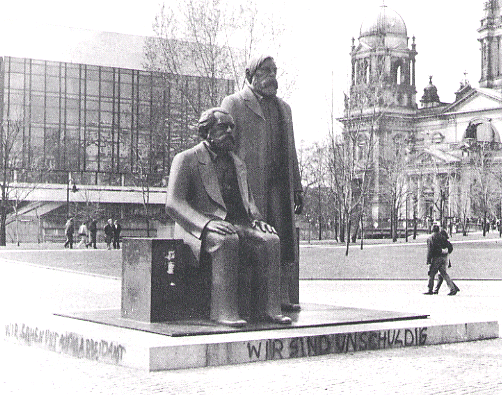
East Berlin worked as an important corrective to such lifeless abstractions. During our trip, M and me went to visit the Marx-Engels Platz and were confronted by the gargantuan stature of earlier generations of men. Standing on M's shoulders, I still would not be able to reach the head of Engels. One of the virtues of socialist realist art is how it expresses material truths through scientific-aesthetic techniques. Instead of "translating" Marx and Engels into men of a present-day size, it lets us experience the wonder of human variation. The finger nail of a 19th century man is the size of my palm! His feet like my thighs and his torso the thickness of a recycling igloo. Instead of trying to comfort us by making dwarves of giants, the sculptor forces us to take stock of both a historical distance and the slumbering possibilities within our present, cookie cut limbs.


Confronted by these statues of the labor movement's great thinkers - as well as by the nameless workers of a similar height that surround the Platz - one understands the urgency which must have inspired works such as "The Housing Question" and the investigation of the living conditions of English workers in that island's great industrial cities. I cannot begin to fathom how those early-industrial giants managed to fit into apartments smaller than those we live in today. After a 12+ hour working day, they had to crawl their way through narrow corridors only to be forced into fetal position, packed like herrings in what passed for a home. The ever new editions of Swift's Gulliver's Travels (a perspective that is often lost sight of today) - what a clever intervention into the great 19th century struggles over social space. The books - no larger than today - must have been the perfect size for a worker to build his own coat library.


But however remarkable the size difference is, what really got our attention was the variations in the actual composition of the human body that the statues hinted at. Specifically: the genitalia of giants.


Concerning the crotches of giants


Socialist Germany apparently tried to make a clean break with bourgeois sexual morals, at least when it came to the variations of genitalia over time. I was aware of how the introduction of a "two-sex" system replaced an aristotelian performative-misogynist theory of sex with a biological-misogynist one in the early-modern period. But just as the political ideology of the day tends to reduce (political) history into a teleological story about the progressive realization of representative democracy, I have taken for granted that today's sexual organization has been present - at least biologically - throughout human history with only slight variations. Changes, even revolutions, in sexual practices, family structures and theories of reproduction and pleasure - sure! But the biological "substrate", the actual genitala, has always seemed to be an invariant which the purely social variations connects and disconnects to in different ways.


The findings of historical materialism tell us otherwise. Because the German artists where not held back by prejudice or political agendas, they could represent the genitalia of our predecessors without resorting to mystifications. The representations, limited to Marx and Engels, are however very limited. I only wish that they had been accompanied by Luxemburg or some other woman - if that is not an altogether too inexact expression - so as to give some kind of hint as to the extent of the variety of genitalia (and other organs) in those early days of the labor movement. With this limited selection in mind, this is what I managed to observe and deduce about the genitalia of giants:


Marx' genitalia corresponds closely to what is referred to as a "penis" today, at least as far as I can tell. The artists, though working with scientifically developed techniques, were not primarily interested in early capitalist anatomy but in creating a homage to two very important theoreticians of the labor movement. Thus, they are both clothed. I do however get the feeling that the sculptor is making a point of the mentioned correspondence by giving the author of Capital a slight erection that shows through his cast iron pants. Apart from his extraordinary size and immense muscles, he is eerily similar to you or me. (A small note: Marx is depicted as sitting, which hints at the possibility that the "boils" that he presumably got as a result from long hours at the British Museum might be a code of sorts.)


At first glance, Engels seems to completely lack sexual organs. But as you move closer, you see fine silver threads extending from his absent crotch towards other parts of the statue as well as to its immediate surroundings. The "web" hosts a number of small black and brown organs that only connect to the main body by those thin milk-like threads. The organs have eight jointed appendices. As far as I can tell, their function is to allow the organs to move along the libidinal strings when the slightest vibration signals the presence of a potential "sexual goal" (to borrow a term from Freud). One of the organs seem to limit its movement to a triangle formed by Engel's ear, collar and shoulder. The threads in the triangle are particularly plentiful, and the density allows one to spot certain patterns in the seemingly anarchic way in which the lines of communication are drawn. Recording and shivering at the slightest tremble in the strings (they are made from some kind of extremely elastic bodily fluid), the organ moves back and forth in the triangle but always to return to a site at the statue's ear lobe. From this base of operation it whispers into the seemingly attentive hollow just above it.


It would be easy to see a certain tragic dimension in this neverending murmur into the ear of a mere representation of man, and the connected rythm of frantic activity and motionless wait of these caressing-communicating organs awake a suspicion: they may not be part of the statue at all. What if this residue of sexual organizations wiped out by the enforced primacy of reproduction ("normality" in the technical sense defined by Dr Freud) somehow managed to survive, attempting to form symbiotic bonds with new bodies? Trees, signposts, window panes, dreaming animals and humans? It must have encountered several difficulties: the unresponsive window pane which refused to stir even when told about the most delicious connections made, the animal suddenly awake - unaware of the perverse possibilities offered - might shrug, move a bit too violently and undo an entire night's labor of love.


But to find tragedy would likely be no more than a relapse into anthropocentrism. It would be presumptous to assign consciousness to such organs, at least any remotely similar to our own. Rather than a project leaving a trail of heart breaking disappointments, it might be better defined as a constant attempts to attach and calibrate itself to more than a century's worth of potential hosts. Then, finally hitting on the very forms and proportions of the host it has attempted to replace, it finds a certain functional "contentment" in the replica of a man. In a reversal of the way that the dreamer's hand searches for and finds its crotch, the organs searches for and find their resting place.


Freud may have kept clear of biology when formulating the object of his science for obvious both practical and theoretical reasons. The "limit"-concept of "drive" is a practical demarcation necessitated both by differences in method and the actual structural conditions of the psychic apparatus (which appears to be dissimilar to those of biological science). This construct of strings and miniscule organs seems to allow for sexual activity in the forms of caressing, strangling, exploring, corresponding. Such functions are not unknown to psychoanalysis: on the contrary, they are perverse elements present in all kinds of sexual organizations and the building blocks of the pregenital configurations. What is striking though, is that the variation of sexual organizations that today are confined to the psyche are here given an immediate, physical form. Engels' libidinal web is highly original in both its relative autonomy towards any given body (both in its ability to make and maintain connections and structures whose connections with a body can be disconnected and reconnected according to chance and optimizations of functionality - and in its ability to if necessary change host) and in the functional, more or less immediate correspondence between biological and sexual organization. While the tongue or the dick or the cunt today varies its significance according to the demands of the psyche (within the material boundaries given by its physical shapes and capabilities), the libidinal web might be proof of a period in human history when this variation rather than shifting significances and practices was actively remolding and reforming organs according to the demands of desire.


This obviously has a great significance for the historical validity of both anatomical studies and the present configuration of the psychic apparatus. A more modest area of research might be to analyze in what ways these arcane strings and organs of Engels' are connected with his great communicative efforts in the service of the labor movement. Is there a connection between his immense web of correspondents and confidants and his immense web of delicate, ever growing milky lines? Or between this elastic secrete and his preoccupation with proteins in his Naturdialektik and Anti-Dühring?


PS. It might be noteworthy that the sculptor's arrangement with a sitting Marx and a standing Engels is reminiscent (or possibly the other way around) of Max Ernst's Capricorn (also present in Berlin at the time); compare ME & M&E.

PS 2. We might owe much more than is readily apparant to our gigantic forefathers. Take wages for example: Marx himself tells us that the wages of the working class tend towards a level where it can simply pay for that which is necessary to reproduce its labor power. But he also tells us that that which is considered "necessary" is to some extent decided by the culture and traditions (and demands of capital) in any given society. This "inertia" coupled with the likely very rapid shrinking of man during the few generations leading up to the 20th century might very well have produced a favorable situation for a number of generations. The level of wages was decided with the physical needs of immense bodies in mind. So, as the bodies shrank, an ever greater part of the wage could be used for other purposes. Imagine the riches available to a working class the size of rats!


Appendix 1: City planning as class struggle in the sphere of anatomical science.


Living on Rosa Luxemburg Strasse, we visited her Platz in the belief that we would find a place of a similarly thought provoking nature. What we found was at first glance very disappointing - the most boring kind of conformism. The genitalia is as present in the activities of the city planners of Berlin as in the preoccupation of artists: it might have permeated the whole intellectual life of those days and produced unforseen effects in the most diverse fields of work. But the contradictory ways in which we find it at Rosa Luxemburg Platz might force us to reevaluate the perhaps all too one-sided, positive way in which we appraised the tendency's presence in regards to Marx-Engels Platz. For where the artists seem to have made a clean break with narrowminded prejudice, the city planners seems to be trapped in it. This should be obvious from a schematic overview of the place: a triangle, and under it two orifices. And as an unwelcome bonus: in the triangle (representing pubic hair) an advertisement for a "Hooters" restaurant near the Zoo. Thus, the present rulers of Berlin try to humiliate the dead, as if to say: "Go ahead workers, suck on the teets of the dead sow of insurrection." Depressing, really, until M points out that their order might very well be built on quicksand - or paving-stones.


For in contrast to the surrounding streets, the triangle is made of cobble stones of a size suitable for throwing. Having thus exorcised the feelings of defeat, we realize that just as the triangle differs from what you might find on a police woman so too does the orifices. Not only eggs, urine and shit, but a whole system of tunnels spanning a city of millions. One might be tempted to make use of one of the pet problems of Trotskyism: how do we define the "socialist countries": As "degenerate workers' states"? As "state capitalism"? And what forms do class struggle assume in such social formations? A triangle and two subway entrances may give us an idea of how one aspect of this struggle took shape in the fields of urbanism and anatomical science. Within the confines of the given order, the primacy of reproduction and sexual conformism is mutated; someone (perhaps a sleeper agent from Sex Pol? Hard to imagine that Reich's comrades would all just disappear or abandon their common project) makes pubic hair take part in the preparations for a renewed insurrection, and develops the two-way street logic of orifices into a ever-growing series of possible destinations. And, ironically enough, enlists the unaware city planners of today in forever expanding and modifying these series.


Appendix 2: Die Toten Mahnen Uns: Michael Jackson, the Paris Commune and the Beach Volley Ball of Reaction.


(to be added)


/Erik Bohman