I read a currently popular pocketbook bestseller where an American journalist (David Randall, was his name) gives an overview of the subject of sleep. The first two chapters introduce some exciting basic facts about sleep that are not generally known, and I was beginning to wonder if this book was going to be one of those "popular revelations" like Krause's book on natural sounds, or Pretor-Pinney's book about clouds, or Johannesson's-Klingberg's book about Swedish extreme metal. But already chapters 3 and 4 are substantially weaker than 1 and 2, and in chapter 5 (only in chapter 5!) he comes to the subject of dreams, and reveals colours.
First he gives a recollection of the Freudian way, a somewhat incomplete but far from unsympathetic and not very superficial account: he even examplifies with the famous analysis of the "Irma's injection" dream and gives the whole "broken kettle" argument!
Then he comes with summaries and interviews of modern dream researchers, who all complain about being pariahs in science because everybody thinks dream research is necessarily about new age, but who have all stubbornly clinged to a cognitive program and thereby conclusively disproved Freud once and for all.
One American professor disproved Freud by collecting 50 000 dreams and formalising their key elements, finding that dreams are not meaningful, symbolic, "surrealistic" or wish-fulfilling – because they are in fact meaningless, banal, standardised, boring, negative and anguish-filled! For example, if a stranger occurs in a dream, he will invariably start pursuing and attacking the dreamer. And when ex-partners, family members and dead friends pop up, it is only to trigger bad conscience.
Another American research team proved that dreams are meaningless because they are totally random memory fragments, and just because of that, they contribute usefully to solving everyday problems because we can see things in a different constellation.
The author of this popular book enthusiastically agrees with all this, and explains that dreams are so consistently negative and anguish-filled because they are fundamentally the playing out of worst-case-scenarios in our everyday worries, and the reason they are negative is not that they are meaningful in any way but they simply reflect that everyday life is mostly about worries.
Any reader with a sense for irony will appreciate this elaborate parable. If dreams are meaningless because they are boring and anguish-filled, systematically negative and totally random, just a continuation of waking thought and entirely meaningless, does not this list provide a rather exhaustive set of self-contradictions that just once more illustrate the case with the broken kettle?
So clearly, this is just a case of the classic philistine "hatred against the marvellous".
Many aggressive common-sense views of the "cognitive" side of the spectrum typically postulate apriori that things are meaningless. They usually take sadistic pleasure in "debunking" the romantic views of the naively meaning-ascribing primitives around them; but as long as the lack of meaning is a postulate, it is also rather logically consistent and escapes counterarguments. You have to have faith in this meaninglessness, or it becomes just a hollow stance, a rhetorical trope.
But then many of these haters turn to actively demonstrating the absence of meaning, a task that easily becomes self-contradictory, because formulating patterns and selecting examples are activities that in themselves produce meaning, and the absence of meaning can never ever be actually demonstrated. The closest thing to a meaninglessness demonstrated is perhaps an almost perfect mathematical randomness. But demonstrating this also requires the conceptualisation, circumscription, recognition, selection and naming of elements as well as the variables measured, and therefore involves meaning.
Another aspect is this weird identification between the common and the negative, between everyday life and anxiety – clinically, I would say that anyone this eager to identify these two very different concepts with each other is simply a very depressed person.
Again we are perhaps reminded of the broken kettle in this credo of miserabilism: the beautiful and the pleasureable are not something very attractive, and anyway they are very very uncommon, and when they do occur they are not real but only illusions.
Yes, and by the way, the rest of the book is mostly bullshit, with a few scattered interesting facts about sleep biology, sleep psychology and sleep sociology. A popular science book is after all typically a compendium of small revelations and great prejudices side by side.
M Forshage
Showing posts with label psychoanalysis. Show all posts
Showing posts with label psychoanalysis. Show all posts
Tuesday, June 3, 2014

Thursday, November 5, 2009
On the shoulders of giants
I always figured that the old scholastic notion of "standing on the shoulders of giants" was a way to describe accumulated learning and express an indebtedness towards tradition. On closer inspection, though, there is no lack of written sources that belie this metaphorist interpretation. Isidore of Sevilla - to name only one - informs us that "just as, in individual nations, there are instances of monstrous people, so in the whole of humankind there are certain monstrous races, like the Giants, the Cynocephali, the Cyclopes, and others." In his Etymologies, in which he attempts to collect all the knowledge of his age, we find peoples in the most varied sizes with organs redistributed in the most striking fashions. Faces on the stomach, a one legged people habitating distant parts of the world, asians without noses - the variations of medieval man shames the monotony of the contemporary human body. And to still think in metaphors? What a cretinizing way of turning flesh into mere words.
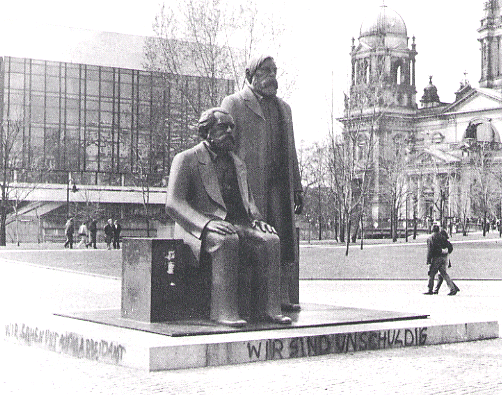
East Berlin worked as an important corrective to such lifeless abstractions. During our trip, M and me went to visit the Marx-Engels Platz and were confronted by the gargantuan stature of earlier generations of men. Standing on M's shoulders, I still would not be able to reach the head of Engels. One of the virtues of socialist realist art is how it expresses material truths through scientific-aesthetic techniques. Instead of "translating" Marx and Engels into men of a present-day size, it lets us experience the wonder of human variation. The finger nail of a 19th century man is the size of my palm! His feet like my thighs and his torso the thickness of a recycling igloo. Instead of trying to comfort us by making dwarves of giants, the sculptor forces us to take stock of both a historical distance and the slumbering possibilities within our present, cookie cut limbs.
Confronted by these statues of the labor movement's great thinkers - as well as by the nameless workers of a similar height that surround the Platz - one understands the urgency which must have inspired works such as "The Housing Question" and the investigation of the living conditions of English workers in that island's great industrial cities. I cannot begin to fathom how those early-industrial giants managed to fit into apartments smaller than those we live in today. After a 12+ hour working day, they had to crawl their way through narrow corridors only to be forced into fetal position, packed like herrings in what passed for a home. The ever new editions of Swift's Gulliver's Travels (a perspective that is often lost sight of today) - what a clever intervention into the great 19th century struggles over social space. The books - no larger than today - must have been the perfect size for a worker to build his own coat library.
But however remarkable the size difference is, what really got our attention was the variations in the actual composition of the human body that the statues hinted at. Specifically: the genitalia of giants.
Concerning the crotches of giants
Socialist Germany apparently tried to make a clean break with bourgeois sexual morals, at least when it came to the variations of genitalia over time. I was aware of how the introduction of a "two-sex" system replaced an aristotelian performative-misogynist theory of sex with a biological-misogynist one in the early-modern period. But just as the political ideology of the day tends to reduce (political) history into a teleological story about the progressive realization of representative democracy, I have taken for granted that today's sexual organization has been present - at least biologically - throughout human history with only slight variations. Changes, even revolutions, in sexual practices, family structures and theories of reproduction and pleasure - sure! But the biological "substrate", the actual genitala, has always seemed to be an invariant which the purely social variations connects and disconnects to in different ways.
The findings of historical materialism tell us otherwise. Because the German artists where not held back by prejudice or political agendas, they could represent the genitalia of our predecessors without resorting to mystifications. The representations, limited to Marx and Engels, are however very limited. I only wish that they had been accompanied by Luxemburg or some other woman - if that is not an altogether too inexact expression - so as to give some kind of hint as to the extent of the variety of genitalia (and other organs) in those early days of the labor movement. With this limited selection in mind, this is what I managed to observe and deduce about the genitalia of giants:
Marx' genitalia corresponds closely to what is referred to as a "penis" today, at least as far as I can tell. The artists, though working with scientifically developed techniques, were not primarily interested in early capitalist anatomy but in creating a homage to two very important theoreticians of the labor movement. Thus, they are both clothed. I do however get the feeling that the sculptor is making a point of the mentioned correspondence by giving the author of Capital a slight erection that shows through his cast iron pants. Apart from his extraordinary size and immense muscles, he is eerily similar to you or me. (A small note: Marx is depicted as sitting, which hints at the possibility that the "boils" that he presumably got as a result from long hours at the British Museum might be a code of sorts.)
At first glance, Engels seems to completely lack sexual organs. But as you move closer, you see fine silver threads extending from his absent crotch towards other parts of the statue as well as to its immediate surroundings. The "web" hosts a number of small black and brown organs that only connect to the main body by those thin milk-like threads. The organs have eight jointed appendices. As far as I can tell, their function is to allow the organs to move along the libidinal strings when the slightest vibration signals the presence of a potential "sexual goal" (to borrow a term from Freud). One of the organs seem to limit its movement to a triangle formed by Engel's ear, collar and shoulder. The threads in the triangle are particularly plentiful, and the density allows one to spot certain patterns in the seemingly anarchic way in which the lines of communication are drawn. Recording and shivering at the slightest tremble in the strings (they are made from some kind of extremely elastic bodily fluid), the organ moves back and forth in the triangle but always to return to a site at the statue's ear lobe. From this base of operation it whispers into the seemingly attentive hollow just above it.
It would be easy to see a certain tragic dimension in this neverending murmur into the ear of a mere representation of man, and the connected rythm of frantic activity and motionless wait of these caressing-communicating organs awake a suspicion: they may not be part of the statue at all. What if this residue of sexual organizations wiped out by the enforced primacy of reproduction ("normality" in the technical sense defined by Dr Freud) somehow managed to survive, attempting to form symbiotic bonds with new bodies? Trees, signposts, window panes, dreaming animals and humans? It must have encountered several difficulties: the unresponsive window pane which refused to stir even when told about the most delicious connections made, the animal suddenly awake - unaware of the perverse possibilities offered - might shrug, move a bit too violently and undo an entire night's labor of love.
But to find tragedy would likely be no more than a relapse into anthropocentrism. It would be presumptous to assign consciousness to such organs, at least any remotely similar to our own. Rather than a project leaving a trail of heart breaking disappointments, it might be better defined as a constant attempts to attach and calibrate itself to more than a century's worth of potential hosts. Then, finally hitting on the very forms and proportions of the host it has attempted to replace, it finds a certain functional "contentment" in the replica of a man. In a reversal of the way that the dreamer's hand searches for and finds its crotch, the organs searches for and find their resting place.
Freud may have kept clear of biology when formulating the object of his science for obvious both practical and theoretical reasons. The "limit"-concept of "drive" is a practical demarcation necessitated both by differences in method and the actual structural conditions of the psychic apparatus (which appears to be dissimilar to those of biological science). This construct of strings and miniscule organs seems to allow for sexual activity in the forms of caressing, strangling, exploring, corresponding. Such functions are not unknown to psychoanalysis: on the contrary, they are perverse elements present in all kinds of sexual organizations and the building blocks of the pregenital configurations. What is striking though, is that the variation of sexual organizations that today are confined to the psyche are here given an immediate, physical form. Engels' libidinal web is highly original in both its relative autonomy towards any given body (both in its ability to make and maintain connections and structures whose connections with a body can be disconnected and reconnected according to chance and optimizations of functionality - and in its ability to if necessary change host) and in the functional, more or less immediate correspondence between biological and sexual organization. While the tongue or the dick or the cunt today varies its significance according to the demands of the psyche (within the material boundaries given by its physical shapes and capabilities), the libidinal web might be proof of a period in human history when this variation rather than shifting significances and practices was actively remolding and reforming organs according to the demands of desire.
This obviously has a great significance for the historical validity of both anatomical studies and the present configuration of the psychic apparatus. A more modest area of research might be to analyze in what ways these arcane strings and organs of Engels' are connected with his great communicative efforts in the service of the labor movement. Is there a connection between his immense web of correspondents and confidants and his immense web of delicate, ever growing milky lines? Or between this elastic secrete and his preoccupation with proteins in his Naturdialektik and Anti-Dühring?
PS. It might be noteworthy that the sculptor's arrangement with a sitting Marx and a standing Engels is reminiscent (or possibly the other way around) of Max Ernst's Capricorn (also present in Berlin at the time); compare ME & M&E.
PS 2. We might owe much more than is readily apparant to our gigantic forefathers. Take wages for example: Marx himself tells us that the wages of the working class tend towards a level where it can simply pay for that which is necessary to reproduce its labor power. But he also tells us that that which is considered "necessary" is to some extent decided by the culture and traditions (and demands of capital) in any given society. This "inertia" coupled with the likely very rapid shrinking of man during the few generations leading up to the 20th century might very well have produced a favorable situation for a number of generations. The level of wages was decided with the physical needs of immense bodies in mind. So, as the bodies shrank, an ever greater part of the wage could be used for other purposes. Imagine the riches available to a working class the size of rats!
Appendix 1: City planning as class struggle in the sphere of anatomical science.
Living on Rosa Luxemburg Strasse, we visited her Platz in the belief that we would find a place of a similarly thought provoking nature. What we found was at first glance very disappointing - the most boring kind of conformism. The genitalia is as present in the activities of the city planners of Berlin as in the preoccupation of artists: it might have permeated the whole intellectual life of those days and produced unforseen effects in the most diverse fields of work. But the contradictory ways in which we find it at Rosa Luxemburg Platz might force us to reevaluate the perhaps all too one-sided, positive way in which we appraised the tendency's presence in regards to Marx-Engels Platz. For where the artists seem to have made a clean break with narrowminded prejudice, the city planners seems to be trapped in it. This should be obvious from a schematic overview of the place: a triangle, and under it two orifices. And as an unwelcome bonus: in the triangle (representing pubic hair) an advertisement for a "Hooters" restaurant near the Zoo. Thus, the present rulers of Berlin try to humiliate the dead, as if to say: "Go ahead workers, suck on the teets of the dead sow of insurrection." Depressing, really, until M points out that their order might very well be built on quicksand - or paving-stones.
For in contrast to the surrounding streets, the triangle is made of cobble stones of a size suitable for throwing. Having thus exorcised the feelings of defeat, we realize that just as the triangle differs from what you might find on a police woman so too does the orifices. Not only eggs, urine and shit, but a whole system of tunnels spanning a city of millions. One might be tempted to make use of one of the pet problems of Trotskyism: how do we define the "socialist countries": As "degenerate workers' states"? As "state capitalism"? And what forms do class struggle assume in such social formations? A triangle and two subway entrances may give us an idea of how one aspect of this struggle took shape in the fields of urbanism and anatomical science. Within the confines of the given order, the primacy of reproduction and sexual conformism is mutated; someone (perhaps a sleeper agent from Sex Pol? Hard to imagine that Reich's comrades would all just disappear or abandon their common project) makes pubic hair take part in the preparations for a renewed insurrection, and develops the two-way street logic of orifices into a ever-growing series of possible destinations. And, ironically enough, enlists the unaware city planners of today in forever expanding and modifying these series.
Appendix 2: Die Toten Mahnen Uns: Michael Jackson, the Paris Commune and the Beach Volley Ball of Reaction.
(to be added)
/Erik Bohman
Monday, September 7, 2009
premonition of a locomotive
Stockholm surrealist group: excerpts from email discussion
EB:
A propos of phantom objects, but not quite a game suggestion yet:
Benjamin borrowed a dear old marxist conflict between form and content, the one between means of production and conditions of production: technical advances do as far as they're able borrow available (social) forms, but will sooner or later end up in conflict with the latter and bring about a formal "revolution". The marxism of the second international placed, as we know, the conflict on the level of the mode of production, while Benjamin interested himself for how the conflict expressed itself on the level of technical innovation.
Benjamin: "When trying to learn them properly, errors and mistakes occurred. From another viewpoint these attempts are the most true proofs that technical production in its initial phase was a prisoner of the realm of dreaming. (During certain stages, not only architecture but also technology bears witness of a collective dream.)"
Marx: "To what extent the old form of the means of production initially dominates the new form, is shown/.../ perhaps most strikingly: the locomotive that was experimentally constructed, before the present locomotives appeared, a locomotive which had two feet that it alternately raised just like a horse"
Thus the horse haunts the locomotive, the canvas the camera, the wood the steel, etc.
MF:
The classical example of a phenomenon contrary to that horse locomotive is what Apollinaire back in his days defined as surrealism "when man set out to reproduce walking, she invented the wheel, which isn't similar to walking at all" (approximate quote). A game could aim at reinventing the wheel, and finding those old idle ghosts haunting us because we are surrealists? Or do we want to find a specific absence in the single objects? What functional-auratic-sentimental inherent object has been completely chased off out of the object at which I am pointing? Which is the unforeseeable wheel which will totally replace the obsolete ridiculousness I am here hugging?
CA:
So, the game would consist of establishing a contact with the exterior, slightly more on the exterior's condition than usually, in order to bring about a transformation instead of the habitual, and thus chasing off the ghosts/ the phantom object part?
NN:
Erik, Erik Homburger Erikson said in a freudian context (three Erik in the same sentence!): The faucet is not a phallos symbol, but the phallos is rather a faucet symbol, since the the faucet would never have been invented if it wasn't for primary experiences of needing to pee while asleep etc, experiences which have very little to do with the aims ascribed to the object. This makes the plausible problem solvings of everyday life into mere post-factum-rationalisations, or distortions of their latent content, which may not at all, or only to a very small extent, have something to do with the formal.
The horse memory of the locomotive ought perhaps to go further back than the horse, to some primary process primordial scenes?
Perhaps that is the explanation of the film manuscript I dreamt in November, "The memories of a locomotive"!
EB:
A propos of phantom objects, but not quite a game suggestion yet:
Benjamin borrowed a dear old marxist conflict between form and content, the one between means of production and conditions of production: technical advances do as far as they're able borrow available (social) forms, but will sooner or later end up in conflict with the latter and bring about a formal "revolution". The marxism of the second international placed, as we know, the conflict on the level of the mode of production, while Benjamin interested himself for how the conflict expressed itself on the level of technical innovation.
Benjamin: "When trying to learn them properly, errors and mistakes occurred. From another viewpoint these attempts are the most true proofs that technical production in its initial phase was a prisoner of the realm of dreaming. (During certain stages, not only architecture but also technology bears witness of a collective dream.)"
Marx: "To what extent the old form of the means of production initially dominates the new form, is shown/.../ perhaps most strikingly: the locomotive that was experimentally constructed, before the present locomotives appeared, a locomotive which had two feet that it alternately raised just like a horse"
Thus the horse haunts the locomotive, the canvas the camera, the wood the steel, etc.
MF:
The classical example of a phenomenon contrary to that horse locomotive is what Apollinaire back in his days defined as surrealism "when man set out to reproduce walking, she invented the wheel, which isn't similar to walking at all" (approximate quote). A game could aim at reinventing the wheel, and finding those old idle ghosts haunting us because we are surrealists? Or do we want to find a specific absence in the single objects? What functional-auratic-sentimental inherent object has been completely chased off out of the object at which I am pointing? Which is the unforeseeable wheel which will totally replace the obsolete ridiculousness I am here hugging?
CA:
So, the game would consist of establishing a contact with the exterior, slightly more on the exterior's condition than usually, in order to bring about a transformation instead of the habitual, and thus chasing off the ghosts/ the phantom object part?
NN:
Erik, Erik Homburger Erikson said in a freudian context (three Erik in the same sentence!): The faucet is not a phallos symbol, but the phallos is rather a faucet symbol, since the the faucet would never have been invented if it wasn't for primary experiences of needing to pee while asleep etc, experiences which have very little to do with the aims ascribed to the object. This makes the plausible problem solvings of everyday life into mere post-factum-rationalisations, or distortions of their latent content, which may not at all, or only to a very small extent, have something to do with the formal.
The horse memory of the locomotive ought perhaps to go further back than the horse, to some primary process primordial scenes?
Perhaps that is the explanation of the film manuscript I dreamt in November, "The memories of a locomotive"!
Monday, October 15, 2007
Surrealism and the holy crap
Surrealism is a revolutionary poetical movement that strives for the liberation of mankind in all its aspects. This is not a simple task, and we see that the surrealist movement often suffers from weaknesses in making this understood. As we know, this has been a constant problem throughout its history, especially as regards its relations to art and "culture".
Here, we'd like to focus on the problems of unclarity regarding the supernatural and its ideological companion, supernaturalism, and also about some related surrealist hookups which seem to be lacking an honest and critical approach.
It is (more or less!) known that surrealism is actively and explicitly against religion.
Other beliefs of dubious character also occur though, e.g. that surrealism, inspired by the psychoanalytic ideas, sees as its mission to liberate the unconscious from the repression of the superego; that surrealism accepts and likes everything that defies rational thinking, including not only dream and chance but also, for this reason, spiritism, esoterism, chaos, the "wild", "primitive" peoples, everything non-Western, sadism, perversions, crime, serial killers ... all this in opposition, of course, to the prevailing capitalist order, but also in opposition to rationalism itself.
We are sorry to say that the reasons for these miscomprehensions are not only misunderstandings from art scholars or journalists, they are often caused by texts written by surrrealists themselves. In the worst cases, these surrealists appear to be little more than art-producing new-age apologists. In better cases, they are inspired writers that somehow have a difficulty of explaining the limits and circumstances of the surrealist appreciations of dreams or of primitive peoples, for example. Maybe they are actually confused, or maybe lazy. (We're not in the business here of judging who is a surrealist or not - but regardless of the label they might put on themselves, they hold attitudes that we find important to confront and that we think surrealism doesn't benefit from. In some cases we think it's obvious they misunderstand basic concepts of surrealism, in others it might be necessary to modify or clarify the surrealist standpoint. We don't mention names because it's better for those concerned to recognize themselves instead of feeling that they need to defend themselves. If someone should be mentioned, why not Breton himself? Isn't it obvious how exaggerated his trust in Freud was, or that he had an uncritical belief in the abilities of (certain?) clairvoyants, mediums and even astrologists?)
In many surrealist texts, the uncritical repetition of Freudian psychoanalytic concepts is embarrasing (or to say the least outdated). Freud's ideas can at most be taken as an inspiring and fascinating attempt to make a theory about the mind, but not as indisputable truths or undoubtable scientific discoveries about it. It must be admitted that they consist of non-scientific specualtion and partly also of falsifying evidence. Freud's writings have in many ways also been contradicted by later research and discoveries. This might therefore not have been possible to know at the time and the surrealists were also apparently lacking in knowledge about scientific methods and the necessary rigour demanded of scientific investigation. The psychoanalytic "case studies" are of no more scientific value than the many observations of UFO landings and their accompanying "conclusions". The tendency to regard the Freudian concepts as holy and unquestionable, whatever they are, does no good to surrealism.
Alchemy and other occult, esoteric or mystic currents, dead or alive, are other subjects that need to be approached more critically. If they historically could be described as "precursors" to science as well as to surrealism (even though many of them still prevail or have been reintroduced), it must also be clarified in what way they have been doomed to be abandoned: their supernaturalistic (often religious) world-view made (and makes) it impossible for them to significantly advance human knowledge and understanding of the world. (The development of science and critical thinking does this, though.) What remains, at best, is a poetical practice misunderstanding itself as anything else. Their beauty and fascination, then, is also tragic.
To hail alchemy as a watchword, like so many surrealists do, is obscurantistic. Alchemy had certain interesting elements, while others are examples of superstitions and the primitiveness of thinking that we should fight today as ever.
The double tool of surrealism: dialectics (or, why not say "critical thinking?") and analogy can only be useful if they are kept apart but also taken to the extreme. Superstition and supernaturalism are failure to do so.
Esoterics and psychoanalysis have been getting an exagerrated attention from some surrealists also just because they to a large extent are symbol-makers. The mere listing of these conventional symbols in accounts of dreams or "objective chance" experiences are not of specificly surrrealist value. Symbols have no truth value and surrealism is not a symbolism. Symbols, just as anything else, can of course be of poetical value if they appear in a personal mythology relating to actualities in the individual desires. But symbols, looked up in a book in order to write a more juicy text to impress the reader, are just anthropological anecdotes, and to base observations on those is a false drama. There is a literature based on the concept of objective chance, that sometimes seem shallow and fake in the sense that they don't really tell about the poetical value for the individual, they list a number of encounters such as every person has now and then. Chance encounters are valuable to people not because they reveal telepathy or other psychic powers, fate or signs of a higher truth (they don't!), but simply because they consist of coincidences that involve elements who talk to the memories or desires of the persons involved or create a certain kind of beauty or adventure. It's no mysticism. It's a heightening of the sensibility in everyday life.
Among the exaggerated hailings are the ones of "primitive peoples" or anything not belonging to the western civilization. This seems sometimes to have a tendency of a blind embrace, disregarding everything that wouldn't fit into the picture. According to this attitude, primitive peoples have a closer non-exploitative relation to nature, they have a poetic relation to the universe, their art is integrated in all of their lives etc; but it's never mentioned that they might have superstitions, they never have a limited understanding of the world, they don't repress women or children and are never violent. A criticism of western civilization doesn't need this one-sidedness. Maybe it is a misdirected solidarity that comes from the fact that primitive and non-western peoples certainly are repressed groups. That surrealism is against workers' chauvinism is clear and obvious since the 30's confrontations with stalinist "workers' culture", but it's time to abolish also "primitive" or "non-western" chauvinism. Neither they, nor us, benefit from it.
We're not new agers or exotists. We have to be more clear about our relation to magical thinking as a world view. As with alchemy, we have to distinguish things. Magical thinking, stripped of its supernaturalism, is no longer magical thinking. It is poetic sensibility.
Magical thinking has to be replaced by personal mythology and poetical thinking. Magical thinking creates superstitions, conserves lack of understanding and blunts critical thought. It enforces gullibility and authoritarianism. Next step is religion and capitalism. Magical thinking did not die with the development of civilization, it's at the base of capitalist ideology and teams up with its "rationalism". (Isn't it enough to look at commodity fetishism and advertisement?)
Some surrealist writing shows a more or less plain opposition to science in general and might scorn its strict rational methods. This is absurd. What is the point of attacking the scientific method? Surrealism has never been an irrationalism, absurdism, anti-intellectualism or denying rationality. (If it ever had tendencies to it, they should be abandoned!)
Science and the scientific method are among the greatest achievements of the human mind, and are enormously valuable to the understanding of the world and, at least potentially, a great vehicle against human misery; material, social, intellectual as well as spiritual. This doesn't mean that science would be the only source of knowledge or of inspiration, but it can certainly be one of the sources, alongside other expressions of the spirit that are more likely to be mentioned by surrealists; love, desire, creativity, play and curiosity: activities outside of, but not necessarily in opposition to, science.
The scientific method is nothing more than an extension of critical thinking. That scientists are often bought and sold and used for commercial and repressive purposes - much in the same way as artists - is an altogether different affair. Science might be done mainly by experts, but is in its philosophical base egalitarian. (Science should be made by all!) Science's theories about the world can in principle be tested by anyone, provided he or she does it in controlled circumstances and with relevant methods. Anyone that have claims about some part of reality will fail to convince scientifically if the claim can not be confirmed through repeated experiment or (in relevant cases) randomized, double-blind observation. Scientific rigour, thus, is above personal interest and a moral question.
The scientific world is not lacking in self-consciousness about its scope and limitations. We want to draw special attention to the international movement of so-called Skeptics in this matter. Robert T. Carroll, author of the Skeptic's Dictionary (http://skepdic.com/) calls skepticism a "virtue" rather than a philosophical system. The different groups and individuals related to this movement fight frauds and pseudoscience and debunk supernatural claims, in an ongoing fight to protect the mind from charlatans, spiritists, healers, fakirs, astrologers, psychics and other liars, robbers and swines, and defend the status of the scientific method. Many sceptics also fight religious superstitions and their preachers' absurd claims about reality.
There must be no doubt that surrealism whole-heartedly supports these struggles, although with (at least theoretically) a wider and complementary understanding. This is not only a fight for the defence of science. Those "healers" (protected by the freedom of religion, i.e. the freedom to fool and be fooled), can destroy people's lives giving them false hopes, false treatments, false beliefs, false understanding of reality and obediance to false authorities besides giving them stupidifying entertainment and wasting their time. In this way it's also a fight for the defense of the freedom, power and understanding of the human spirit.
Surrealism should be in a special position to properly embrace the whole scope of the reasons to fight supernaturalism: the scientific, political, ideological, moral and poetical reasons. We don't need any mystical, esoteric or psychoanalytical concepts to explain that the human mind by itself (interacting, of course, with the "outer world") is capable of its deductions, productions and inspirations, that the poetic sensibility is not divine or supernatural, but purely human.
Surrealism should be able to appreciate the discoveries and the achievements of the rational and intellectual minds, at the same time demand the same liberty for the imagination and see them as one and the same quest. Surrealism should see the repressions of free inquiry (scientific investigation, research and knowledge), of the freedom of expression and the freedom of imagination as one and the same. The liberation from capitalist and state repression, commercialism, work ethic and careerism is the same as the liberation from priests, superstitions, healers and psychics.
If surrealism will have any significance today, it is still in the struggle for the liberation and expansion of the totality of the human potentials; fighting all the repressions of the mind: from stifling symbolism and stupidifying supernaturalism to repressive ideology and downright ignorance; for the expansion of rational thinking as well as of inspired thinking.
Anna BERGMARK
Johannes BERGMARK
Here, we'd like to focus on the problems of unclarity regarding the supernatural and its ideological companion, supernaturalism, and also about some related surrealist hookups which seem to be lacking an honest and critical approach.
It is (more or less!) known that surrealism is actively and explicitly against religion.
Other beliefs of dubious character also occur though, e.g. that surrealism, inspired by the psychoanalytic ideas, sees as its mission to liberate the unconscious from the repression of the superego; that surrealism accepts and likes everything that defies rational thinking, including not only dream and chance but also, for this reason, spiritism, esoterism, chaos, the "wild", "primitive" peoples, everything non-Western, sadism, perversions, crime, serial killers ... all this in opposition, of course, to the prevailing capitalist order, but also in opposition to rationalism itself.
We are sorry to say that the reasons for these miscomprehensions are not only misunderstandings from art scholars or journalists, they are often caused by texts written by surrrealists themselves. In the worst cases, these surrealists appear to be little more than art-producing new-age apologists. In better cases, they are inspired writers that somehow have a difficulty of explaining the limits and circumstances of the surrealist appreciations of dreams or of primitive peoples, for example. Maybe they are actually confused, or maybe lazy. (We're not in the business here of judging who is a surrealist or not - but regardless of the label they might put on themselves, they hold attitudes that we find important to confront and that we think surrealism doesn't benefit from. In some cases we think it's obvious they misunderstand basic concepts of surrealism, in others it might be necessary to modify or clarify the surrealist standpoint. We don't mention names because it's better for those concerned to recognize themselves instead of feeling that they need to defend themselves. If someone should be mentioned, why not Breton himself? Isn't it obvious how exaggerated his trust in Freud was, or that he had an uncritical belief in the abilities of (certain?) clairvoyants, mediums and even astrologists?)
In many surrealist texts, the uncritical repetition of Freudian psychoanalytic concepts is embarrasing (or to say the least outdated). Freud's ideas can at most be taken as an inspiring and fascinating attempt to make a theory about the mind, but not as indisputable truths or undoubtable scientific discoveries about it. It must be admitted that they consist of non-scientific specualtion and partly also of falsifying evidence. Freud's writings have in many ways also been contradicted by later research and discoveries. This might therefore not have been possible to know at the time and the surrealists were also apparently lacking in knowledge about scientific methods and the necessary rigour demanded of scientific investigation. The psychoanalytic "case studies" are of no more scientific value than the many observations of UFO landings and their accompanying "conclusions". The tendency to regard the Freudian concepts as holy and unquestionable, whatever they are, does no good to surrealism.
Alchemy and other occult, esoteric or mystic currents, dead or alive, are other subjects that need to be approached more critically. If they historically could be described as "precursors" to science as well as to surrealism (even though many of them still prevail or have been reintroduced), it must also be clarified in what way they have been doomed to be abandoned: their supernaturalistic (often religious) world-view made (and makes) it impossible for them to significantly advance human knowledge and understanding of the world. (The development of science and critical thinking does this, though.) What remains, at best, is a poetical practice misunderstanding itself as anything else. Their beauty and fascination, then, is also tragic.
To hail alchemy as a watchword, like so many surrealists do, is obscurantistic. Alchemy had certain interesting elements, while others are examples of superstitions and the primitiveness of thinking that we should fight today as ever.
The double tool of surrealism: dialectics (or, why not say "critical thinking?") and analogy can only be useful if they are kept apart but also taken to the extreme. Superstition and supernaturalism are failure to do so.
Esoterics and psychoanalysis have been getting an exagerrated attention from some surrealists also just because they to a large extent are symbol-makers. The mere listing of these conventional symbols in accounts of dreams or "objective chance" experiences are not of specificly surrrealist value. Symbols have no truth value and surrealism is not a symbolism. Symbols, just as anything else, can of course be of poetical value if they appear in a personal mythology relating to actualities in the individual desires. But symbols, looked up in a book in order to write a more juicy text to impress the reader, are just anthropological anecdotes, and to base observations on those is a false drama. There is a literature based on the concept of objective chance, that sometimes seem shallow and fake in the sense that they don't really tell about the poetical value for the individual, they list a number of encounters such as every person has now and then. Chance encounters are valuable to people not because they reveal telepathy or other psychic powers, fate or signs of a higher truth (they don't!), but simply because they consist of coincidences that involve elements who talk to the memories or desires of the persons involved or create a certain kind of beauty or adventure. It's no mysticism. It's a heightening of the sensibility in everyday life.
Among the exaggerated hailings are the ones of "primitive peoples" or anything not belonging to the western civilization. This seems sometimes to have a tendency of a blind embrace, disregarding everything that wouldn't fit into the picture. According to this attitude, primitive peoples have a closer non-exploitative relation to nature, they have a poetic relation to the universe, their art is integrated in all of their lives etc; but it's never mentioned that they might have superstitions, they never have a limited understanding of the world, they don't repress women or children and are never violent. A criticism of western civilization doesn't need this one-sidedness. Maybe it is a misdirected solidarity that comes from the fact that primitive and non-western peoples certainly are repressed groups. That surrealism is against workers' chauvinism is clear and obvious since the 30's confrontations with stalinist "workers' culture", but it's time to abolish also "primitive" or "non-western" chauvinism. Neither they, nor us, benefit from it.
We're not new agers or exotists. We have to be more clear about our relation to magical thinking as a world view. As with alchemy, we have to distinguish things. Magical thinking, stripped of its supernaturalism, is no longer magical thinking. It is poetic sensibility.
Magical thinking has to be replaced by personal mythology and poetical thinking. Magical thinking creates superstitions, conserves lack of understanding and blunts critical thought. It enforces gullibility and authoritarianism. Next step is religion and capitalism. Magical thinking did not die with the development of civilization, it's at the base of capitalist ideology and teams up with its "rationalism". (Isn't it enough to look at commodity fetishism and advertisement?)
Some surrealist writing shows a more or less plain opposition to science in general and might scorn its strict rational methods. This is absurd. What is the point of attacking the scientific method? Surrealism has never been an irrationalism, absurdism, anti-intellectualism or denying rationality. (If it ever had tendencies to it, they should be abandoned!)
Science and the scientific method are among the greatest achievements of the human mind, and are enormously valuable to the understanding of the world and, at least potentially, a great vehicle against human misery; material, social, intellectual as well as spiritual. This doesn't mean that science would be the only source of knowledge or of inspiration, but it can certainly be one of the sources, alongside other expressions of the spirit that are more likely to be mentioned by surrealists; love, desire, creativity, play and curiosity: activities outside of, but not necessarily in opposition to, science.
The scientific method is nothing more than an extension of critical thinking. That scientists are often bought and sold and used for commercial and repressive purposes - much in the same way as artists - is an altogether different affair. Science might be done mainly by experts, but is in its philosophical base egalitarian. (Science should be made by all!) Science's theories about the world can in principle be tested by anyone, provided he or she does it in controlled circumstances and with relevant methods. Anyone that have claims about some part of reality will fail to convince scientifically if the claim can not be confirmed through repeated experiment or (in relevant cases) randomized, double-blind observation. Scientific rigour, thus, is above personal interest and a moral question.
The scientific world is not lacking in self-consciousness about its scope and limitations. We want to draw special attention to the international movement of so-called Skeptics in this matter. Robert T. Carroll, author of the Skeptic's Dictionary (http://skepdic.com/) calls skepticism a "virtue" rather than a philosophical system. The different groups and individuals related to this movement fight frauds and pseudoscience and debunk supernatural claims, in an ongoing fight to protect the mind from charlatans, spiritists, healers, fakirs, astrologers, psychics and other liars, robbers and swines, and defend the status of the scientific method. Many sceptics also fight religious superstitions and their preachers' absurd claims about reality.
There must be no doubt that surrealism whole-heartedly supports these struggles, although with (at least theoretically) a wider and complementary understanding. This is not only a fight for the defence of science. Those "healers" (protected by the freedom of religion, i.e. the freedom to fool and be fooled), can destroy people's lives giving them false hopes, false treatments, false beliefs, false understanding of reality and obediance to false authorities besides giving them stupidifying entertainment and wasting their time. In this way it's also a fight for the defense of the freedom, power and understanding of the human spirit.
Surrealism should be in a special position to properly embrace the whole scope of the reasons to fight supernaturalism: the scientific, political, ideological, moral and poetical reasons. We don't need any mystical, esoteric or psychoanalytical concepts to explain that the human mind by itself (interacting, of course, with the "outer world") is capable of its deductions, productions and inspirations, that the poetic sensibility is not divine or supernatural, but purely human.
Surrealism should be able to appreciate the discoveries and the achievements of the rational and intellectual minds, at the same time demand the same liberty for the imagination and see them as one and the same quest. Surrealism should see the repressions of free inquiry (scientific investigation, research and knowledge), of the freedom of expression and the freedom of imagination as one and the same. The liberation from capitalist and state repression, commercialism, work ethic and careerism is the same as the liberation from priests, superstitions, healers and psychics.
If surrealism will have any significance today, it is still in the struggle for the liberation and expansion of the totality of the human potentials; fighting all the repressions of the mind: from stifling symbolism and stupidifying supernaturalism to repressive ideology and downright ignorance; for the expansion of rational thinking as well as of inspired thinking.
Anna BERGMARK
Johannes BERGMARK
Tuesday, December 5, 2006
Volupte?
VOLUPTÉ?
Our notes from discussions on sensual pleasure
in response to an enquiry from the Paris group
the surrealist group in Stockholm 2005
(delivered long past deadline - as usual - and yet unacknowledged by the Paris group)
1° Comment décririez-vous la volupté ?
First of all, we ask ourselves: What is the point in analyzing sensual pleasure? The experience tend to dissolve in its bodily sensation. The difference between sexual gratification and pleasure is that in the course of gratification you are aware of
the need that you are satisfying so that you are ready to rationalise your experience, but in sensual experience - like vomiting - the experience is not rational.
We agree, however, that the sphere of sensuality is the privileged area for reconcilement of dual concepts. Some of us take the same pleasure in taking a shower as in having human relations. The hypnotizing effect of sensual pleasure can be an experience of fascination and openness to the senses, a bodily joy. Neither reflecting state, nor self-reflecting. A possible dissolving of the limits between self and other natural (unnatural?) processes in the world, a partaking in the weather. Shared sensual pleasure also temporarily making the contradiction between communication and non-communication disfunction. Silence. Sensual pleasure is in that sense a magical act, wherein the dichotomy subject-object disappears. Eating exemplifies this: Eating disgusting things but still feeling that it tastes good. Or the sensual pleasure in
humiliation, in vomiting: vertigo. Shared sensual pleasure: disappointments and the faith in the contradiction that exists between love and sexuality.
Some of us emphasize that sexuality (in acto) is a magnetic field, involving intuitive communication, a further increase of sexual desire, exhaustion, paralysis.
Some of us stress the imaginary aspects of physical contact. The seemingly intensified experiences of psycho-physical sensations within oneiric states; incubi/succubi, developing and exploring pseudo-corporeal states, "touching from a distance", hexed
glances, word magic.
Some of us stress also the undesired aspects of sensual pleasure: the restlessness and laziness that can be one of the trappings of a narrow hedonism. The attitude of (although not the typical behaviour of) consumerism. We don´t think that well-being has a given place as a normal state in our mental topography. General well-being is an old repressive myth that haunts us in the mechanisms of control of social democratic state versus its citizens, and of parents versus children. Wherever well-being is held up as a superordinate goal, justice, truth, passion and curiosity are sacrificed. Hedonistic pleasure and common-sense well-being may have appeared as conflicting forces before; but since the breakthrough of the market mechanisms regarding our physical bodies in the early 80s (exercise, fitness, skin-grills, spas, sadomasochism, hygiene) they≠ve successfully joined forces almost everywhere.
Some of us hold that labour can be sensual pleasure. Not labour in its dead, wage-dictated form, but the living labour of producing both mental and material objects. Depersonalization appears during sensual pleasure as well as during labour, where
the primary actor resides not necessarily in the consciousness, but in some bodily function.
Some of us entertain the idea of the experience of non-contradiction between the body parts inside the body.
Some of us call to mind the states where sensual pleasure fails to trigger a corresponding motion (emotion) in the mind and becomes some irrelevant or an absurd background, establishing a duality between mind and body of another order than the usual disengaged alienation.
Some of us stress the metaphysical aspects of sensual pleasure; as concrete experience of Heideggerean "outholdedness" in "being" and of the irrelevance of good and evil.
(Love and sensual pleasure are not the same thing. It's stupid to talk about psychology.)
2° Pensez-vous que, par delà le plaisir, l'orgasme et sa jouissance, il y a des conditions particulières pour que l'acte sexuel engendre la volupté ? Lesquels ?
We are interested in the dynamic relationship between desire and sensual pleasure, in the romantic sense. It's a form of desire where the actual movements towards the object of desire is more important than the object itself. This specific dynamic can be said to be essential when answering this question. The object of desire is unreachable. A stress on sensual pleasure often connects with a depreciation of the dynamic forces of desire. We
may crudely summarise the romantic method as postponing the fulfillment of desire, not in the Freudian sense of derouting libido for socially useful means, but in order to savour it fully and reenchant reality by impregnating every aspect of it with obsessive imagery (and paranoiac-criticism, mythologisation and objective chance). Some of us see this as a fundamental surrealist and personal strategy. But then again, only inasmuch
as it doesn‚t totally refrain from the dynamics of transgressive behavior!
The imperative is to strive to be perfectly visible.
Where distraction disappears. Peaks. That is, multiple peaks or general leverage instead of single peaks and linear regression. Pansexuality! Love, passion (confusion).
3°) Que nous dit-elle sur notre condition de vivants ?
The non-fourierian organisation of pleasure, the industry of simulation closely linked to the society of the spectacle, the scandalous physical laws of the universe as resembled by the market relation, social-democracy, the repressive sublimation, the repressive tolerance, the poverty of social relations, the organisation of misery and its rationalisation etc etc. And its dialectical transgression.
4°) Quel éclairage vous apporte-t-elle sur le sens de la vie, de la mort, et de leurs reproductions ?
The ephemary nature of sensual pleasure not only resembles, but is closely linked to the ephemary nature of life itself ˆ as exemplified by death.
5°) pensez-vous pouvoir la considérer comme un bien absolu ?
To accept the notion of sensual pleasure as "absolute good" we have to consider to what extent its "absolute" value would be intrinsical (demarcating for or against certain problematic forms of amoralism) or relative (as a part of a the whole of the human experience, which tend to be our general attitude). To reconcile these modes of the absolute is perhaps only possible by adopting an entirely practical point of view, being aware of the arbitrariness of the operation, as did, for example, Eckhart by splitting the absolute into God and Godhead. Are there any practical advantages in uniting a multitudinous field of esteemed experience under the monicker of "sensual pleasure"? Or would such an attitude become hopelessly entangled with the demoralizing atmosphere of logical formalism and celestial hierarchies? Our strategical answer to that question would be: yes. But in the realm of speculation, the idea that sensuality is the only fundamentally real and what characterizes reality actually raises a non-nonsensical onthological question, far from adhering to any onto-theological absolutism. Intuitively it´s hard to reject the hegelian notion that man could experience the absolute in sensual phenomena in line wih how he imagines it in art, conceptualizes it in religion and thinks it in philosophy. But isn't "good" mostly a secondary category which in specific historical contexts are ascribed to imaginations, inventions and initiatives; who needs it to make poetry and revolutions?
6°) Participerait-elle au centre d'une conscience et/ ou d'une inconscience approfondies, du point suprême de l'esprit tel que l'a exprimé André Breton.
On a philosophical level, we could agree to the proposition. But we are quite uncertain, and haven't discussed it enough.
7°) A-t-elle pu inspirer plus ou moins directement quelques civilisations, quelques traditions, quelques utopies ?
The political-economical organisation of keynesianism would probably constitute the most dialectical example of this. While reducing sensual pleasure to its consumistic, commercial base, it nontheless succeded in co-opting it to the incitament of increase of production and social peace. The model of the welfare-state and its organisation through socialdemocracy also implies this kind of structuring of sensual pleasure on a repressive basis for social peace. The current situation is however puzzling: while the industry of simulation have on its own basis succeeded in recuperating and producing the simulacra of pleasure as a means of diverting potential subversive desires into the world of commodification, it can nevertheless not withhold the standards of social peace that keynesianism so successfully could provide during the decades after WWII. Perhaps it doesn't have to. Perhaps the crisis itself is a productive aspect of capitalist recuperation. And thus, we might have to ask ourselves: on what terms is the crisis of pleasure today being founded? How is it used by the capitalist machinery as a means of not only producing commodities (and facilitating their circulation), but also of organising the libidinal desires of modern society. How might this be linked to the fact the sensual pleasure because of its direct, unreflected state of perception is a guarantee of authenticity, while at the same time being the most heavily guarded trophy of the industry of simulation? Can the contemporary crisis be written in the diverted, but yet authentic language of sensual pleasure?
8°) Pourrait-elle, sans pour autant être banalisé ou exploitée, être assumée par une société et à quelles fins ?
Every individual act is hostile to society. Therefore, the democratic organisation of sensual pleasure implies a banalisation of its potentials. True pleasure is undemocratic in
a simple sense. But again, the opposite might also be true. In the unrestricted operations of the pleasure principle during dreaming, a level of collectivity might be attained during waking-life that directly corresponds, or gets enhanced by this operation. By collectivity, we here mean a state of intersubjectivity, where the desires and extensivity of eachsubject is interlinked with others through channels that are not normally controlled by consciousness. However not under democratic control, the conditions for engendering or augmenting such a state might be improved by the collective and democratic efforts of society. In essence, you could say that democracy should be concerned with conditions rather than substance. The substance itself is a collective or individual adventure that could not be reduced to a democratic stature. In this respect, various utopian schemes often have very little to teach us in political terms, while on the other hand the attempts in the early soviet union (cf Reich: The sexual revolution) and in the practice of "radical psychiatrists" deserve to be further built upon.
9°) De l'infiniment petit à l'infiniment grand, concerne-t-elle les phénomènes cosmiques, dont nous appréhendons que la mécanique mais dont les mouvements forcent à l'analogie ?
Possible: However interested we may be in cosmic correspondences, we have nothing substantial to say about it apart from speculation and ephemeral poetic discoveries. The difficulty seems to be one of contexts, and of admitting real differences between separate disciplines of thought. Some of us tend to delve into the context of natural science. Others aremore inclined to intuitive epistemology. The accumulated "expertise" in each field represents of course not only complementary starting-points, but also partly overlap each other, and will do so even more after further research. Thus, we have yet to come up with a mythical scheme that neither vulgarizes scientific methodology nor discredits the scope of poetic sense. To begin with, both a Bataillian "general excess economy" and a model of cosmic passionate attraction (whether in its hermetical or Newtonian form) may be elaborated in both terminologies . Would the concept of sensual pleasure perhaps add something inbetween? Not at first glance, but perhaps we shouldn‚t rule out the possibility entirely.
left unsigned, but elaborated by Christian Andersson, Johannes Bergmark, Kalle Eklund, Jacob Emery, Jonas Enander, Mattias Forshage, Emma Lundenmark, Niklas Nenzén.
Our notes from discussions on sensual pleasure
in response to an enquiry from the Paris group
the surrealist group in Stockholm 2005
(delivered long past deadline - as usual - and yet unacknowledged by the Paris group)
1° Comment décririez-vous la volupté ?
First of all, we ask ourselves: What is the point in analyzing sensual pleasure? The experience tend to dissolve in its bodily sensation. The difference between sexual gratification and pleasure is that in the course of gratification you are aware of
the need that you are satisfying so that you are ready to rationalise your experience, but in sensual experience - like vomiting - the experience is not rational.
We agree, however, that the sphere of sensuality is the privileged area for reconcilement of dual concepts. Some of us take the same pleasure in taking a shower as in having human relations. The hypnotizing effect of sensual pleasure can be an experience of fascination and openness to the senses, a bodily joy. Neither reflecting state, nor self-reflecting. A possible dissolving of the limits between self and other natural (unnatural?) processes in the world, a partaking in the weather. Shared sensual pleasure also temporarily making the contradiction between communication and non-communication disfunction. Silence. Sensual pleasure is in that sense a magical act, wherein the dichotomy subject-object disappears. Eating exemplifies this: Eating disgusting things but still feeling that it tastes good. Or the sensual pleasure in
humiliation, in vomiting: vertigo. Shared sensual pleasure: disappointments and the faith in the contradiction that exists between love and sexuality.
Some of us emphasize that sexuality (in acto) is a magnetic field, involving intuitive communication, a further increase of sexual desire, exhaustion, paralysis.
Some of us stress the imaginary aspects of physical contact. The seemingly intensified experiences of psycho-physical sensations within oneiric states; incubi/succubi, developing and exploring pseudo-corporeal states, "touching from a distance", hexed
glances, word magic.
Some of us stress also the undesired aspects of sensual pleasure: the restlessness and laziness that can be one of the trappings of a narrow hedonism. The attitude of (although not the typical behaviour of) consumerism. We don´t think that well-being has a given place as a normal state in our mental topography. General well-being is an old repressive myth that haunts us in the mechanisms of control of social democratic state versus its citizens, and of parents versus children. Wherever well-being is held up as a superordinate goal, justice, truth, passion and curiosity are sacrificed. Hedonistic pleasure and common-sense well-being may have appeared as conflicting forces before; but since the breakthrough of the market mechanisms regarding our physical bodies in the early 80s (exercise, fitness, skin-grills, spas, sadomasochism, hygiene) they≠ve successfully joined forces almost everywhere.
Some of us hold that labour can be sensual pleasure. Not labour in its dead, wage-dictated form, but the living labour of producing both mental and material objects. Depersonalization appears during sensual pleasure as well as during labour, where
the primary actor resides not necessarily in the consciousness, but in some bodily function.
Some of us entertain the idea of the experience of non-contradiction between the body parts inside the body.
Some of us call to mind the states where sensual pleasure fails to trigger a corresponding motion (emotion) in the mind and becomes some irrelevant or an absurd background, establishing a duality between mind and body of another order than the usual disengaged alienation.
Some of us stress the metaphysical aspects of sensual pleasure; as concrete experience of Heideggerean "outholdedness" in "being" and of the irrelevance of good and evil.
(Love and sensual pleasure are not the same thing. It's stupid to talk about psychology.)
2° Pensez-vous que, par delà le plaisir, l'orgasme et sa jouissance, il y a des conditions particulières pour que l'acte sexuel engendre la volupté ? Lesquels ?
We are interested in the dynamic relationship between desire and sensual pleasure, in the romantic sense. It's a form of desire where the actual movements towards the object of desire is more important than the object itself. This specific dynamic can be said to be essential when answering this question. The object of desire is unreachable. A stress on sensual pleasure often connects with a depreciation of the dynamic forces of desire. We
may crudely summarise the romantic method as postponing the fulfillment of desire, not in the Freudian sense of derouting libido for socially useful means, but in order to savour it fully and reenchant reality by impregnating every aspect of it with obsessive imagery (and paranoiac-criticism, mythologisation and objective chance). Some of us see this as a fundamental surrealist and personal strategy. But then again, only inasmuch
as it doesn‚t totally refrain from the dynamics of transgressive behavior!
The imperative is to strive to be perfectly visible.
Where distraction disappears. Peaks. That is, multiple peaks or general leverage instead of single peaks and linear regression. Pansexuality! Love, passion (confusion).
3°) Que nous dit-elle sur notre condition de vivants ?
The non-fourierian organisation of pleasure, the industry of simulation closely linked to the society of the spectacle, the scandalous physical laws of the universe as resembled by the market relation, social-democracy, the repressive sublimation, the repressive tolerance, the poverty of social relations, the organisation of misery and its rationalisation etc etc. And its dialectical transgression.
4°) Quel éclairage vous apporte-t-elle sur le sens de la vie, de la mort, et de leurs reproductions ?
The ephemary nature of sensual pleasure not only resembles, but is closely linked to the ephemary nature of life itself ˆ as exemplified by death.
5°) pensez-vous pouvoir la considérer comme un bien absolu ?
To accept the notion of sensual pleasure as "absolute good" we have to consider to what extent its "absolute" value would be intrinsical (demarcating for or against certain problematic forms of amoralism) or relative (as a part of a the whole of the human experience, which tend to be our general attitude). To reconcile these modes of the absolute is perhaps only possible by adopting an entirely practical point of view, being aware of the arbitrariness of the operation, as did, for example, Eckhart by splitting the absolute into God and Godhead. Are there any practical advantages in uniting a multitudinous field of esteemed experience under the monicker of "sensual pleasure"? Or would such an attitude become hopelessly entangled with the demoralizing atmosphere of logical formalism and celestial hierarchies? Our strategical answer to that question would be: yes. But in the realm of speculation, the idea that sensuality is the only fundamentally real and what characterizes reality actually raises a non-nonsensical onthological question, far from adhering to any onto-theological absolutism. Intuitively it´s hard to reject the hegelian notion that man could experience the absolute in sensual phenomena in line wih how he imagines it in art, conceptualizes it in religion and thinks it in philosophy. But isn't "good" mostly a secondary category which in specific historical contexts are ascribed to imaginations, inventions and initiatives; who needs it to make poetry and revolutions?
6°) Participerait-elle au centre d'une conscience et/ ou d'une inconscience approfondies, du point suprême de l'esprit tel que l'a exprimé André Breton.
On a philosophical level, we could agree to the proposition. But we are quite uncertain, and haven't discussed it enough.
7°) A-t-elle pu inspirer plus ou moins directement quelques civilisations, quelques traditions, quelques utopies ?
The political-economical organisation of keynesianism would probably constitute the most dialectical example of this. While reducing sensual pleasure to its consumistic, commercial base, it nontheless succeded in co-opting it to the incitament of increase of production and social peace. The model of the welfare-state and its organisation through socialdemocracy also implies this kind of structuring of sensual pleasure on a repressive basis for social peace. The current situation is however puzzling: while the industry of simulation have on its own basis succeeded in recuperating and producing the simulacra of pleasure as a means of diverting potential subversive desires into the world of commodification, it can nevertheless not withhold the standards of social peace that keynesianism so successfully could provide during the decades after WWII. Perhaps it doesn't have to. Perhaps the crisis itself is a productive aspect of capitalist recuperation. And thus, we might have to ask ourselves: on what terms is the crisis of pleasure today being founded? How is it used by the capitalist machinery as a means of not only producing commodities (and facilitating their circulation), but also of organising the libidinal desires of modern society. How might this be linked to the fact the sensual pleasure because of its direct, unreflected state of perception is a guarantee of authenticity, while at the same time being the most heavily guarded trophy of the industry of simulation? Can the contemporary crisis be written in the diverted, but yet authentic language of sensual pleasure?
8°) Pourrait-elle, sans pour autant être banalisé ou exploitée, être assumée par une société et à quelles fins ?
Every individual act is hostile to society. Therefore, the democratic organisation of sensual pleasure implies a banalisation of its potentials. True pleasure is undemocratic in
a simple sense. But again, the opposite might also be true. In the unrestricted operations of the pleasure principle during dreaming, a level of collectivity might be attained during waking-life that directly corresponds, or gets enhanced by this operation. By collectivity, we here mean a state of intersubjectivity, where the desires and extensivity of eachsubject is interlinked with others through channels that are not normally controlled by consciousness. However not under democratic control, the conditions for engendering or augmenting such a state might be improved by the collective and democratic efforts of society. In essence, you could say that democracy should be concerned with conditions rather than substance. The substance itself is a collective or individual adventure that could not be reduced to a democratic stature. In this respect, various utopian schemes often have very little to teach us in political terms, while on the other hand the attempts in the early soviet union (cf Reich: The sexual revolution) and in the practice of "radical psychiatrists" deserve to be further built upon.
9°) De l'infiniment petit à l'infiniment grand, concerne-t-elle les phénomènes cosmiques, dont nous appréhendons que la mécanique mais dont les mouvements forcent à l'analogie ?
Possible: However interested we may be in cosmic correspondences, we have nothing substantial to say about it apart from speculation and ephemeral poetic discoveries. The difficulty seems to be one of contexts, and of admitting real differences between separate disciplines of thought. Some of us tend to delve into the context of natural science. Others aremore inclined to intuitive epistemology. The accumulated "expertise" in each field represents of course not only complementary starting-points, but also partly overlap each other, and will do so even more after further research. Thus, we have yet to come up with a mythical scheme that neither vulgarizes scientific methodology nor discredits the scope of poetic sense. To begin with, both a Bataillian "general excess economy" and a model of cosmic passionate attraction (whether in its hermetical or Newtonian form) may be elaborated in both terminologies . Would the concept of sensual pleasure perhaps add something inbetween? Not at first glance, but perhaps we shouldn‚t rule out the possibility entirely.
left unsigned, but elaborated by Christian Andersson, Johannes Bergmark, Kalle Eklund, Jacob Emery, Jonas Enander, Mattias Forshage, Emma Lundenmark, Niklas Nenzén.
Monday, November 13, 2006
hell choir pt 3
The crisis of legitimacy for postbretonian surrealism remains and does not remain an issue.
In a sense the easiest way to motivate continued surrealist activity is that it is a timeless endeavour. It corresponds with or innermost desires and critiques, and we feel affinities with the surrealist tradition, and so we go on forever whatever happens. In a sense, this is hopefully a part of the driving force for several of us, but note that it is perfectly compatible with for example a Schuster’s view of the surrealist movement being objectively dead while the surrealist spirit survives eternally, or on the other hand with any wellmeaning cultural snob seeing surrealism as a perpetual reminder of the imaginative sources in art and literature.
So, on the other hand, surrealism still claims to be a progressive movement, some kind of a contemporary force, a historical agent, the present face of a specific real historical movement.
Surrealism has definitely developed before. Early 20’s surrealism differs from late 20’s surrealism differs from middle 30’s surrealism etc in themes, in methodology and in strategy. At least from the second world war on, we see that a lot of the development of surrealism takes place partly outside surrealism or in undercurrents of surrealism (but probably before that as well, with for instance Bataille’s circle and Le Grand Jeu), while an ”official surrealism” was actually constructed not only by art and literature historians but actually by the french group themselves, most obviously in choosing to organise the great all-integrating partly-retrospective timeless 1947 exhibition instead of (as another suggestion at the time was) organising a conference for surrealists to develop the movement’s direction based on a confrontation and comparison of the very different experiences made during the war. In a sense, surrealism as a unified historical agent died exactly there, where for the first time the forum for coordinating/accumulating surrealist experience chose to develop not the sum and its implications but actually something else than the combined individual energies/ experiences, actually thus creating this ghost (or if you will spectacle) of ”official surrealism”. The major tracts of the late 40’s focused on RE-instating timeless themes of anti-colonialist freedom, anti-stalinist freedom, anti-religious freedom, and very consciously did not adress themes or experiences made during the war years (the journals of the same period do contain more than usual of occult-mediumistic themes and display some new artistic themes, but in the spirit of additions rather than developments).
This is NOT to say that the surrealist movement nor the french surrealist group died or reverted at that point. I’m only saying that from 1947 on the surrealist movement was definitely DIVIDED and without a historical focal point. The french group and Breton himself kept up an admirable organisational, creative and critical output and represent the single most important activity center throughout that period, but that is as one group among others, with its specific limitations, rather than a coordination center, focal point or something like that. In a sense, surrealism became ”timeless” in 1947 because it became infinitely inclusive, came to consist of the total sum of themes, works and activities that had ever been a part of it, in an indiscriminately accumulative way, instead of moving forward through new discoveries superceding and changing the meaning of the older ones, that is, without historical breaks, without coupure, without aufhebung. So the legitimity crisis of postbretonian surrealism is actually a problem for the whole postwar period, it was just that the inspiring living presence of Breton made a lot of people unaware of the fact for a few decades until he died. (4)
And what then are the objective advances of surrealism after Breton’s death? First of all, I don’t know if it’s needed or not to point out that the term ”advance” is intended as ”irreversible development” (and not necessarily ”progress for the better”, whatever that would mean). Contemporary surrealism in a sense only consists of a very wide spectrum, but for those who have chosen to link up with each other in an organisational/activist framework (what we like to refer to as a movement) there may still be some themes and some experiences that are shared. Well, we’d probably need nothing less than an international con-ference to establish that. I do NOT consider, neither as advances nor shared experiences, as some seem inclined to do, the tactical or local retreat from revolutionary politics in france and some other places in the 40s, nor the rhetorical autodissolution twists of the liquidationist faction of 1969, and probably not (but I’m open to suggestions from someone who studied – or experienced – it closer) the scattered local outbursts of enthu-siasm and optimism about more or less superficial occult, drug, humanism, mass campaign politics, or sexual themes. Instead, my suggestions for shared advances are:
* A more effective and more explicit network structure,
due to two mutually reenforcing factors:
a) Changed communication infrastructure, to which the movement has only partially responded but that partial response is still sufficient to alter our organisational framework, with in several sectors a far more effective networking, new transversal alliances, etc
b) Recognition of the lack of an organisational center and the need to base collaborations on voluntarity and mutual interest, thus creating a non-hierarchic free-association-based structure (and if you will, democratic and anarchic).
* reintegration of ”parasurrealist” traditions;
most notably the situationist movement and the work of Bataille and his circle, but also Cobra, various groups of Phases and a number of individual artists and writers. However the experiences of several other such efforts remain for the movement to suck up; for example Mass-Observation.
* a hardcore insistence on the ludic
as the core of surrealist collectivity and surrealist experience
* a renewed focus on urbanism and walking,
partly inspired by the reintegration of situationist psychogeography. (there have been tendencies to forward surrealist focus on rural and natural environments as well, but these have been much more isolated, and usually mere minor parts of more generally focused interests in either geography, biology or so-called ”ecological awareness”).
* a successive (but still far from fulfilled) re-abandonment of official culture.
In a way this was the starting point of surrealism, but rather soon the antagonism softened, and it was for many decades (and sometimes still is) nothing out of the ordinary to have members ”double-organised” contributing more or less the same type of the work to the art market, literature market or academia on the one hand and to the surrealist movement on the other hand. Of course this involves partly tricky questions about the nature of work, and about the ability of poetry to function even in coopted settings, where different groups and different individuals will keep assessing the priorities differently. What I’m suggesting here is merely that after Breton’s death the pendulum has been on a backstroke, with more new surrealists keeping the distance to official culture than striving for recognition and market shares…
* a recognition/appreciation of the surrealist aspects of popular culture,
which of course was partly present for a long time, but first made an irreducible part of the surrealist sphere of interest by the comprehensive investigation and agitation by the Chicago group in the 60s and 70s.
* Music,
a sphere made impossible to keep dismissing with a lazy quote of de Chirico’s and Breton’s (partial) lack of interest, by the number, scope and frenzy of surrealist interventions and investigations in recent decades. These concern the surrealist aspects of popular music (part of the previous point), to a lesser but still significant extent the surrealist inspiration of many 20th century composers, but most of all, the musicking of surrealists themselves including emphasizing the analogies between automatism and musical improvisation, between musical and poetical communication, etc. (Apparently, the partly analogous field of dance remains a minor topic)
* Politics.
Most surrealist groups have made some bad experiences in this field and ended up in defending the good old baseline of emphasising the politically revolutionary aspect of surrealism together with the movement’s autonomy visavis all purely political revolutionary organisations, and the freedom to associate with such in a non-sectarian manner to a lesser or greater degree in accordance with one’s own assessments of present necessities. This is fine, especially in comparison with all these mostly isolated and more or less bitter individuals who think that surrealism abandoned revolutionary politics on the whole; but still not sufficient. A lot of us have also seen the old quarrel between the two classically available alternatives of anarchism and trotskyism as totally fruitless and these alternatives in themselves clearly insufficient or even entirely outdated, and that a non-sectarian revolutionary attitude today must include an openness towards new means of struggle and more recent original theories.
* Critique of the image.
Again partly as a result of the reintegration of situationist critique, but also as a part of the general retreat from official culture and a direct response to the present overflow of all kinds of imagery stemming from the commercial sphere but effectively colonising larger part of the mind and the social; several groups (but not all) have been emphasising the need for vigilance and suspiciousness in this area and the futility of merely contributing to this flow as if nothing happened.
Some of these may not be part of the development of surrealism on the whole but belong to only certain cultural contexts, while on the other hand there may be things which I have omitted, either simply not being able to discern them or believing them to be confined to only certain cultural contexts while they are actually better regarded as parts of the development of surrealism on the whole.
Some controversial issues require more international discussion; I did put the critique of the image on the list because it appeared to be a dynamic force that united several points of activity a few years ago, but the discussion appeared to halt prematurely, just like the discussion over religion and notions of sacredness at the same time, which was perhaps even less conclusive but partly recently made topic by Ducornet’s initiative of reissuing the 1948 antireligious tract and the subsequent call for new positionisngs from the Paris group. At the same time, there is a whole field of ”anticlerical (or even profane) mysticist” practices paralelling and even tangenting surrealist focus on the imagination which is largely unexplored by the movement. I’m sure there are individuals in the movement who are more oriented than others in this and have suggestions for what currents and writers of recent or contemporary occultism/magic, unorthodox psychoanalys/ psychology etc that are more worthy of studying than others.
The attitudes towards science remain to be thoroughly discussed. There are two types of questions there. First the fascinating perspective on reality and the immense number of startling discoveries and poetic details made available in, for example, particle dynamics, spacetime theory and the whole of quantum physics, scientific cosmology and astronomy in general, metereology, systems ecology and microbiology, evolutionary theory and genetics, plate tectonics and geomorphology, quaternary geology and palaeoecology, cladistics and probability theory, cybernetics and general linguistics, etc (as I’m personally able to gather many examples only from the biological and geological fields and not other ones, I’ll leave that for some other occasion). All fascinating, but also partly coming into conflict with con-victions held dear in the surrealist tradition.
Second the focus on methodology and epistemology. How many remember today that the surrealist watchword coupure is actually Bachelard’s description of the leap from prejudice to scientific thinking? Actually there is so much to gain in adopting the methodological stance; to design ones projects specifically to be able to give results regardless of ones prejudices, to always ask how things can be known and investigated rather than if they feel true or false, to abandon faith and custom to be able to identify anything novel, unexpected, counterintuitive etc. In a sense this has always been a part of the core of surrealism, but there is very often a distinct sloppyness in methodology, a tendency to stop halfways and jump to conclusions from there, very often in order to artistically or literarily exploit the investigation and then leave it behind. I’m not saying we should all become scientists (though it would be fun!), simply that there is a lot to gain from straightening up the methodology and pose epistemological questions.
The nature of the traditional allegiance to hegelian philosophy and freudian psychology (despite their continuing relevance!) and the superficial rejection of the whole poststructuralist sphere (despite its many deep flaws!) is something that seems partly shaky and demands a critical discussion in the movement, also being the perhaps most concrete aspect of an the apparent lagging behind in theoretical issues. Antihumanism is actually one of the most radical pillars of modern poetry on the whole, present in surrealist ludic/collective/”mediumistic” practices but very often discussed on only the most shallow of levels or even denied; it remains a critical issue for the surrealists to develop a relevant understanding of specifically in this period. Issues posed by for instance feminism and queer theory, of intergender power relations, microlevel democracy and social domination issues on the whole, have certainly advanced and reshaped the movement during the period, but in these issues the surrealist movement very often seem to be lagging a little bit behind other parts of society, in spite of having some extremely radical perspectives to offer; why it is so certainly demands a discussion. Partly this overlaps with the necessity to refocus on eroticism and its potential and pitfalls in present society where the configuration and role of sexuality is partly much different from in the days of classic surrealism. While we´re at it we could also need some fresh perspectives on the role of love.
In all these questions surrealism should have something to say, and possibly a lot of us would be capable of reaching some common understanding of the present necessities. In several of them there appeared to be a broader discussion on its way a few years ago. The difficulties at the time of organising the publication of the international surrealist bulletin seemed to postpone the discussions. (Of course it’s possible that the discussion kept on, only we were much out of circulation; in that case, we’d be happy to see the developments!) Anyway, during the years, digital communication has become increasingly available and reliable, so we should be able to carry on a serious discussion more swiftly now, shouldn’t we?
Mattias Forshage (5)
Notes:
(4) We were very happy to find this course shift acknowledged and emphasised in Michael Richardson’s and Krzysztof Fijalkowski’s anthology Sur-realism against the Current.
(5) The text has been thoroughly discussed and largely approved (but not necessarily in its entirety) by the Stockholm surrealist group and also incorporating important comments from Merl Storr of the SLAG group
In a sense the easiest way to motivate continued surrealist activity is that it is a timeless endeavour. It corresponds with or innermost desires and critiques, and we feel affinities with the surrealist tradition, and so we go on forever whatever happens. In a sense, this is hopefully a part of the driving force for several of us, but note that it is perfectly compatible with for example a Schuster’s view of the surrealist movement being objectively dead while the surrealist spirit survives eternally, or on the other hand with any wellmeaning cultural snob seeing surrealism as a perpetual reminder of the imaginative sources in art and literature.
So, on the other hand, surrealism still claims to be a progressive movement, some kind of a contemporary force, a historical agent, the present face of a specific real historical movement.
Surrealism has definitely developed before. Early 20’s surrealism differs from late 20’s surrealism differs from middle 30’s surrealism etc in themes, in methodology and in strategy. At least from the second world war on, we see that a lot of the development of surrealism takes place partly outside surrealism or in undercurrents of surrealism (but probably before that as well, with for instance Bataille’s circle and Le Grand Jeu), while an ”official surrealism” was actually constructed not only by art and literature historians but actually by the french group themselves, most obviously in choosing to organise the great all-integrating partly-retrospective timeless 1947 exhibition instead of (as another suggestion at the time was) organising a conference for surrealists to develop the movement’s direction based on a confrontation and comparison of the very different experiences made during the war. In a sense, surrealism as a unified historical agent died exactly there, where for the first time the forum for coordinating/accumulating surrealist experience chose to develop not the sum and its implications but actually something else than the combined individual energies/ experiences, actually thus creating this ghost (or if you will spectacle) of ”official surrealism”. The major tracts of the late 40’s focused on RE-instating timeless themes of anti-colonialist freedom, anti-stalinist freedom, anti-religious freedom, and very consciously did not adress themes or experiences made during the war years (the journals of the same period do contain more than usual of occult-mediumistic themes and display some new artistic themes, but in the spirit of additions rather than developments).
This is NOT to say that the surrealist movement nor the french surrealist group died or reverted at that point. I’m only saying that from 1947 on the surrealist movement was definitely DIVIDED and without a historical focal point. The french group and Breton himself kept up an admirable organisational, creative and critical output and represent the single most important activity center throughout that period, but that is as one group among others, with its specific limitations, rather than a coordination center, focal point or something like that. In a sense, surrealism became ”timeless” in 1947 because it became infinitely inclusive, came to consist of the total sum of themes, works and activities that had ever been a part of it, in an indiscriminately accumulative way, instead of moving forward through new discoveries superceding and changing the meaning of the older ones, that is, without historical breaks, without coupure, without aufhebung. So the legitimity crisis of postbretonian surrealism is actually a problem for the whole postwar period, it was just that the inspiring living presence of Breton made a lot of people unaware of the fact for a few decades until he died. (4)
And what then are the objective advances of surrealism after Breton’s death? First of all, I don’t know if it’s needed or not to point out that the term ”advance” is intended as ”irreversible development” (and not necessarily ”progress for the better”, whatever that would mean). Contemporary surrealism in a sense only consists of a very wide spectrum, but for those who have chosen to link up with each other in an organisational/activist framework (what we like to refer to as a movement) there may still be some themes and some experiences that are shared. Well, we’d probably need nothing less than an international con-ference to establish that. I do NOT consider, neither as advances nor shared experiences, as some seem inclined to do, the tactical or local retreat from revolutionary politics in france and some other places in the 40s, nor the rhetorical autodissolution twists of the liquidationist faction of 1969, and probably not (but I’m open to suggestions from someone who studied – or experienced – it closer) the scattered local outbursts of enthu-siasm and optimism about more or less superficial occult, drug, humanism, mass campaign politics, or sexual themes. Instead, my suggestions for shared advances are:
* A more effective and more explicit network structure,
due to two mutually reenforcing factors:
a) Changed communication infrastructure, to which the movement has only partially responded but that partial response is still sufficient to alter our organisational framework, with in several sectors a far more effective networking, new transversal alliances, etc
b) Recognition of the lack of an organisational center and the need to base collaborations on voluntarity and mutual interest, thus creating a non-hierarchic free-association-based structure (and if you will, democratic and anarchic).
* reintegration of ”parasurrealist” traditions;
most notably the situationist movement and the work of Bataille and his circle, but also Cobra, various groups of Phases and a number of individual artists and writers. However the experiences of several other such efforts remain for the movement to suck up; for example Mass-Observation.
* a hardcore insistence on the ludic
as the core of surrealist collectivity and surrealist experience
* a renewed focus on urbanism and walking,
partly inspired by the reintegration of situationist psychogeography. (there have been tendencies to forward surrealist focus on rural and natural environments as well, but these have been much more isolated, and usually mere minor parts of more generally focused interests in either geography, biology or so-called ”ecological awareness”).
* a successive (but still far from fulfilled) re-abandonment of official culture.
In a way this was the starting point of surrealism, but rather soon the antagonism softened, and it was for many decades (and sometimes still is) nothing out of the ordinary to have members ”double-organised” contributing more or less the same type of the work to the art market, literature market or academia on the one hand and to the surrealist movement on the other hand. Of course this involves partly tricky questions about the nature of work, and about the ability of poetry to function even in coopted settings, where different groups and different individuals will keep assessing the priorities differently. What I’m suggesting here is merely that after Breton’s death the pendulum has been on a backstroke, with more new surrealists keeping the distance to official culture than striving for recognition and market shares…
* a recognition/appreciation of the surrealist aspects of popular culture,
which of course was partly present for a long time, but first made an irreducible part of the surrealist sphere of interest by the comprehensive investigation and agitation by the Chicago group in the 60s and 70s.
* Music,
a sphere made impossible to keep dismissing with a lazy quote of de Chirico’s and Breton’s (partial) lack of interest, by the number, scope and frenzy of surrealist interventions and investigations in recent decades. These concern the surrealist aspects of popular music (part of the previous point), to a lesser but still significant extent the surrealist inspiration of many 20th century composers, but most of all, the musicking of surrealists themselves including emphasizing the analogies between automatism and musical improvisation, between musical and poetical communication, etc. (Apparently, the partly analogous field of dance remains a minor topic)
* Politics.
Most surrealist groups have made some bad experiences in this field and ended up in defending the good old baseline of emphasising the politically revolutionary aspect of surrealism together with the movement’s autonomy visavis all purely political revolutionary organisations, and the freedom to associate with such in a non-sectarian manner to a lesser or greater degree in accordance with one’s own assessments of present necessities. This is fine, especially in comparison with all these mostly isolated and more or less bitter individuals who think that surrealism abandoned revolutionary politics on the whole; but still not sufficient. A lot of us have also seen the old quarrel between the two classically available alternatives of anarchism and trotskyism as totally fruitless and these alternatives in themselves clearly insufficient or even entirely outdated, and that a non-sectarian revolutionary attitude today must include an openness towards new means of struggle and more recent original theories.
* Critique of the image.
Again partly as a result of the reintegration of situationist critique, but also as a part of the general retreat from official culture and a direct response to the present overflow of all kinds of imagery stemming from the commercial sphere but effectively colonising larger part of the mind and the social; several groups (but not all) have been emphasising the need for vigilance and suspiciousness in this area and the futility of merely contributing to this flow as if nothing happened.
Some of these may not be part of the development of surrealism on the whole but belong to only certain cultural contexts, while on the other hand there may be things which I have omitted, either simply not being able to discern them or believing them to be confined to only certain cultural contexts while they are actually better regarded as parts of the development of surrealism on the whole.
Some controversial issues require more international discussion; I did put the critique of the image on the list because it appeared to be a dynamic force that united several points of activity a few years ago, but the discussion appeared to halt prematurely, just like the discussion over religion and notions of sacredness at the same time, which was perhaps even less conclusive but partly recently made topic by Ducornet’s initiative of reissuing the 1948 antireligious tract and the subsequent call for new positionisngs from the Paris group. At the same time, there is a whole field of ”anticlerical (or even profane) mysticist” practices paralelling and even tangenting surrealist focus on the imagination which is largely unexplored by the movement. I’m sure there are individuals in the movement who are more oriented than others in this and have suggestions for what currents and writers of recent or contemporary occultism/magic, unorthodox psychoanalys/ psychology etc that are more worthy of studying than others.
The attitudes towards science remain to be thoroughly discussed. There are two types of questions there. First the fascinating perspective on reality and the immense number of startling discoveries and poetic details made available in, for example, particle dynamics, spacetime theory and the whole of quantum physics, scientific cosmology and astronomy in general, metereology, systems ecology and microbiology, evolutionary theory and genetics, plate tectonics and geomorphology, quaternary geology and palaeoecology, cladistics and probability theory, cybernetics and general linguistics, etc (as I’m personally able to gather many examples only from the biological and geological fields and not other ones, I’ll leave that for some other occasion). All fascinating, but also partly coming into conflict with con-victions held dear in the surrealist tradition.
Second the focus on methodology and epistemology. How many remember today that the surrealist watchword coupure is actually Bachelard’s description of the leap from prejudice to scientific thinking? Actually there is so much to gain in adopting the methodological stance; to design ones projects specifically to be able to give results regardless of ones prejudices, to always ask how things can be known and investigated rather than if they feel true or false, to abandon faith and custom to be able to identify anything novel, unexpected, counterintuitive etc. In a sense this has always been a part of the core of surrealism, but there is very often a distinct sloppyness in methodology, a tendency to stop halfways and jump to conclusions from there, very often in order to artistically or literarily exploit the investigation and then leave it behind. I’m not saying we should all become scientists (though it would be fun!), simply that there is a lot to gain from straightening up the methodology and pose epistemological questions.
The nature of the traditional allegiance to hegelian philosophy and freudian psychology (despite their continuing relevance!) and the superficial rejection of the whole poststructuralist sphere (despite its many deep flaws!) is something that seems partly shaky and demands a critical discussion in the movement, also being the perhaps most concrete aspect of an the apparent lagging behind in theoretical issues. Antihumanism is actually one of the most radical pillars of modern poetry on the whole, present in surrealist ludic/collective/”mediumistic” practices but very often discussed on only the most shallow of levels or even denied; it remains a critical issue for the surrealists to develop a relevant understanding of specifically in this period. Issues posed by for instance feminism and queer theory, of intergender power relations, microlevel democracy and social domination issues on the whole, have certainly advanced and reshaped the movement during the period, but in these issues the surrealist movement very often seem to be lagging a little bit behind other parts of society, in spite of having some extremely radical perspectives to offer; why it is so certainly demands a discussion. Partly this overlaps with the necessity to refocus on eroticism and its potential and pitfalls in present society where the configuration and role of sexuality is partly much different from in the days of classic surrealism. While we´re at it we could also need some fresh perspectives on the role of love.
In all these questions surrealism should have something to say, and possibly a lot of us would be capable of reaching some common understanding of the present necessities. In several of them there appeared to be a broader discussion on its way a few years ago. The difficulties at the time of organising the publication of the international surrealist bulletin seemed to postpone the discussions. (Of course it’s possible that the discussion kept on, only we were much out of circulation; in that case, we’d be happy to see the developments!) Anyway, during the years, digital communication has become increasingly available and reliable, so we should be able to carry on a serious discussion more swiftly now, shouldn’t we?
Mattias Forshage (5)
Notes:
(4) We were very happy to find this course shift acknowledged and emphasised in Michael Richardson’s and Krzysztof Fijalkowski’s anthology Sur-realism against the Current.
(5) The text has been thoroughly discussed and largely approved (but not necessarily in its entirety) by the Stockholm surrealist group and also incorporating important comments from Merl Storr of the SLAG group
Subscribe to:
Posts (Atom)