Showing posts with label poetic phenomenology. Show all posts

Thursday, June 23, 2016

Surrealist bestiary


The surrealist bestiary is not an old tome trying to account for the fauna of a lost continent.

If animals and especially certain animals are common in surrealism yet surrealists rarely want to make a big issue of this fact, this is because we hope to make other use of them. Some types of animals have assumed poetic associations from several surrealists and become part of a tradition of surrealist animals. Sometimes we describe such selected animals as “totems”, often when they represent a creative, spiritual or emblematic focus for the individual, or a sign of shared affinity among comrades. But on the collective level, they may start acquiring a “mythological” sense, being part of a life-world of hopes, values and fantasies shared between those who collaborate in the particular spirit, but also spanning over geography and history to those who work, have worked or will work within the same framework under other circumstances. And it is in the sense of real, active mythology in the hands of a movement that I am using the world “bestiary”. A shared imagery is a diffuse and largely objective or unconscious part of such a mythology, which nevertheless keeps being mobilised in minor struggles and perhaps also in major ones.

The major point with a surrealist bestiary is the extent to which it is and promises to be a force in the arsenal of ”miraculous weapons”, as Césaire said, and he was already at the time referring, no doubt, to something that emphatically included his own fiery invocations of close and exotic animals as living imaginative defiers of racist western civilisation and all obstacles to the exploration of the unknown and to the freedom of the imagination. Why would anyone want to be human anyway? There might be reasons. It's just a sad and lonely position, unless you know where to look for accomplices. Or you don't know at all, and therefore might start finding them.

Kenneth Cox: Canal Creature


A compendium that addresses the preliminary conditions for such a bestiary and collects element in an obsessed yet unbelievably sober taxonomy is now available through the bonegarden page or directly here.

Ika Österblad: Rabbit Fairytale


Saturday, September 19, 2015

Reality check


I sometimes dream about colorful pasts that I have supposedly had, and often end up in analytical deliria concerning how to distinguish ”real” memories from memories ”incepted” by dream content. Recently, I revisited a place where I had supposedly been a regular, and I devised the clever method of asking two trusted friends whether the place was real or not. These two fulfil a function of ”certified friends”, people I trust I will keep seeing also without any specific bonds or shared projects, and therefore, the logic went, they were an external point of reference, not involved in ongoing processes, could not have their own agenda, and were absolutely trustworthy. One of them confirmed the reality of this particular dreamt past, and added the argument that I had been having very fanciful plans about the surrealist group taking over the place, and such a poor connection with reality implies that it must have been a reality to be poorly connected to in the first place.


But elsewhere, such a ”reality check” is often more complicated. Sometimes the question is posed as simplicistically as ”what is dream and what is real”. If we approach this question empirically, not borrowing from various physical and psychological theories which we were taught as gospel in school or in textbooks, instead recognising that things do phenomenologically feel sometimes more real and sometimes less real immediately and regardless of our later intellectual interpretation of them; then what? We would first need a definition of the two states, which would need to be empirically based in our available methods of objectively distinguishing between them, thus we’d need to devise methods and reach definitions only in conjunction with each other, and only then empirically evaluate whether they are actually mutually exclusive.

Actually, modern fiction seems to have made this somewhat easier. With fictional ”universes”, there is always a question of which stories are part of continuity and which are not. This is in fact the same question that some of us keep asking ourselves about our lives in general. Stories that are part of continuity (”real”) are the ones that has consequences for character development, relationships, and long-term plot. In stories outside continuity anything could happen, people can act ”out of character”, do things they will never have to answer for, go on uninhibited sex and violence rampages, they could die, over and over again, the whole logic of the story could collapse and the characters or the writer start speaking directly to the reader/viewer, etc.

Something real, phenomenologically speaking so as not to have to get involved in metaphysical questions which will have to be based outside the investigation, is something that is vivid and ”makes sense”, and especially in the sense of coherence and contingence, something that takes part in ongoing chains of causality and ongoing life processes.

A dream, in a similar framework, can perhaps be tentatively defined as any course of event or other vivid experience which seems to have an inner origin and is experienced with the body at rest.

And perhaps only then we can claim without being misunderstood that surrealism has always been about recognising reality in its entirety, thus being somewhat polemical against all the narrow instrumentalist conceptions of the real which are based on nervously invented restrictions and oppositions. The ”realism” that was professed by vociferous advocates is typically characterised by attempts to circumscribe the real as narrowly as possible. No, all such attempts to represent reality with only a small portion of it (rhetorically a synecdoche) usually fails to convey the experience of reality, which is not the least the experience of a type of fullness and inexhaustibility of reality.

And we see that dream and reality very often overlap. There are of course many dreams that we return from with relief or reluctance that not only feel no less real than anything else, but which also connects with several major ongoing processes in our lives, and do get practical consequences. And, even more strikingly, there is a large portion of our waking life which has no consequences whatsoever, which does nothing to forward our desires or respond to our curiosity, so much time spent at work, or with extensive entertainment, or with various uninteresting chores, or alone at home, or with the family… (Other arenas for social interactions might be just as conventional or dull, but it is typical for the family that any showdowns or any resolution are quickly forgotten and then repeated again and again, and outside the family even conventional social relationships do keep changing at least in terms of the relationships.) Clearly, Swedenborg, Blake and Nerval were pioneers in recognising the ontological status of their dreamlife as real, and instructively, they were also good at making things happen based on this more inclusive, more full, sense of reality.


Surrealism, it has been argued, can be translated with the watchword ”more reality!”

Mattias

Thursday, July 9, 2015

Surrealism is and is not something particular


- A few general notes about poetry as raised in a recent correspondence with editors of the interesting Swedish poetry journal Staden (the city):


/.../
The thing is however not just to find the spirit and give voice to the spirit, but not the least to challenge the spirit and thereby find the spirit by losing and finding it and losing it, and give voice to the spirit by giving voice to nothing and thereby force the spirit to take place therein and fill the void.

Many who are poets are mere narcissists, a few are mere epigones. But so what, that isn't what decides whether they are poets or not, because the only question is whether they give voice to poetry. Many seem far to timid to be poets, and if you beseech them to go further they often end up in raw self-pity, contained nostalghia, unhampered misogyny, or all of the above; no, it wasn't that that was the open gate to poetry, that seems more like trying to hold on to the sloppy borders of the fluttering ego when the wind is rising.

But there was a question of surrealism as well. Questions about surrealism often have simple answers and are clearly secondary to questions about poetry. I could assume either of two perspectives.

On the one hand surrealism is nothing particular, except a burning desire to explore the unknown, and accordingly defend the core of poetry against all these domestications of it, and a burning desire to use it as an act of accusation against the present state of the world. For all that it is about, the label "surrealism" is secondary.

On the other hand, surrealism is a historically manifested cluster of sensibilities and coincidences where this has taken shape and been formulated and traded down and questioned, which is alive and demanding in itself (alive and demanding? inspiring and immodest if you want to sound less dramatic, possessing and fate-determining, if not).
    But also then it is still not about a particular kind of poetry (since poetry is as we know "one and indivisible") nor about tying it to certain among its associations; instead the framework it has had and will receive in its new situations are to a large part specifically about connecting it with many of its least expected manifestations and forums, about emphasising its unprejudiced and general character, about pointing out that it is poetry which infuses with life not only all instances of the marvels of dreams and love around us but also the constellations of the bizarre, coincidences of the remarkable, resistance movements, the popular-cultural expressions of popular imagination, scientific expeditions into the unknown, etc.
    And it is not the specific expressions. It is not about how american silent comedies, turn-of-the-century occultism, twenties bohemics, and early popular science has the same aesthetical aura as high modernism itself and becomes part of a glittering beyond with a similar taste in the shared distance from the contemporary, but instead about seeing whatever within for example the Hollywood production and science today that could be the same kind of involontary bastions for the marvellous.
    Surrealism, for those who are surrealists, is not the least about thus "generalising" surrealism, laying bare its structural and methodical core (and if you will its political and poetical core) from the specific historical choices that gave it its original shape, and not in order to devalue them or to eagerly-nervously update or adapt surrealism, not in order to "openmindedly" demand the inclusion ones own petty contemporary preferences in the whole synthetic outlook of an entire movement into some diluted eclecticism, but instead about learning to make oneself attentive towards its many potential guises in the contemporary world and the local environment, in order to, as usual, find allies, and to find the most striking poetry just there where one didn't know it existed in the first place.


MF

The editors found this explication very interesting and it was reedited into an essay (in Swedish) in the recent issue of Staden. 


One of the editors, Robert Azar, has in fact published quite a lot about his own interpretation of surrealism. I could take this opportunity to quote in translation a few selected highlights excerpted from a long reflexive poem:


Surrealism is the name of an incurable grief. It is that thirst "for which nature did not create a drink".

It advocates truth only against those who banalise human existence. I'm not denying death.

What I oppose is the reduction of memory into a retrospective instance.

Waiting deciphers an answer out of the wash of the waves. Surrealism is the art of waiting.

Surrealism is the art of communicating with the dead.

Hymenopteran pace


Just after I wrote the text about Peter Dubé’s anthology I happened to read a book of poetry by Swedish author Leif Holmstrand, which I had picked up at a secondhand poetry sale just for its beautiful title (”stekelgång”, which is the walk of a wasp, but also the wasp’s route, a wasp tunnel, and a wasp iteration). The author’s name was at most vaguely familiar. But the poems were beautiful and very fascinating. Just as I’d been asking, again, whether there are particular imaginational forms in the phenomenology of homosexual desire, this was now a powerful love poetry which focused on concrete sensual detail (which is metaphysical in the framework of love poetry) without pronouns and without explicit gender markers also in the bodily descriptions. Eroticism in a weirdly universal guise?
It turned out that the author was an established name in alternative side of the cultural market, quite active in sexual politics and famous as a ”queer artist”, and also a visual artist. While in visual art, this was mainly about ”addressing topics” and therefore usually not embodying poetic spirit, also the more recent poetry published was quite powerful and with a relentless poetic focus. Chance signs keep showing us many of the best poets when we can't be bothered to keep track of the literary field...
Paper wasp dismembering a stick insect

Tuesday, June 3, 2014

Gifts of compensation


I´m not sure what an artwork is. A sympathetic viewer may hold that an artwork is an item in a class of objects that we have agreed to contemplate in a privileged way, experience freely and discuss openly. A more hostile viewer may argue that an artwork is a commodity that promises to satisfy certain contrived and mystified needs. Both views are relevant, and hardly contradict each other, since they share an emphasis on the social function of artworks. What I´d like an artwork to be – as someone who makes visual images – is probably a shapehifter, a gestalt switch-machine or the transformative meeting-place of interacting living forces. An object that functions like a catalyst, an Alkahest, Prospero´s wand, an internal combustion engine. But more often than not, the concept of art and the category of artworks, as social constructions, are a hindrance or a nuisance to me, or something like an inheritance that must be spent in order to permit these rawer and more subtle qualities to shine through.


It can never be sufficient to make art. One must start somewhere else. What I experience in making images is being two instances in a continuum; both giver and reciever, or creator and spectator. Therefore I tend to expect that the given transfer from one state of mind to another is what also occurs in the transfer of an image from one person to another. Or in the case of artworks: what should have effect. So by pursuing this effect, I drift away from art, and get back to art, without settling. This movement may also represent two states of mind to reconcile, like dreaming and waking life.
 

What the giver and reciever see in the artwork before and after the change is interesting in itself. But what they experience in the mind-state that they fleetingly share in the change is what really matters to me. ”My” mind is usually unable to contain such a shift, so instead a temporary body or a new and specialized organ is developed: the particular artwork. The change the artwork makes can perhaps most bluntly be described as offering a vehicle for the transportation of unconscious aspects into conscious reflection. Still, the experience is not particularly mine. The personal ”art coefficient” of the giver is, with Duchamp´s words, ”like an arithmetical relation between the unexpressed but intended and the unintentionally expressed”. We need at least two minds or mind-states to perform that equation.
 

Sometimes the vehicle is secondary, while the difference or discrepancy between states of mind and how they can join means everything. Waking up and falling asleep are the mysteries that that point to this. Vast amounts of poetic insight into this liminality is being sacrificed because vehicles were not jotted down on a sketch pad or in a note book. No need to regret the loss though, since hypnagogic, hypnapomic and alike states (lucid dreams, not the least) let us assume that the point of transfer may unfold itself as a place in its own right, like a hovering non-euclidean domain in the very act of cognition, more or less continually, and certainly in areas outside of art-appreciation.
 

Consider for example what happens when we step into new psychic atmospheres by way of some unforeseen arrangement, like the sun passing behind a cloud at the exact moment of a crow´s caw on one´s walk through a forest. Whether such passages happen by chance or are created willfully as artistic devices, in both cases the effect is that a gap between what´s previously experienced as on the one hans natural processes and on the other hand personal efforts is bridged. Hereby micro-reenchantments of the world are instilled, that may lie close to superstition. Artworks then can perhaps be seen as teachers that contribute to the progress of the attention necessary for reenchantments to happen, without a need for superstitious rationalization. They may have personality and be original, like spiritual entities, but all they do is point and mimic. They may grasp your attention through their authority or their charisma, but they never actually rely solely on authority and charisma.
 

That artists really follow hints from nature´s hidden form-creating principles was clearly understood in ancient times. In Aitareya Brahmana, a Vedic text from roughly between 1700–1100 BC, we can read: ”Works of art created by humans are an imitation of divine forms; by utilizing their rhythms, a restructuring of the vibrational rate of the limited human personality is effected.”
Although ”a restructuring of the vibrational rate of the limited human personality” in my view can correspond to the above described dynamic of the relation between giver and reciever, my imagination may not be plastic enough to recognize divine forms as such. But, by taking a hint from cognitive linguists Lakoff and Johnson´s ”embodiment hypothesis”, I call these lucky arrangements metaphorical situations or metaphorical objects. Lakoff and Johnson´s research suggest that the laws of thought are metaphorical rather than logical and that truth is a metaphorical construction rather than an attribute of objective reality. They suggest that the ontology of our lifeworld is given from metaphors drawn from our experience of having a body, not from the physical sciences or from coherent metaphysical systems. This means that our understanding of one idea, or one ”conceptual domain”, is informed by the terms of another (e.g.: understanding quantity in terms of directionality, like ”prices are rising”).
 

By recognizing metaphor as an epistomological principle one of course arrives in the domain of poetry. Owen Barfield, in Poetic diction, has this to say about the poetic process: ”Seeking for material in which to incarnate its last inspiration, imagination seizes on a suitable word or phrase, uses it as a metaphor, and creates a meaning. The progress is from meaning, through inspiration to imagination, through metaphor, to meaning; inspiration grasping the hitherto unapprehended, and imagination relating it to the already known.”
 

In view of conceptual metaphors it makes sense to me that I, as a figurative artist, am not sure what the difference between an artistic object and a situation is. Or should be sure. For in decisive ways, an artwork can not be an object of knowledge; it reveals too many loose ends stretching into the world of imagination and into the imaginations that make up the world. What I can do, is to try to grasp artistic objects through the situations they evoke, regardless of whether these situations are depicted or imaginary. To me, captivating ideas appear like symbolic mise-en-scenes, filmic stills or picture-poems, that may or may not want to be further objectivized. Making ”sense” of them is to explore the general relationality of their life in thought. And laying out the frozen pattern of divine rhythm, merging the known with the unknown in visual metaphor, is the ongoing self-reflection or epistemological feedback of the body-mind.
 

In fact, visual and linguistic representations are very close, if not sometimes interchangeable. Once while fever-sick, in a hypnagogic revery, I constructed a series of written situations / objects to make my thoughts about the ontology of artworks clearer to myself: that the ”objectivity” of the world is corporeal and poetical rather than physical and conventional. The following phrases can be seen as ”vehicled” language-counterparts to how I approach and create images. I quote these situations here, with brief explications:

”Her eyebrows are adjacent to outer space, the yellow dress takes her away from the beach.”

This image suggested itself as an expression of the feeling-essence or singularity of an astronaut leaving the mothership, floating in space attached only by a rope. But by decoding the situation thus the sign-function of the image takes precedence. So the point here is to forget the astronaut, the information. There were and will be astronauts before and after astronauts, so to speak.
 

”On a day of overcast weather his goalie hat attracts sunlight to his eyes.”
 

A simple everyday magic act is a reliable starting-idea. An idea (putting on a goalie cap for shade) magically attracts a desired situation (sun). Semiotically speaking, a concept is displaced or moved from one logical context to another.
 

”When the rattling door closes, the area is filled up with the barn´s silence.”
 

Atmospheres are essential. Tangible weather or change of weather is nature´s way of creating them. They also thrive on stillness and the dynamic of presence and absence. The silence of composition.
 

”His hands have grown out of apples, he can spit the seeds out of a glass of water.”
 

Imagination can be kick-started by pursuing reversed causality, simultaneity, or spontaneously renegotiated object-relationships.
 

Through these modes of thinking I try to postpone or delay discursive information in favor of the image´s purely sensual clues. An artwork to me is therefore at best initially in some way repulsive or resistant against a certain type of decision-prone curiosity. And vis-a-vis expectations preferrably to some extent incomprehensible.That an image may be saturated with precise thought and still delay enough information to benefit communication on the levels of emotion, intuition and imagination is the possibility I favor. The real power of Prospero was not in his wand but in his books, that is: less in someone having the power to decide what something is than in something being given as potentially available to everyone. That an artwork remains ”nothing but sensual clues” is something worth pursuing, I think, even to the point of trying to convey (subconscious) thoughts that are ”more real than perceptions”. So: corporeal thoughts.

The artistic object may then resemble the ”Frog Prince” from the Grimm brothers´ fairy-tale. Like the frog who´s not yet transformed to a prince, the artwork presents itself as something that either has a fixed or a dual identity, depending on if you ”know the story” or not. Knowing the story of an artwork is nothing complicated, but it is as easy to forget as it is to learn, and in my view Magritte expressed it most succinctly with the phrase ”Ceci n’est pas une pipe”. Or as I like to understand his phrase here: the artwork represents nohing in the world other than your own understanding of the particular arrangement you´re viewing. An understanding that is on the move away from the well-grounded opinion or that is expanding beyond ”my” perspective.
 

And, again in comparison with the frog-prince, the artwork is something whose ”true essence” depends upon the engaged faculties of the reciever to become living, meaningful, engaging, beautiful. There is of course no ”true essence” corresponding to one correct interpretation, at least not in any expressible way. In one way, the artwork functions as a veil we move through on our way to another veil. This movement seems very real to us, since it has a feeling-tone, since it awakens an emotional response and since it has a specific character or momentum. But the visions themselves which we sometimes mistake it for are illusory. Plato said: the image moves toward the objects and away from them, with a ”tone of desire”. Artistic freedom, as it seems to me, lies in moving with one´s desire and in the understanding of how images merge with physical objects on the ”as if”-condition. Therefore I remain suspicious against art that seems too stuck in the art world, fulfilling a concept of art, for the same reasons that I´m wary of art that depends too much on naturalism.
 

At the same time – and this often feels like a paradox – the artwork is unusually concrete, material and objective. In the lacunae of thoughts, when the passage between veils is permitted by the spectator, its ”thereness” may be overwhelming. In the artist´s hands the artistic object remains in a raw state, which the spectator has to accept in order to, again with Duchamp´s words, ”determine the weight of the work on the esthetic scale.” The reciever is the one who has to permit the transmutation, which is ultimately not representable by words, by computer screens or by brains. It demands not only a shift of consciousness, but also a thoughtless confrontation, akin to the moment of ”the princess kissing the frog”. It is the overwhelming sense of nearness to the truth, which keeps one going “back from bark to bark to the white-hot kernel” (Breton) without being overcome with or stopped by the inherent absurdity of thought activity.

Making image after image, without this feeling of nearness to truth would be absurd. A world without dusky meaning, without secret signs, is a life acquainted with shadows only. The artist is one such shadow. Empedocles proposed the sign, that if you´re reborn as a poet, a prince or a healer you may have arrived at your last incarnation. The artwork then, to paraphrase the philosopher, is never nearer to us than when it´s neither frog nor prince, but embodies the moment in between.
 

Frog-poets, frog-princes and frog-healers are all in the making of the change.

Niklas Nenzén
(reposted from the lavishly image-populated and high thought-density Niklas Nenzén webpage)

The Inhabitants of Mythology

- part 1 in a triptych february 2014

People we meet seem human. In fact, they are often the best approximations we have of human beings. Ourselves? Not so much. We'll never know if we are monster, god, illusion, parasite, host, world, "creative nothing"... ("They say I'm human. That surprises me." "Je est un autre")
    Usually, people we meet act autonomously. They do interact with us, so we can (in a wide sense) manipulate them, but their actions are partly unpredictable. They act partly out of chance and objective necessity, and partly out of something called "free will"; their groping self-understanding and self-rationalisation, strategical (usually careerist) "life choices" and various narcissistic needs for achievements, revenge and acknowledgment/confirmation.
    Sometimes they invade our imaginary world. One notices in dreams and reveries. There, they don't act out of their own shortsighted motives. They act partly out of our needs, but mostly out of the inner dynamics of their character. They have a particular meaning and a particular striking potential.
    In our imaginary world they tend to become part of mythology.
    Still, this population have particular problems. Especially since the relationship between the biographical person and the imaginary person is underdetermined. The imaginary person is separate, has a life of its own, but since it is based on a largely intuitive assessment of the potential of the biographical person, then increased knowledge about the biographical person, as well as real changes in relationship brought about by the biographical person, may either be integrated into a revision of the potential and actually change the imaginary person, or it may be considered irrelevant to that potential and ignored.

Perhaps the most widespread "method of mythologisation" consists of looking for and developing mythological implications of the people met. Under dramatic circumstances in life this is remarkably easy, and indeed people will very willingly act out their "hidden identities" as gods and witches and vampires and secret agents; this is one of the basic mechanisms in paranoia and accessible to everyone. Fantasy stories based in the contemporary world very often rest on this idea, and ETA Hoffmann was basing an implied metaphysics on it which runs through many of his stories. Modern followers have often focused on the paranoid idea that some of the people in our surroundings are gods in fetters or in disguise. I don't know much modern fantasy, but famous examples are Jean Ray in "Malpertuis", Jack Kirby in the "Eternals" saga, Neil Gaiman in "American gods" and in the "Eternals" relaunch, China Mièville in "Kraken". But note also for example "Häxprocessens åskbetingelser" by yours truly.


 Then there are other recruitment bases for mythology than the people we meet.
    One is the spontaneous characterisation in dreams. Through means of creativity that are unconscious yet considered normal, one creates human beings, partly out of fragments and interpretations of people met.
    Another one is the character galleries of novels and classic mythology; of newspapers, ads and various other superficial appearances of celebrities. These do not have the physical appearance of real human beings, but their distinct determinations and lack of privacy makes it easy to imagine their realness, if so desired their humanity, and they may start developing imaginational autonomy and become mythological. (And, as we already noted, they might merge with people we meet, or at least occasionally possess them.)

On one level, this is of course how characters in classic mythology are mythological as well as modern celebrities, by having this combination of simpleness and significance to them, they are readily available as projection surfaces for desires and identifications on a collective level. And wherever that is realised, they therefore tend to transgress their simpleness which might be seen as only a trap.
    In fact, they work very much according to the same mechanisms as symbols. In principle: they are sticky peaks in the imaginary landscape which our fantasies, desires and associations tend to bump into, drawing from their potential to produce meaning, new connections, and emotional intensity, beyond the exhaustible and serving as something like a combination of beacons and stepping stones in the imaginary world and therefore in our orientation in the world on the whole. In fact, the relationship between symbols and mythological characters is far from elucidated. Perhaps mythological characters is just a particular class of symbols. Or a parallel case. I don't know how to circumscribe the realm of symbols.
    In many individuals, the action of the mythological characters is limited to very unsystematic, brief and pedestrian fragments of reverie, and support in rational and semi-rational modelling. People with a particular interest in the imagination or in fetishism will probably cultivate a pantheon with a little more effort, and pay more attention to the instances where characters "break through" to seemingly deliver a "message". In some people this means collecting the characters as idols or pinups or perhaps as specimens in an inner museum which itself becomes a zone of possibilities. Or an imaginary "reference group" to consult for even practical choices in life ("voices-in-the-head"-style, very useful up to the point where they start having a treacherous agenda without that being obvious). In other people, systematically developing them through experimental means such as surrealist games. In yet others, they will be utilised in the production of extensive narrative. Within this area, there is a fundamental difference but in practice pretty much of an uninterrupted continuum between on one hand free-roaming reverie, where events disenvelop entirely according to their inner dynamics, and on the other hand literary fiction, where the author imposes a more linear storytelling by sticking to an overall plan and limiting the character gallery as well as the behavior of the characters to what is considered rational as well as congruent with the plan.
    I'm sort of a novelist; weaving daily continuations and variations to reveries and dreams into an ongoing polyphonic world of imagination which seems no less real than the life biographically acted out. Occasionally I write such stories down but usually I prefer not to, partly because it takes a lot of time, but mostly because it is a nuisance to have a lot of book manuscripts lying around that people nag on you to work hard to try to get published or equally hard to publish yourself. Nevertheless, this particular method of fantasising is something that could be looked more closely upon as an example in this context: but that would be an essay in itself. Ok, I have started writing it, but I don't know if I'll finish.


 Then let's go into a completely different sphere to see another mythological recruitement base, in surrealist research: game suggestions, chance suggestions, interpretation.
    Sometimes we are looking for phantoms, imaginary friends, new members, helpful spirits, talker ghosts, ouija board broadcasters, etc; sometimes they tend to take shape when we are not looking. These are a particularly interesting category because it is not just their utilisation but also their origin which is fundamentally collective: one sees all the early steps in "autonomous entities assuming shape". Being early steps, they are very often not subjectively or emotionally convincing, they are scraps of spirits being born.
    Very often it is just a particular constellation of external characteristics or determinations. Indeed the spirit is usually shown not in its directly palpable form but only through a particular set of attributes which seems to presuppose a spirit and therefore might effectively conjur up a spirit. A bundle of traits which suggests a certain necessity; it may be the subjective necessity of the visionary paranoid, the methodical necessity of the surrealist at play, or the hidden but obvious necessity of poetry, which breeds this spark of autonomous life within these sketchy borders.
    While those, indeed fewer, entities who are more insistent may intrude in our lifes with an autonomy that makes them sometimes subjectively very scary, and this indeed one of the things that are called ghosts in everyday language.


 Yet another recruitment base to mythology, remarkably powerful, is film. Similarly to novels and celebrities, the determinations are made particularly distinct and privacy is abandoned, but similarly to people we meet, film characters appear real. That's why film characters often are the most powerful mythological candidates today. They are real and mythological, just like gods and heroes are said to have been for people in antiquity. They have flesh and movement and atmosphere and one must assume they have a history and a sense of autonomy. And there is certainly a trace of truth (as long as we don't stay to elaborate on it or expect the analogy to be very detailed!) in the popular slogan that film is still the major form of collective dreaming or collective fantasy.
    Of course, a realised film character is realised only through a script and through an actor (as Christian Andersson pointed out in passing in his brilliant essay about the Emma Peel character); the two of them are less important in forming the personality of the character, but they need to live up to it to bringing it to life. But the major components are not the same as the basic components: the major components are the components of imaginary and mythological life: realness, atmosphere and dynamics, the ability to invoke a completely convincing personality (often far more distinct or far more available than the neurotic constructions of personality in biographical humans), a completely convincing history (which may or may not be referred to), and a completely convincing extraordinary (surreal, or supernatural, if you like) significance to their appearance and actions and future; a significance which may be one that ties in with concerns, wishes and fantasies that are present and take them further, or one that seems exemplary in reminding about the greatness of scope of the reasonable tasks and the greatness of implications of everyday actions as an inspiring critique against many petty everyday civil concerns.
    But then of course it is only through one's creative response that some of this potential mythological life starts being realised, and that needs to be triggered by some specific correspondences, usually in the form of intermingling with ongoing analytical or emotional processes elsewhere in biographical or mythological life, and very often in the form of a specific attraction, which will sometimes be very similar to everyday passionate attraction, or, as some try to put it as bluntly as possible, erotic object choice.
    This difficulty is further emphasised by all those film characters which seem to follow the actors that play them rather than the named characters in the script. Many of the most powerful mythological characters from film are indeed actors who are such oracles that it seems like regardless of what role they play, they actually incarnate one and the same character, who is a spirit they're channeling, a character that lends itself to playing all these different characters in different films (similar or dissimilar). The character may even follow the actor in his/her civil life, who knows? (Nobody knows, because it is intensely uninteresting to follow actors in their daily lives.)
    My major uncertainty is where to draw the line to sift away some of the fixations that appear to be perhaps more of actual long-distance love interest than mythological sensitivity. But isn't it on a mythological level that this type of long-distance love interest makes sense? Obviously, yes, I don't know where to draw the line. There is a line. Some attractive actors are just interesting to see because they are attractive and seem real. But then, what is attraction actually? Could we turn it the other way round? Is it perhaps the case that many instances of everyday attraction too are rather cases of sensibility to mythological potential and passionate curiousness in this potential than personal attraction aiming for romance, sex or pair bonding? I can easily recall instances of passionate interest in people where such responses would seem irrelevant. So are there even instances where one would gladly follow any dynamics of events triggered into romance, sex or pair bonding even though the passionate interest is more that of mythological curiosity than personal attraction? Isn't that one particular aspect of the general phenomenology of love, and one that is commonly exalted in surrealist or other concepts of romantisation or erotisation of everyday life?
    I see a lot of film. I'm exalted by characters and actors which can be preliminary grouped for example under the following headings:
    Fully formed mythological beings
    Haunting amoeba-like unknown creatures
    Revelations from outer space
    Utopian playmates (including those imaginable in family terms)
    Human overloads
    Revelations of overwhelming beauty
    Demonic surrealist characters
    Incarnations of aspects of the self
    Examples? You want examples? That's an essay of its own. Ok, I have started writing it, but I don't know if I'll finish.


MF

Madder Love


In surrealism it has been relevant to talk quite a lot about sexuality, but many of these discussions has a lot to benefit from paying attention to discussions elsewhere about it in the past decades. For example, the concepts of "queer" are a bit of a revelation to the discussion about sexuality, which highlight certain things that are innate in the dynamics of desire and which are traditionally addressed but in a largely intuitive way in surrealism. Thus, I think the conjunction of surrealism and queer is crucial nowadays. Queer theory and the queer movement have made explicit several issues that were always essential to surrealism, sometimes in a way which clearly deviates from the more surrealist potential of the topic, sometimes in a way that has radical implications that surrealism might need to learn as new. Surely, surrealism and queer are natural allies in the struggle against neoconservative-christian core family ideology, sexual obscurantism and sexual hypocrisy, and in the exploration of the vast field of possibilities beyond normality, convention and fixed identities. Many concerns are shared or analogous, others divergent or simply irrelevant to each other. At the crossroad of these various concerns, I think that Peter Dubé's anthology Madder Love, about the conjunction of surrealism and male queer fiction, is highly interesting already from highlighting the conjunction it claims to explore.

 
Dubé himself is the only author in the book with anything like an active involvement in surrealism and a good knowledge about surrealism, and his introduction is the only text in the book which is not fictional. It is not a surprise then that this introduction provides the most useful clues to the sense of overlap between queer and surrealism, being one of the texts in the book that felt most original as well as most personal; bringing up all the basic motivations and concerns and complications, offering the example of himself as a case study along with certain necessary distinctions and reservations. There are definitely many questions which are still just breached upon ever so lightly, but it is more easy to identify them standing out between questions that have been discussed. Dubé emphasises the way in which surrealism and queer both are faithfully founded in and emphasising desire, both as a point of departure in itself and as the arena or watchword for the transformation of the self and the world alike, processes that go hand in hand, and not the least through the cultivation of heterogenity and nonconformism, beyond conventions and against family, religion, law and order.
    Rather too easily Dubé admits and echoes any criticism of prejudices on Breton's behalf, though, as a surrealist, only to get on to the point that the radical core of Breton's thought lies elsewhere and is what matters in the end (many of these issues of prejudice are real and should be recognised, but the superficial and categorical form in which the accusations are part of art history "general knowledge" today are very misleading, and anyway primarily used as arguments against surrealism or Breton on the whole, rather than as examples of contradictions with particular historical reasons within the manifestations of surrealism, which may have planted some obstacles but hardly affected the general direction of the inner dynamics of the movement).
    One thing which Dubé does not bring up, as he bases his comparison on his personal example, is the fundamental ground shared between surrealism and queer on the theoretical level, not just through the emphasis on heterogenity and transformation, but on the problematisation (or deconstruction, if you will) of normality: there is nothing naturally given and obvious about what is considered normal, the normal is always just a chosen narrow portion of the spectrum of possibilities, which always has its specific causal origins, its specific historic circumstances, and its ideological reasons for being emphasised. Concerning sexuality and love, on the theoretical level, it was definitely Sigmund Freud that provided concepts and explanations for much of how this occurs. After him, surrealism investigated one level of the consequences of this, while remarkable empirical studies cementing the foundations were provided by enquiries as diverse as that of Alfred Kinsey and that of Michel Foucault. Nowadays, the more philosophical formulations by writers like Georges Bataille and Gilles Deleuze are very popular.
    Then the stories. Interesting, with good and bad surprises. Taken all together, neither answering my questions nor all that convincing. But still unusually interesting for a literary anthology, of course... Indeed a lot of the included texts were very readable, fun and enjoyable, but very few I percieved as immediately moving for the spirit, and most added little or very little to highlighting particular possibilities of the conjunction of the two terms of the theme.
    The exceptional piece of the book was Stephen Beachy's, which succeeded in establishing a very strange atmosphere in a loosely coherent odd world of certain associative connections that seemed a bit random but obsessive; an un-pre-meditated poetry emerging from the weaving of the fantasies, in a way that I perceive as immediately surrealist and trust as undoubtedly productive. There were some elements that were recognisable as traditional gay fetishes, but they seemed to be mere associations that had been internalised as parts of the rules of the games in the personal mythology governing this strange world, rather than identity markers or (sub-)cultural markers. The way this personal mythology assembled all kinds of elements that seemed unexpected or random to the reader but absolutely necessary according to the unusual inner logic of the story, gave it a certain "suchness" of the special kind usually found in outsider art...
    I also much appreciated the ambitious experiments of Tom Cardamone and Craig Laurance Gidney, who determinedly set out to investigate certain particular regions of the imagination – much more convincing in the beautiful miniature by Cardamone (an instructive exercise in bachelardian material fantasy), less convincing but commendable and fun in Gidney.
    Of the remaining contributions, though different in terms of formal/stylistic genre, and in quality, I was very surprised to see so much convergence. It just seemed to me that most of the contributions in the book were based in a particular approach in terms of method: they were all built on a certain kind of exaltation of memory fragments of sexual encounters, disconnecting rather than connecting individual strong images of strong sensual/sensory details, mixed with scattered stream-of-consciousness associations and with a battery of usually unsurprising metaphors highlighting the erotic content, musing over these memory fragments with an obvious feeling of nostalghia (often combining tough attitude with sentimentality), and with a definitive collage aesthetic, sometimes very filmic and sometimes more literary-proustian.
    Of all the different stories that I roughly group as displaying these characteristics, Dubé's own was the one I liked best, and it had a bit of coherence-generating mechanism going in the metonymical pulsating between the photograph and the memory images around it, with some strong and/or unexpected images providing flaring beacons. Others like the manneristic porn of Sven Davisson (or the softer variety of Shaun Levin), or the pretentious rhetoric of Jeffery Beam, and others, I was completely unimpressed by.
    Ok, Boyer and Killian do not conform to this at all, and were really fun, but it's not obvious to me what they have to do with either of the terms of the theme (perhaps it's just something I miss...).
    Nevertheless, this particular angle that I find so many contributions coming from, seems very Beat to me, and, like Beat, in general very urban, American, masculine, posturing, verbose, self-conscious, rather deliric, underground, streetwise, dirt-containing, sex-focused, at best lyrical, associative, sensuous; ok I see how this can be one relevant idiom for writing gay fiction. But wherein would the opening towards surrealism lie? The general points made in the introduction are relevant. But based on these particular examples, I see less of such obvious surrealist aspects. Ok, there is something that makes you think of Bataille about it all too. The themes of transgression, of erotic overdetermination, of expenditure, of celebrating low materialism. Is this the connection with surrealism? Bataille is a rich and ambiguous writer whose approaches can be used from very different viewpoints; a surrealist Bataille is a particular Bataille. (Swedish radical-conservative gay catholic anarchist publicist Bo Cavefors – a hero in his publicist deed but quite confused theoretically and politically – once wrote about the "cock" in Bataille's writings, and I almost wondered whether he had read Bataille at all, I know of few writers with so little "cock" as Bataille, who keeps on his eternal celebration of the wound, the pain, the abyss, the existential exaltation of everything before this abyss, the masochist vertigo of letting everything go but in the sadean manner of staying at the edge and talking ceaselessly about it, and thus metonymically if you will then perhaps the ass, but hardly cock...) And what about Burroughs? Is he an important figure in these connections or not? I was personally into industrial music before I turned to surrealism so sure, I'm an old fan, and I do see surrealist aspects of Burroughs, but far more in his paranoia, especially the paranoic-critical image transformation series (often with a certain focus on sexual images) but probably also in his mindboggling metaphysical paranoia, than in his "low materialism" or his eroticism. Beat is clearly not surrealism, and very few (such as Ted Joans) have managed to bridge the gap, Bataille was a surrealist but most of the contemporary use of his theories and of his name is from clearly other viewpoints than the surrealist one, Burroughs was not at all a surrealist but is relevant to surrealism if we emphasise the surrealist aspects.
    And reading the authors presentations (indeed a small section of the book) feels, admittedly far more than reading the stories themselves, as the regular bundle of common misunderstandings of surrealism, gratefulness for spontaneity and weirdness to have released a productivity in purely literary terms. Is it only the uneducated general public who still equals surrealism with Salvador Dalí, while younger people who are into culture nowadays usually cannot distinguish it from collage aesthetics in general, William Burroughs, David Lynch, John Cage, psychedelic indie, sexual excess, odd Science Fiction? and so will not be able to distinguish surrealism from any pop-culture extremism, or twisted beat-style, or western mysticism, or industrial music/extreme-goth aesthetics, or retro-modernism, or whatever they are already doing? And by distinguish I'm not saying it is some specific boundaries of surrealism that need to be guarded, but a distinctness in overall aims and above all atmosphere that can't be compromised without missing the point, perhaps above all the trust in poetry to emerge from the unknown...
    But I really wonder, this particular pattern that I've been seeing in the stories, is it something significant of a common strain within the established field of "gay fiction" in general, or is it on the other hand specifically what writers in the gay fiction scene come to think of when they think about surrealism? Is it what they usually do, or is it a specific phantom that has emerged? Of course, I'm quite clueless here as I don't really have a notion of what is going within this gay fiction field; surely an established field, it surely has a bunch of conventions and a bunch of inner contradictions and a bunch of diverging or aberrant tendencies... It makes me really curious as to how the anthology was assembled: were the individual works themselves chosen, or a certain number of writers invited to contribute whatever they chose, or was an invitation circulated in a wider circle?
    On the other hand, much of my consternation with this material may have little to do with the particular context, and it may be various things that I feel baffled about merely since I read very little contemporary on-the-cultural-market prose whatsoever, and this is perhaps the only anthology of contemporary short stories outside the surrealist movement that I will read this decade... It is not just propaganda but probably very often true when the surrealists say that it is easier for "ordinary people" to grasp and practice surrealism than it is for people who come from cultural circles. Surrealism is dependent on that particular abandonment , that particular break with the concerns of the literary purpose. Otherwise it'll easily become mere exercise in style, perhaps focusing on nostalghia for a particular Paris interwar sense of urbanism and adventure, which easily becomes a facet of postwar American beat sensibility...
    Yet, in the restatement of the existence/potentiality/urgency of this particular field, and perhaps also in the unseen atmosphere ripe with fetishistic constellations of an opaque personal mythology in Beachy, and suggestions of certain particular movements of the imagination in Cardamone, or emerging from a distance after having read and reacted to all the text on the petty level of being texts... a reply of sorts, after all, to my questions, or kindred questions.


M Forshage

Monday, April 23, 2012

Third lecture on atmosphere


"A midnight´s visit is grand. The paint shop nothing."

Hypnagogic phrase and image.

/ Christofer Dahlby

Saturday, April 21, 2012

First lecture on atmosphere


Atmosphere one

Let's hear a tale about the primordial atmosphere. Or, if that is taken specifically as the original atmosphere only, then rather the atmosphere during those emblematic prehistoric days, and then most emblematically that of the Carboniferous era, the rich and intoxicating air at the time, when dense warm forests covered earth, gigantic insects were flying around, bizarre reptiles and amphibians were crawling around, long before the dinosaurs. The transformations of the primordial atmosphere is largely the story about the cycles of oxygen levels.

Oxygen is a lethal substance. Very reactive, and therefore threatening for anything that wants to remain. For us, painfully adapted to life under these directly life-threatening oxygen levels, the very process of life consists to a large extent of spending very much energy on hindering and redirecting the amok of the inflammable oxygen on cellular level. We eat to cope with oxygen, to be able to retain physical integrity, to keep our body, and as soon as we fade or die we start disintegrating.

Just to make a long story short: For some reason we received water on earth (the reason is not clear); water is one form where oxygen is strongly bound and largely passivised. But in the water life emerged, bacteria that commenced photosynthesising and thus releasing the oxygen that had been bound in the water. Free oxygen, very reactive, then was bound largely by iron, forming massive layers of iron oxides all over the earth. After long times then more or less all available iron was bound with oxygen, and then free oxygen started accumulating in pure form in the atmosphere. This was quite dangerous, and the original bacteria were retreating to hidden, oxygen-poor environments. But then came the animals. Animals were a new, quickly evolving lineage that survived oxygen, and not only survived but were net consumers of it. But on a geological time scale the respite became brief: after the animals came in the Cambrian and made the earth far more pleasant, then already in the Silurian the plants came, incorporating photosynthesising bacteria offering such bacteria entirely new habitats and a new scale in their previously largely microscopic life; oxygen levels were increasing again. Especially during the Carboniferous, oxygen levels rise dramatically: plants form forests spreading out to cover all land. Hot, wet, oxygen-rich, thronging, crawling; the emblematic vegetation type of the period is a magnificent, infernal and uterine jungle; a grandiose fever hallucination. Huge animals, thick prosperous vegetation (tree ferns, giant clubmosses, cycads), massive forest fires on a continental scale; an immense supply of nutrients, incessant green growth, incessant biological production, dramatic increase in oxygen... But then a similarly drastic decrease during the Permian! This was mainly for reasons of plate tectonics; the continents drifted together to form a super continent, Pangea. This includes an increase of the proportion of land on earth, when all the shallow continental shelves are dried up. The warm parts of earth are more land than sea so much less water is evaporating into the atmosphere. The global air masses get drier, less land is situated close to the coast; the climate becomes dramatically drier: deserts replace jungles. During the Permian, oxygen levels in the atmosphere decrease from 30% to 15%! Then, during the mesozoic era, those more well-documented times when flowering plants, dinosaurs and others diversified, oxygen rose slowly again, and has for a very long time now been around 21%.


Atmosphere two

But let us begin in another end as well. If atmosphere can be taken in a strictly chemical-meteorological sense it can just as easily be taken in a phenomenological-spatial-existential. It is one of the characteristics of poetry that it generates atmospheres, and that this easily can become an aesthetic criterion: an image which does not generate an atmosphere is a lifeless and flat image, which is perceived as arbitrary or cerebral, mechanical or constructed; while an image which generates an atmosphere animates the senses and imagination, invites to revery and co-creation.

An atmosphere is a charged spatiality. It is generated by a presence. A presence which takes occupancy of a place and erects a sense of room. This presence is a trigger of psychic dynamics and thereby in some sense an image. But whatever becomes a poetic image is also a matter of flexible categorisation, and completely dependent on its effectiveness in concrete mental terms. It may even be the very currency of spiritual exchange...

So, we often have reason to return to the formulation of the poetic image as defined by Reverdy and examplified by Lautréamont from Breton's manifesto onwards. Maybe some people haven't heard them to boredom or learned them by heart. It's about the image as "a creation of the mind /arising/ from the rapprochement of two more or less distant realities /.../ the more /.../ remote and accurate /.../ the greater /.../ emotional power and poetic reality"; "beautiful as the chance meeting on a dissecting table of a sewing machine and an umbrella". This concerns the spritual dynamics in a suggestion of an unusual relationship, an unusual displacement, an unusual constellation. On the one hand it has a polemical side, the dynamics of freedom itself, the width of the field of possibilities as soon as one abandons those relationships dictated by utilistic concerns, by realistic assessments and by old habit. On the other hand, not everything is poetic and it concerns very specifically those concrete connections, intercourses and possibilities that are revealed in the specific suggested relationship, which might be able to take us somewhere or not. It is this latter aspect that makes the criterion functioning as a criterion. Atmosphere is a field of possibilities, but not only in the formal, technical sense, but it is also a substantial part of the explanation why an atmosphere is poetic, that it is a sensorily tangible condensaiton of the field of possibilities, moving us with the weight of its yet unrealised dynamic. It is not just the case that we don't know what will happen, but unusual things will also feel tangibly possible; while the outcome is notably uncertain the very act of opening is so directed that the climate prevailing in this beyond entangle ones face with sticky tentacles, poking and blowing on the spirit. And this presence, which in some sense is an image, does not need to be ab image in the classical sense with two separate identifiable elements being connected; it could also be an image emerging from some more metonymical suggestion: a self-reference becoming a vicious circle, a very distinct absence, or something. Anything that is capable of generating an enigma. Because actually it is only when an enigma, only when there is a certain measure of spiritual fuel in a place, and then also a tendency to not be exhaustible by all the interpretations and guesses it gives rise to, and this elusiveness in itself becomes tangible; only then does this producitivity reach its actual gas generation and creates a real atmosphere, a concrete measure of room on its own conditions.

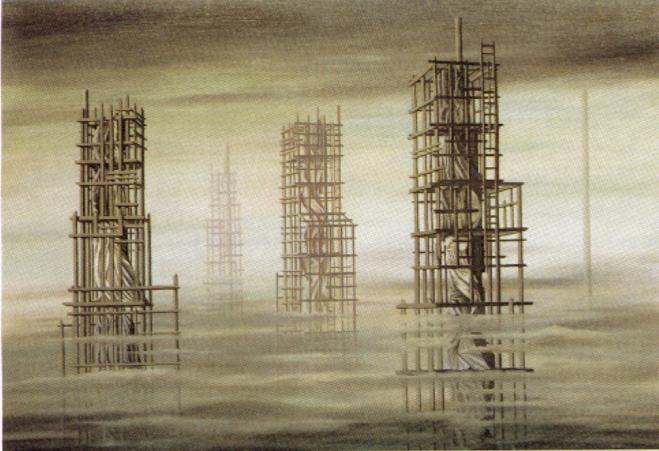
Etymologically an atmosphere is a "breathing ball". A circular room where we could possibly live and breathe. A bearable environment. A poetic bubble. The visualisation of this point where things can start happening, the sensorily tangible extension of the field of possibilities, the charged spatiality, is actually the alpha and omega of a substantial part of surrealist art.

 (CO Hultén)

 (Kay Sage)

Atmosphere in art

Historically it is entirely due to Chirico that atmosphere assumed such a central role in surrealism. Chirico was crucial for the direction of several of the pioneers of the surrealist adventure in pictorial art; Tanguy, Magritte, etc. But note also how strong this tendency is in some of the other immediate sources to surrealist pictorial art; Atget, Rousseau, Moreau. Or? In surrealist art, this is clearly one, but still only one, of the main tracks.

But in the beginnings of surrealism, literary sources were more frequently acknowledged and cited. Only through these we can say that atmosphere is a topic in the manifesto of surrealism of 1924. Of course concerning the image, in the already mentioned orchestration of Reverdy's thoughts and the cultivation of the autonomous and dynamic image, but even more with the launching of the specifically surrealist sense of the Marvellous. This is actually introduced with a discussion of the gothic novel and especially Lewis. So here we find support that atmosphere has an affinity for the gothic, for the fairy-tale-like, immense, occult, for romanticism, for grandiose nature and grandiose decay. But the early surrealists also took part in the exaltation of modernity, and not in its most plain and disgusting forms like the machine, war, the factory, commerce, money; but in its most profoundly and dynamically contradictory or ambiguous aspects. More than anything, atmosphere resides in certain zones where the gothic coincides with the modern in a dismissal of time, or continue wrestling in raging contradictoriness, of a kind actually becoming a lever for the spirit: natural science, the fleamarket, adolescent-boy-literature adventure, film, criminality, utopia, revolution. And of course not everywhere in those.

But we were still in the origins and constitution of surrealism. Equally interesting is to see how the "Chirico track" in pictorial art continued to be productive, and now finds two prominent representatives, magicians in staging such spatial scenery, in my own closest environment in John Andersson and Niklas Nenzén.

But also that other main tracks in surrealist artistic struggles has come to revolve in relation to the very same questions and mechanisms; psychological morphology – as it expressed the eagerness to abandon all the conventional (in the sense of art history) representation of projecting three dimensions onto two, momentarily framed selection, central perspective, middle-sized objects represented by contours and coloured surfaces; preferring an investigation of a realisation inspired by modern physics of an inner space beyond kantian categories and realistic school tricks, – also becomes atmospheric in how it associates to dramatic and threatening weathers and thereby atrmospheres in every sense of the word, and equally much by generating an ambiguity in scale and in the spontaneous interpretational efforts in spatial terms, staggering moving from microscopic worlds over oceanic and atmospheric systems all the way to galaxies, nebulae and other cosmic entities, and back again. Abandoning the compulsion to represent opens a manifold of possibilities, not the least in how we in the appropriation still expect representation, and spontaneously interpret by means of representing potentialities, and then since all unambiguousness on that level have been abandoned in the abandoning of the convention, the spectator is actually forced to real productivity in this sense.

Two modes of visions. Two classes of suggestions. And there are no sharp dividing lines. Not the least as the common usage of architecture as a structural element in the chiricoan tradition to raise a frame for the invoked spatiality to take place in, or between or beyond, also fills the function of establishing a grid addresing the basic questions of space through resembling the architectural organisation of the sponge or the coral, or the arrangements of vertebral columns on the submarine cemeteries. And not the least since the slowly condensating atmosphere becomes pillows of clouds and then a landscape of shrubs and crowns of deciduous trees and rocks and waterfalls (remember Gainsborough's tricks when painting a landscape!) and that particular uncanny opening in the forest. And the very creeping-thronging of organic shapes from here and there turns out have a growth algorithm and an interactive chaos factor, and is in itself a jungle as well as a simple city scene. We wil expect something to be coming down this particular street. The street vendors barricaded in the monumental flowerpots today are offering the ingredients of a completely new disease. What an absurd bathing suit, what an interesting sky of stars! It was for that reason the window was left ajar, but the rat trap remains suspended, while the neighborhood is quickly decaying and sea birds are recolonising.

But why are we talking about art? Atmosphere as a phenomenon is, just like other allegedly aesthetical phenomena, even more relevant for an offensive approach to life than specifically for art. Recognising, deepening, creating atmospheres in everyday life. Which isn't isolated from artistic activity. Maybe it is just a matter of what kind of artifacts one leaves behind. Pictorial art is one of several useful ways of generating and investigating atmospheres.

So atmosphere belongs in surrealist aesthetics, whenever the word aesthetics is taken in the wide sense necessary in order to not make surrealist aesthetics a contradiction in terms.

Surrealism keeps confounding morals and aesthetics. Refuses not to. Entirely focused on poetic effects and their deeper content and connection with everything else. Inseparable from a moral perspective and a whole-generating framework. The part which is actually subordinated is the formal, superficial, stylistic aspect – since this is merely the means of the particular individual, or the particular experiment, and couldn't have a central role. They are means for sensibility, sensibly chosen and sensibly exercised, regardless of whether experimentally or calculatingly, incidentally or insistently. The little tools of the spirit and the small ingredients in an alchemical recipe for conjuring an atmosphere. Not to be ignored.

And let's skip the discussion of the spirit here.

Yes a pictorial creativity with a core point in the sensible realisation of atmosphere generated by the presence and sensitivity of the spirit. A series of unheard of suggestions of bubbles in which it would be possible to breathe. Uncanny thought.

MF?


(Thomas Gainsborough)