Showing posts with label surr. and art. Show all posts

Thursday, July 9, 2015

The Dignity of Art


In the 20s, surrealist attitudes to art were partly polemical. In order to lay bare the true creative mechanisms and their accessability for everyone, there were powerful attacks on the dignity of art. Surrealists emphasised automatic texts, dream accounts, then collage, then found objects. Exhibiting a urinal had just earlier been a great scatological joke as well as a serious questioning of the boundaries of art and art’s self-understanding and pompous dignity. Of course, from the surrealist viewpoint, these were never primarily provocations and nivellations, it was always about the actual findings and their poetic potential, but also very much polemically about the accessibility of this potential.

The coup ”worked”. Pranks and provocations were accepted as a part of art, and also the more democratic, less educated and more unintelligable visions such as those brought about by the surrealists were accepted as a part of art. Eventually, and that was a later development, conceptual art was established; creativity and skills of realisation were both altogether abandoned as criteria. And what happened to the dignity of art? Well, it’s still there, but only as a power structure. Only in the structure of institutions and funding agencies that decides who is an artist and who is not, and then it is up to the certified artists (who have a proper art education and a cv with received grants and a backing gallerist) to decide what is art and what is not. There is no dignity in art except for this power structure. Everybody will react, when something pretentious and ugly comes in their way, by thinking ”ok, never mind, it’s obviously art” and look away as when ignoring a drunk in the street. Provocations through art don’t work well, and provocations of art are self-contradictory as they often pay well within official art. It is futile to question the concept of art through art, because that’s what a major chunk of official art is doing and there is little left to question. Except the institutional form itself. Which is perhaps best questioned not by grand or small gestures within its own sphere, but by maintaining essential creativity outside of it. As millions of sunday painters, autodidacts, obsessed, odd visionaries, absentminded scribblers, children, madmen, street artists, surrealists, housewives, underground artists, and study-circle attendants do on a daily basis anyway.

Therefore the concept of outsider art or art brut is, as has been noted before, becoming superfluous at the same time as it contains that which is of uttermost importance. It becomes art itself, because there is no official art to be outside of, except as for its institutional structure itself, which is usually of extremely little interest.

But still, some people animated by inner necessity will even now continue to try the route of official art, of art schools, grant applications and gallerists, just to try to procure an opportunity to be able to create all day without starving for it. A lot of really beautiful things are in fact being done also within the art world. People are that desperate. If you go looking for interesting art, you will probably find some. Of course it is a small fraction of all the aspiring artists out there, but since these are very many, it’s still quite a lot. Surely far fewer than those who do similar or equally or more interesting things without trying to squeeze it or themselves into the art institution, but since self-promotion is the major work task of any contemporary artist it is often easier to find these exceptions within the art world than it is to find those who struggle less for recognition and are often happy to stay out of the limelight. Thus, even for extremely suspicious surrealists, there is a lot of good art to find from card-carrying artists who struggle in the art world, it is enough to fill exhibitions or journals or assemble alliances for those who want to do that.

But just because we are devoted to poetic visions this doesn’t mean we have any business promoting the careers of careerists who happened to hit a pregnant ore. The major demarcation criterion will not lie in who is capable of producing striking and powerful works, that is a little bit too wide circumscription, but rather in the attitudes of the artist. It is certainly not the attitudes of the artist that makes a work good or not, but it is definitely that which makes the company of the artist bearable or not. It is possible to collaborate with people who see art as something serious enough to demand a setting that recognises the challenges it poses, who do not do things to please, who do not do things to impress the impressarios, the critics, the tutors and the celebrities, who do not do things to make their name known, but who take their own creative urge seriously enough to dare stay in the shade if necessary and not to start bartering with it as soon as an opportunity arises. It is in fact those who are more serious about the possibilities of art who are usually more modest about their own contribution and more prone to participate in investigations, experiments and games. With a basic attitude that the point of creativity lies in creation and not in the market and institutions it is far easier to take part in playing games, in collective enquiries, in uncertain adventures without guarantees, in manifestations and initiatives and refusals in other media, based on what the dynamics of the creativity, of the random or fate-given discoveries, of the poetic spirit, seems to demand.

But what happened, in this context, to the democratic dimension of denigrating the dignity of art? Well, the production of images overflowed and the art institution swallows anything. We hardly need to convince anyone. And there is no need to stain art, pull it down into the gutter with us. Art has no dignity left, and there is nothing to win in attaining the position of being art. On the other hand, denying any significance of art by postulating definitions where art is anything bad which is determined by the art institution, and anything good outside the art institution is by definition not art, as is perhaps suggested by Madrid surrealists or at least their sympathisers, seems like a pointless semantic trick or an inconsequential battle against windmills.

So, some of the simplest procedures in the surrealist bag of tricks, originally overdetermined by their polemical function, are at this point very little but well-known party tricks and hardly vehicles for transgression and vision. Especially collage. Which has become a bit of an identity politics affair for surrealists rather than an enquiry into the unknown. The idea with collage was that anyone would be able to make up atmospheres, haunted spaces, and remarkable new combinations, in an impersonal language independent of acquired drawing and painting skills. Exquisite corpses may be traditional too, but in exquisite corpses there is still the element of creating something new outside of your own control, while in collages you have picked all the elements yourself and paste them together in a form that is, despite good intentions, often pleasing to the eye far more than to the imagination, and often pleasing to the eye simply because they remind you of Max Ernst or of some other classic surrealist art that you hold dear, or because the parts are interesting in themselves.

Pictorial creation still makes an unrelenting sense, as vehicle of imagination and the exploration of the unknown.

Tuesday, June 3, 2014

An exhibition held

We had an exhibition at a commercial gallery (Galleri Lili) in Stockholm throughout the month of April 2014. One of its main focuses was on intermediate forms, and we assembled a relatively large object section in order to investigate various aspects of intermediate objects. The exhibition space was also utilised for a small series of experiments and performances contributing to this investigation.


NN
NYMPH IMAGO- an exhibition about intermediate forms, unknown animals and the crystalised flutter of transformation itself.

As a homage to the revolutionary nature of imagination, the Surrealist Group in Stockholm with friends, issues an invitation to a spring exhibition, a collective attempt to make do with the petrified spirit of the times and conjure forth all the dimensions of reality, to temporary occupy space in order to smuggle down seeds of life between the high-rise buildings.

During three weeks we fill the exhibition space with objects and events which will remain in their moments of transformation: text, image and invisible sea-stars, fossilised nerve signals along the walls and a throng of enigmatic life forms moving in the periphery of the field of vision.

Take a pause from your rusty telephone, drag your body through the payment zones of the city, and help us finding out what it is that moves just behind the set.

Who or what is it that speaks through our mouth, sleeps in our beds, creates in our place? Mythological creatures, socioeconomical contingencies, schizoid partial personaliites, lightnings from the future? What are the prehistorical animals moving between the trembling membranes of the brain?

Through games and speculation you are invited to join forces with the exhibitors and reconstruct, imagine or reveal who was made what and who has made whom, or just to become uncertain about it all at last.

The Stockholm surrealist group and friends


JA
(Coordinators Niklas Nenzén & Lars Rosenström. Original setup of exhibition included John Andersson, Linnea Bergman, Erik Bohman, Christofer Dahlby, Kim Fagerstam, Mattias Forshage, Riyota Kasamatsu, CM Lundberg, Emma Lundenmark, Giuliano Medici, Niklas Nenzén, Lars Rosenström, Hugo Röjgård, Emil Särelind, Ika Österblad. Later participation also by others.)

Games about objects

These were the active investigations into the transformations during the course of the exhibition Nymph Imago:

1. Disguised as an opening performance, MF and EL carried out the game of questioning chosen objects simply by touching them and allowing them to inspire automatic speech.


2. During a game evening with friends and a few curious, we asked participants to pick an object in the exhibition and imagine what two things it was an intermediate between.
3. Similarly but the other way around, we asked participants to pick two objects in the exhibition and develop an image of the intermediate form between them.
4. Furthermore, a number of improvised enquiries and collective drawings were passed around founded in questions raised by the objects.
5. During the closing event, KE was quickly writing poems inspired by chosen objects and reading them aloud.


Gifts of compensation


I´m not sure what an artwork is. A sympathetic viewer may hold that an artwork is an item in a class of objects that we have agreed to contemplate in a privileged way, experience freely and discuss openly. A more hostile viewer may argue that an artwork is a commodity that promises to satisfy certain contrived and mystified needs. Both views are relevant, and hardly contradict each other, since they share an emphasis on the social function of artworks. What I´d like an artwork to be – as someone who makes visual images – is probably a shapehifter, a gestalt switch-machine or the transformative meeting-place of interacting living forces. An object that functions like a catalyst, an Alkahest, Prospero´s wand, an internal combustion engine. But more often than not, the concept of art and the category of artworks, as social constructions, are a hindrance or a nuisance to me, or something like an inheritance that must be spent in order to permit these rawer and more subtle qualities to shine through.


It can never be sufficient to make art. One must start somewhere else. What I experience in making images is being two instances in a continuum; both giver and reciever, or creator and spectator. Therefore I tend to expect that the given transfer from one state of mind to another is what also occurs in the transfer of an image from one person to another. Or in the case of artworks: what should have effect. So by pursuing this effect, I drift away from art, and get back to art, without settling. This movement may also represent two states of mind to reconcile, like dreaming and waking life.
 

What the giver and reciever see in the artwork before and after the change is interesting in itself. But what they experience in the mind-state that they fleetingly share in the change is what really matters to me. ”My” mind is usually unable to contain such a shift, so instead a temporary body or a new and specialized organ is developed: the particular artwork. The change the artwork makes can perhaps most bluntly be described as offering a vehicle for the transportation of unconscious aspects into conscious reflection. Still, the experience is not particularly mine. The personal ”art coefficient” of the giver is, with Duchamp´s words, ”like an arithmetical relation between the unexpressed but intended and the unintentionally expressed”. We need at least two minds or mind-states to perform that equation.
 

Sometimes the vehicle is secondary, while the difference or discrepancy between states of mind and how they can join means everything. Waking up and falling asleep are the mysteries that that point to this. Vast amounts of poetic insight into this liminality is being sacrificed because vehicles were not jotted down on a sketch pad or in a note book. No need to regret the loss though, since hypnagogic, hypnapomic and alike states (lucid dreams, not the least) let us assume that the point of transfer may unfold itself as a place in its own right, like a hovering non-euclidean domain in the very act of cognition, more or less continually, and certainly in areas outside of art-appreciation.
 

Consider for example what happens when we step into new psychic atmospheres by way of some unforeseen arrangement, like the sun passing behind a cloud at the exact moment of a crow´s caw on one´s walk through a forest. Whether such passages happen by chance or are created willfully as artistic devices, in both cases the effect is that a gap between what´s previously experienced as on the one hans natural processes and on the other hand personal efforts is bridged. Hereby micro-reenchantments of the world are instilled, that may lie close to superstition. Artworks then can perhaps be seen as teachers that contribute to the progress of the attention necessary for reenchantments to happen, without a need for superstitious rationalization. They may have personality and be original, like spiritual entities, but all they do is point and mimic. They may grasp your attention through their authority or their charisma, but they never actually rely solely on authority and charisma.
 

That artists really follow hints from nature´s hidden form-creating principles was clearly understood in ancient times. In Aitareya Brahmana, a Vedic text from roughly between 1700–1100 BC, we can read: ”Works of art created by humans are an imitation of divine forms; by utilizing their rhythms, a restructuring of the vibrational rate of the limited human personality is effected.”
Although ”a restructuring of the vibrational rate of the limited human personality” in my view can correspond to the above described dynamic of the relation between giver and reciever, my imagination may not be plastic enough to recognize divine forms as such. But, by taking a hint from cognitive linguists Lakoff and Johnson´s ”embodiment hypothesis”, I call these lucky arrangements metaphorical situations or metaphorical objects. Lakoff and Johnson´s research suggest that the laws of thought are metaphorical rather than logical and that truth is a metaphorical construction rather than an attribute of objective reality. They suggest that the ontology of our lifeworld is given from metaphors drawn from our experience of having a body, not from the physical sciences or from coherent metaphysical systems. This means that our understanding of one idea, or one ”conceptual domain”, is informed by the terms of another (e.g.: understanding quantity in terms of directionality, like ”prices are rising”).
 

By recognizing metaphor as an epistomological principle one of course arrives in the domain of poetry. Owen Barfield, in Poetic diction, has this to say about the poetic process: ”Seeking for material in which to incarnate its last inspiration, imagination seizes on a suitable word or phrase, uses it as a metaphor, and creates a meaning. The progress is from meaning, through inspiration to imagination, through metaphor, to meaning; inspiration grasping the hitherto unapprehended, and imagination relating it to the already known.”
 

In view of conceptual metaphors it makes sense to me that I, as a figurative artist, am not sure what the difference between an artistic object and a situation is. Or should be sure. For in decisive ways, an artwork can not be an object of knowledge; it reveals too many loose ends stretching into the world of imagination and into the imaginations that make up the world. What I can do, is to try to grasp artistic objects through the situations they evoke, regardless of whether these situations are depicted or imaginary. To me, captivating ideas appear like symbolic mise-en-scenes, filmic stills or picture-poems, that may or may not want to be further objectivized. Making ”sense” of them is to explore the general relationality of their life in thought. And laying out the frozen pattern of divine rhythm, merging the known with the unknown in visual metaphor, is the ongoing self-reflection or epistemological feedback of the body-mind.
 

In fact, visual and linguistic representations are very close, if not sometimes interchangeable. Once while fever-sick, in a hypnagogic revery, I constructed a series of written situations / objects to make my thoughts about the ontology of artworks clearer to myself: that the ”objectivity” of the world is corporeal and poetical rather than physical and conventional. The following phrases can be seen as ”vehicled” language-counterparts to how I approach and create images. I quote these situations here, with brief explications:

”Her eyebrows are adjacent to outer space, the yellow dress takes her away from the beach.”

This image suggested itself as an expression of the feeling-essence or singularity of an astronaut leaving the mothership, floating in space attached only by a rope. But by decoding the situation thus the sign-function of the image takes precedence. So the point here is to forget the astronaut, the information. There were and will be astronauts before and after astronauts, so to speak.
 

”On a day of overcast weather his goalie hat attracts sunlight to his eyes.”
 

A simple everyday magic act is a reliable starting-idea. An idea (putting on a goalie cap for shade) magically attracts a desired situation (sun). Semiotically speaking, a concept is displaced or moved from one logical context to another.
 

”When the rattling door closes, the area is filled up with the barn´s silence.”
 

Atmospheres are essential. Tangible weather or change of weather is nature´s way of creating them. They also thrive on stillness and the dynamic of presence and absence. The silence of composition.
 

”His hands have grown out of apples, he can spit the seeds out of a glass of water.”
 

Imagination can be kick-started by pursuing reversed causality, simultaneity, or spontaneously renegotiated object-relationships.
 

Through these modes of thinking I try to postpone or delay discursive information in favor of the image´s purely sensual clues. An artwork to me is therefore at best initially in some way repulsive or resistant against a certain type of decision-prone curiosity. And vis-a-vis expectations preferrably to some extent incomprehensible.That an image may be saturated with precise thought and still delay enough information to benefit communication on the levels of emotion, intuition and imagination is the possibility I favor. The real power of Prospero was not in his wand but in his books, that is: less in someone having the power to decide what something is than in something being given as potentially available to everyone. That an artwork remains ”nothing but sensual clues” is something worth pursuing, I think, even to the point of trying to convey (subconscious) thoughts that are ”more real than perceptions”. So: corporeal thoughts.

The artistic object may then resemble the ”Frog Prince” from the Grimm brothers´ fairy-tale. Like the frog who´s not yet transformed to a prince, the artwork presents itself as something that either has a fixed or a dual identity, depending on if you ”know the story” or not. Knowing the story of an artwork is nothing complicated, but it is as easy to forget as it is to learn, and in my view Magritte expressed it most succinctly with the phrase ”Ceci n’est pas une pipe”. Or as I like to understand his phrase here: the artwork represents nohing in the world other than your own understanding of the particular arrangement you´re viewing. An understanding that is on the move away from the well-grounded opinion or that is expanding beyond ”my” perspective.
 

And, again in comparison with the frog-prince, the artwork is something whose ”true essence” depends upon the engaged faculties of the reciever to become living, meaningful, engaging, beautiful. There is of course no ”true essence” corresponding to one correct interpretation, at least not in any expressible way. In one way, the artwork functions as a veil we move through on our way to another veil. This movement seems very real to us, since it has a feeling-tone, since it awakens an emotional response and since it has a specific character or momentum. But the visions themselves which we sometimes mistake it for are illusory. Plato said: the image moves toward the objects and away from them, with a ”tone of desire”. Artistic freedom, as it seems to me, lies in moving with one´s desire and in the understanding of how images merge with physical objects on the ”as if”-condition. Therefore I remain suspicious against art that seems too stuck in the art world, fulfilling a concept of art, for the same reasons that I´m wary of art that depends too much on naturalism.
 

At the same time – and this often feels like a paradox – the artwork is unusually concrete, material and objective. In the lacunae of thoughts, when the passage between veils is permitted by the spectator, its ”thereness” may be overwhelming. In the artist´s hands the artistic object remains in a raw state, which the spectator has to accept in order to, again with Duchamp´s words, ”determine the weight of the work on the esthetic scale.” The reciever is the one who has to permit the transmutation, which is ultimately not representable by words, by computer screens or by brains. It demands not only a shift of consciousness, but also a thoughtless confrontation, akin to the moment of ”the princess kissing the frog”. It is the overwhelming sense of nearness to the truth, which keeps one going “back from bark to bark to the white-hot kernel” (Breton) without being overcome with or stopped by the inherent absurdity of thought activity.

Making image after image, without this feeling of nearness to truth would be absurd. A world without dusky meaning, without secret signs, is a life acquainted with shadows only. The artist is one such shadow. Empedocles proposed the sign, that if you´re reborn as a poet, a prince or a healer you may have arrived at your last incarnation. The artwork then, to paraphrase the philosopher, is never nearer to us than when it´s neither frog nor prince, but embodies the moment in between.
 

Frog-poets, frog-princes and frog-healers are all in the making of the change.

Niklas Nenzén
(reposted from the lavishly image-populated and high thought-density Niklas Nenzén webpage)

Lost and found

In surrealism there has typically been quite a lot of "found photography", but perhaps not enough in quantitative terms for it to be noted as a "stylistic" element for surrealism by the art historians. It has made more sense for those who give surrealism an immediate meaning in terms of methods and attitudes of appropriating the world; chance findings, sub-surface meaning, poetic atmosphere, strange juxtaposition, paranoic-critical method, vigilance towards the unusual, are an important part of popular imagination and therefore commonly found in anonymous creation. While "funny" websites are typically filled with "found photography" from the world of contemporary advertising and shrill colours, there is perhaps also a bit of a peak of interest in art books of found photography from older times, with black-and-white and certainly more inviting pictures. Odd street scenes, group portraits in weird settings and forming larger shapes, portraits with masks, various kinds of portraits and interactions involving animals and small children and juxtaposing roles, unusual nature phenomena, things that look like something else, involontary double exposures, still-lifes with weird constellations, etc. Often very enjoyable, and stimulating for the imagination. Especially when without ironic comments.
 

And suprisingly enough, a cheap one among them ("Found Photography" in the Thames & Hudson Photophile series) had an introduction where some French writer (named Anne-Marie Garat) discussed in completely reasonable terms the surrealist significance of found photographs! ("beneath the surface of ordinary appearances and the banality of everyday life, the world is full of ambivalence and uncertainty. Within the predictable order of things lies the potential for all kinds of adventures /.../ the bizarre photograph, which seems to go against all reason, uncovering unknown enigmas or perhaps giving us a sense of déjà vu, a mysterious, intuitive awareness of a world beneath the one we know, with all its menacing duplicity /.../ the unusual combination of elements creates a disturbing effect – what is seen is more than what is seen /.../ this quest for bizarre images may derive from a game we play as children: we see a face in a tree, a giant in a cloud, a landscape in the veins of a block of marble." She sounds like an outsider yet knowing what she is talking about, but it is indicated that she is perhaps not entirely innocent in this sense by the inclusion in the book of a portrait of Raymond Roussel and his mother?

Modes of the possible

(Excerpts from a rather intense email discussion about performance art and some of its implications last autumn, based in an example which we have considered less interesting than the general observations and lines of thought and therefore omitted here, along with a lot of the more peripheral or personally combative points.)

JB:
It is a persistent, goal-oriented effort to solve a puzzle, with which they may not have high hopes of succeeding, only the passion to find new methods of approaching it./.../ The question of body and spirit never finds an answer, but after a passionate and honest attempt at gaining insight, or some kind of result, intuitively, one is once again left at the agnostic point of departure. But if that point would be philosophically or scientifically unsatisfactory, which is also the case regarding "serious" paranormal research, it is not meaningless at all. This is because the answer is found in the work itself: the devotion, the obsession and also the playfulness they possess is in itself a unity of body and spirit, and if performance art is to have a purpose or definition, the process of employing the body in the service of the spirit should be it – in my opinion.
    /.../
    If you take an interest in what music is, you will soon discover that the most important basic qualities are common to all artistic types of expression. I never tire of explaining that my basic view of music is based on music sociologist Christopher Small’s model: music is a social ritual with utopian contents, that is, where people get together to act out an ideal society within spatial and temporal limitations, by the initiation of an intricate network of relations between people, objects and ideas. Where sound structures are only a small, but indispensable component. To varying degrees, it is always about celebrating, confirming and exploring these relations. Small mentions this in passing, but viewing it in this way, as a current, present and time-based activity, makes it possible, from a human perspective, to readily apply this model to all artistic experience. The centre of the activity is what anthropologists call ritual. You could call it »the aesthetic dimension« (to borrow Kant’s expression via Herbert Marcuse, who wrote an excellent book with this title). Art is an other-worldly, or magical, experience of transcending our everyday lives. Anthropologist Hans Peter Duerr has called it a faint remnant of the magic of archaic peoples. But the faintness may indeed vary. For someone like Cecil Taylor, the quality of trance is emphasized in his playing. The connection is exemplified by a comment by an American Indian shaman, after seeing Taylor in concert: »I thought this was secret«; according to Taylor this was the best review he had ever received.

NN:
(...) what you (JB) mean by (...) the idea of virtuality of art. Meaning is achieved when the body is put into the service of the mind in meaningless work that conveys hope. That sounds like existentialism. One has to imagine the performance artist as Sisyphos, that is as being happy, talking with Camus.

MF:
I was reminded by the corporality as a key to performance art. It really is among the most pleasurable aspects (but far more for the performer than for the audience...) that it is hard physical labour of no use. Of course utility can be defined in different ways and one may choose to get stuck in paradoxes. But this is work that is productive and lacks exchange value and lacks a use value according to all conventional criteria of utility. And if one manages to create an atmosphere that allows this ritual potential to start getting realised on a collective basis, which I believe is the core of the model that you (JB) describe as Christopher Small's, then also the audience is pulled into this physical dimension. (On the other hand, the often strong sensation of boredom, sleepiness, spontaneous tickling in the feet, aching butt, or for that matter pain and feeling overrun or pinned down from very high sound volumes, I would rather regard as alienating than utopian physical exchange...) Is this the labor of the body in the service of the spirit? It could also be the other way around. The body is pulling the leg of the spirit. And in the confusion arising in that relationship, yes, the spirit can be realised, and unexpected modes of unity and play and jerky fusions may occur, yes. That is what constitutes its mystique, if you will. You are right there. I do not think NN is right in the interpretation that this is existentialism, because the hope of existentialism consists with a necessary voluntarism in the the very choice of ascribing hope, not in the real hope that may be glimpsed in the type of the work and the type of confusion chosen.
    Nevertheless I think your (JB) explanation of this carries a lot further than the specific expression you are discussing does. This expression seems to be far more nivellating, experimentally placing all imaginable human activities side by side and arbitrarily focusing on one to the point of the absurd but without ascribing it any particular potential. I am sure this is what you describe as play in the context, but play in itself is not nivellating in this postmodern sense, because for play the possibility chosen has an aura and a dynamics from overdetermination by desire, and it is specifically not at all exchangable with anything else.
    Where I want to go is just to once more, as in several discussions, emphasise the distinction between on the one hand a logical potentiality, the very idea that anything is possible, and a manifest possibility, which is the exciting real concrete psychophysical sensation that unexpectedly much is actually possible and it is enticing because it is only that which puts us into contact with the unknown, which is the core of poetry, and which is among the cornerstone of experiencing art and of creating art.
    Earlier I used to criticise CA for getting triggered by what I perceived as merely logical potentiality. He successfully rebuked me and, the way I remember it, emphasised that the logic of desire will make the selection anyway or will step into the activity as a meaning-creating dimension once an activity is chosen. This is quite correct, but also far from dead safe, there are many counterexamples, when instead the path of least resistance, conformism, and/or simple cynicism gets the last word.
    While I kept believing that there was a continuous interplay between logical and manifest potentiality, at least that the moments of the truth of art where in the leap when quantitative (logical) potentiality changed into qualitative (manifest) potentiality. This all sounds fine. But maybe it sounds fine because a hegelian explanation always sounds better than an analytical one. In practice this connection between the two meanings may be almost inexistant: since any genuine artistic activity is based in manifest potentiality, while many artists when they are interviewed or interrogated and expected to explain how their art works often grasp at logical potentiality as a mode of rhetoric and a legitimation; sometimes they will be true to their words and actually make art that expresses the unwillingness to distinguish between good and bad ideas, between hunches worthy of following and those that aren't, between the imaginative and the banal, between the exciting and the deadly boring – but on the other hand there are also those who in spite of these unexciting modes of explanation continues exerting a visionary sensibility in their praxis. That's the way it works. Art.

CA:
I would like to add one or more types of possibility to those listed by MF, and the one which is most important to me is the ontological one.
    If logical possibility is purely speculative and exists by power of the structure of logic, as an additive combinatory extension of a specific emerged pattern, I understand the manigest potentiality of which MF speaks as the experience or epiphany that possibilities are present in a particular moment.
    Now I will refer to these as logical and phenomenological possibility respectively.
    Ontological possibility I would like to see from an objectively rationalist perspective, as referring to a specific geography of possibility unevenly distributed in a dynamically evolving and causally coherent world. The fact that the world is causally coherent leads us to end up in the same question as the rationalists did: Do possibilities not exist at all (strict determinism in Spinoza's style) or does possibilities imply diverging worlds whose different globally coherent principles of selection exclude possibilities within themselves (Leibniz), as well as the question whether determinism can be combined with clinamen or any type of unstable chaotic core.
    What I here refer to as phenomenological possibility does not need to consider these questions. What I here refer to as ontological possibility is not dependent on whether the world is strictly deterministic or not, but instead on whether there are, for the individual human being in a particular moment, several alternatives and a selection is made (regardless of whether the selection couldn't have been made differently based on the dynamical coherence of the world (not of logic)). In this case, this presents itself in the phenomenological sense, but I would like to separate the presentation of this "ontological possibility" from a certain phenomenological singularity which may accompany the perception of the field of possibilities, as an indication of unfolding possibilities or as a receipt that one indeed stands before possibilities.

phenomenological possibility (the appearance of possibility 1)
There might be different singularities for, i e the hunch that there is a dog buried somewhere, that there is more to learn about something, that there is suddenly a wealth of newly acquired alternatives, or a weird object presenting evidence that the world wasn't created the way we thought. I want to distinguish these qualities of the experience from those appearances which are simultaneous with its actualisation, because if one sees a diffuse situation that indulges oneself in an interpretative delirium, then the associated quality of manifest possibility might still occur isolated, for example by elaborating by means of brainwork, without the brain simultaneously pondering a diffuse situation. The singularity, or singularities, I talk about here would be like the sense of possibility, as it presents itself, semi-attached to an actual set of possibilities.

ontological possibiltiy (the appearance of possibility 2)
I would define this as the disenveloping/evolving of a dynamic selective process, such as an interpretative delirium, a selection among alternatives of action or interpretation suggesting themselves and criteria for selection suggesting themselves, speculative fantasies about what one self, organisations, objects or subjects would be able to suggest when their different sides and qualities are combined. This ontological possibility is independent of the question of ontological determinism, and independent of whether the disenvelopment is put to music by the "feeling of possibility" (it could occur unconsciously).
    Thus, I see ontological possibility as an objective operation of the spirit in combination with the workings of other elements (the world) in it.

The virtual

The concept of the virtual has been used in different ways throughout the history of ideas. Most commonly it is synonymous with either the eidetic (the idea), the possible, or the latent. /.../ So is the possible synonymous with the latent? This is a trickier question, but I would like to say no. Both are there and are ontologically real, but the concept of the latent I think should be restricted to something which acts objectively but takes another expression or only is expressed under certain circumstances. /.../ For minds we could say that there are latent tendencies (those that work even when they are not manifested), virtual tendencies (that may be latent or manifest in different situations depending on the actual constitution of the mind or the world), and virtual possibilities (reconfigurations of the virtual constitution of the mind, depending on the totality of the world and thereby not empty logical possibility).
    The separation between the two last mentioned categories perhaps rests on the idea of the statistically probable. Or, on the idea of clinamen. For me, it rests on the idea of time as duration. /.../ This perspective corresponds with the idea of a chaotic core or a clinamen, but retains the idea of a determined virtuality. Time is brought in as a transformatory force, but in contrast to ideas of generative negativity this is about a positive generative field of possibilities actualised in the present and having a virtual structure, including the radically new without being undetermined.
    What I would like to do is putting definitions into discussion to distinguish the virtual from on the one hand the possible and on the other hand the latent. I would also like to distinguish that synthesis of duration form the experience of facing a field of possibilities. This latter distinction is mainly theoretical, but seems important to note. The syntheses of duration continue also when they are not being acknowledged as striking. Though I do believe that the experience of something being full of possibilities often coincides with a synthesising, investigative and selective mental activity before an ambiguous material, testing implications etc. An interpretative delirium or a sudden questioning of habitual conceptions (can carpets fly?).
    One last note about the virtual. If earlier philosophy, inspired by Plato, saw the Idea as something more profound, and perhaps more crystalised, beyond temporary emergences, then post-husserlian philosophy tends to see the eidetic, or virtual, specifically as emergences as such, and that which constitutes the Idea is in large parts temporary emergences (or simulacra). The eidetic is emergence as a whole, and that which is called Idea is temporary and subject to change, with contingencies as raw material. What survives and runs ahead to meet the present, both earlier experience and habitual ways of organising information, constitutes the emergent virtual structure in the present.

/.../

Rituals

Rituals and symbols are everywhere. What makes them magic is their being affirmed. There are magical geographies everywhere. Psychogeographical portals and delimitations. Boundaries and signs that reconfigurate the fields of possibilities of our bodies, our posture, our focuses, what presents itself as possible courses of action. The boundaries separating an audience from performers, separating a performance ritual before an audience from a hazing event at Lundsberg private school, an appointment with the hairdresser, or a wedding.
    /.../ don't believe in the rituals they perform. They are too nihilistic. They may claim they are trying to make a carpet fly. That's bullshit. I can claim I am struggling to make a relationship work, through rituals, That's not bullshit. They may claim they don't care whether they make the carpet rise or not. That it's the attempt and not the result that counts. But they don't try, and that matters to me. I regard it as impossible that the audience possibly during the performance may be struck by the hunch that there might be a small possibility, because this is beyond their suggestive power. Instead we may all unite in a nihilistic giggle about people performing real rituals, while missing their actual magical activity. /.../ I much prefer people trying to conjure up a 4D-printer, and it doesn't matter whether they succeed or not, than people who try to conjur up grants for themselves by ridiculing visionaries.

JB:
It is not just about imagining anything, it is specifically the connection between the real and the virtual that sparks an emotion. Not distinguishing between "make-believe" and "for real", as children do already when they start playing, means that you can confuse things that are in different categories, make a carpet fly, make a relationship work, or create a functional 4D-printer. /.../ Art is both real and make-believe at the same time. One does what one does, but it is also an image, an attempt, a vision to be conveyed and pondered or digested. It doesn't have to be a possibility, but gets the chance of pondering whether it is a possibility or not. I found Marcuse's The Aesthetic Dimension to describe that way of functioning very well at that time.
    /.../
    But I didn't give any particular significance to performance art being meaningless work? I don't believe in such things, and if so I have expressed myself unclearly. Art is a kind of work, and if it is meaningless it is not art, since the essence is a form of communication (conveying meaning). But then of course one might use meaningless work (of another kind) as an element in art if one so wishes.

NN:
Yes, I intended meaninglessness in a dialectic sense in my comment. /.../ The example with the carpet is significant for this rhetoric: since "everybody knows" that magic doesn't work, they make a meaningless magical effort confirming what we already know. Sartre compares this type of ritual with the fox who, after having reached for the grapes in vain, transforms them "by the power of thought" into "sour", and he calls the magical attitude that makes this transformation come about a flight behavior aiming to make the world more bearable which for good and bad characterises the condition of man. Thereby this performance appeared to me as existentialist lowbrow comedy for me, with all respect for that it may have appeared differently if one would have been there. If defining magic as "power that does not exist" one misses that it is about mental power. And it should preferrably be used for transforming peppercorns into a dragon than the other way around.

JB:
Sure. But I think it is a more precise terminology to refer to this power of the mind as imagination, like surrealists usually do. Calling it magic causes unnecessary misunderstandings, I think: it sounds like one is presupposing supernatural powers where no such powers have any explanatory power. Magical thinking and poetical thinking may in practice be the same processes, but they have different selfunderstandings, and this should not be neglected.

NN:
On the contrary, they have rather coinciding selfunderstandings, as surrealists repeatedly note. Magic according to the european tradition that surrealists usually acknowledge (Novalis, Levi, Paracelsus, Böhme, Swedenborg) stipulates a world image where we are in contact with everything, then, now and in the future, and where all manifestations are regarded as external forms hiding the unknown principles of nature, and where it depends on ourselves whether they world changes in accordance with our will or not. Poetic thinking is a recollection of the worldview of magic in that sense. Imagination on the other hand is a philosophical, psychological and aesthetical concept which may refer to almost anything relating to desire-driven production of mental images, thus a theoretically diverse concept, unproblematically used in everyday language but insufficient in a revolutionary vocabulary – "power to the imagination" and similar. Most of the surrealists that speak theoretically about magic tend to mean that imagination is an obvious element in human actions and being while magic actualises it in a specific connection, often connected with a tradition of naturale philosophy, or the child's wish-based perception of the world, or so-called primitive cultures etc; including Breton (L'Art magique), Bataille, Carrington, Colquhoun, Paz, Alleau, Chazal, etc.


Outside of art or outside of surrealism


(unpublished post from july 2013)

With the new issue of Patricide (#6), though full of interesting things, I cannot but get the feeling that editor Neil Coombs is abandoning his earlier attempts to establish credability among surrealists and aims higher into the vaguely surrealismophilic art world this time.
    Considering the suspiciousness with which the Patricide project has been met with by many surrealists, one could perhaps speak of revealing true colours. But that would be a selfrighteous self-fulfilling prophecy. Coombs has indeed made some serious attempts, been persistent over a period of several years, opened up a few interesting discussions, and if never lucid also never, in spite of certainly frustrating resistance encountered, turned around into ressentment-full all-emotional verbage against the high horses of many surrealists. I still have a feeling I don't know quite what this was all about.
    There is a certain significant overlap with a large official ongoing show of outsider art at official Hayward Galleries in London. There is due thanks, without whom the present work would not have been possible, to some of the leading central figures in the modern reintegration of art brut into the art world, namely the leading British outsider art dealer Henry Boxer, and the leading British outsider art historian academic and catalog preface writer Roger Cardinal.
    Roger Cardinal started out in the vicinities of surrealism, was associated with the Paris group from Canada in the 60s, then a member of some of the shortlived British surrealist groups in the late 70s. He had not been heard from in explicit surrealist connections for quite some time when it was noted that he had started publishing the usual antisurrealist grossly misrepresenting opinions about surrealism, in connection with the planned Svankmajer extravaganza at the annual surrealismological conference of West Dean in 2010. This was in fact a big issue for the Prague surrealist group, and therefore for the Paris group and for the British surrealists at the time. As an additional sign of Patricide coming from a position somewhere else than within surrealism, the whole scandal of Cardinal's antisurrealism (three long years ago) is not mentioned with a word here and he is offered space and admiringly presented as the big authority and claimed to have written "the first book about art brut" (p 123) (in 1972!). First? What about Dubuffet? What about Prinzhorn 1922?
    Coombs employs an eclectic and partly journalistic investigative method. Instead of thoroughly studying the subject he is addressing, he invites anybody to contribute on the subject whatever their perspective on it might be, and amidst these motley sources he picks a few to interview as authorities. In the case of his "Surrealism and Music" issue, of the authorities he picked, some were just irrelevant and said nothing interesting, some were active surrealists and could perhaps have been expected to say something clarifying but didn't, and some were surrealists who actually contributed to shedding light on the subject. In the case of art brut Coombs isn't messing around trying to pry info out of active surrealists anymore, he goes directly to the big oracles in Britain: the big academic authority Cardinal and the big commercial authority Boxer. And does not problematise at all the hierarchy and the artworld or para-artworld map that positions the big academic and the big salesman as the two main authorities. And does not question what they are saying and the position they are saying it from.
    But within the material here, there is a lot of implicit critique of that in the stories of the artists themselves, or of non-authoritative thinkers on the subject, mainly Stephen Kirin and John Holt. (The latter is a priest, which does not preclude him from saying something interesting, but the fact that he is "openmindedly" given space without even an editorial discussion about the fact, again shows that Patricide does not struggle anymore to be a surrealist journal.) Surrealists Renay Kerkman, Shibek and Martin Marriott contextualise the concept a bit. Tony Convey says "Outside art has spawned a new academy with its own Popes, Bishops and Gatekeepers". Indeed, and the editor doesn't mind boosting their positions further.
    Of course, the plethora of artists, journals, exhibitions and museums of outsider art, art brut, insane art, autodidactic art, folk art, etc, show us a lot of magnificent stuff, teach us a lot about creative practice and about the human condition and about imaginative and social possibilities and about the world. The major problem with advertising it is that there is nothing particular to advertise: this is of course what art is really about – these are not some new and cool artists to highlight, they are not the representatives of a particular style or movement that merit recognition: they are simply artists, like the rest of us, with a moving and inspiring vision or not...
    By rhetorical necessity, acknowledging art brut when you are in the art world (as for example an academic art historian or a salesman) cannot mean to give it a polemical edge against educated and conventional art, because that would mean eventually sawing off the branch on which one is sitting, so instead it must be about claiming it must get the recognition it earns within the art connections, that is being reintegrated, and accepted in official art with the values, standards and criteria of official art basically unchanged. And very much of the recognition is specifically about giving this kind of art its share of the art market, having art dealers specialising in the works of these actually innovative, imaginative and obsessed people. Hooray, their works became commodities too! This integrative art reformism is clearly different from a surrealist perspective.
    A surrealist perspective would instead point at this as a sphere which cannot be separated from what we all are doing, and while recognising many of the most striking and moving creators coming from this angle as heroic and inspiring examples, maintaining this not as example doing good in the competition, but rather as propulsing a devastating critique of the largely stifling imagination-less prestige-driven narrow boring spectacle offered by official art! And resuming the old slogan, it is not the outsiders that need to get in (into the museums, the art market, the art history books etc) but the insiders that need to get out...
    By the way, the Hayward show is really interesting, having a somewhat unusual focus on physics, mathematics and architecture. The cathedral paintings of Marcel Storr, the beautiful utopian dollhouses of Bodys Isek Kingelez, the exquisite junk sculpture of Emery Blagdon, the automatic painting of Guo Fengyi. The poor man's Bellmer, doll fetishist Morton Bartlett, wasn't as spectacular as the advertisements wanted. Strangely enough, by Lee Godie only her photobooth self-portraits, and by Eugene von Bruenchenhein only his portaits of his wife and not at all his marvellous paintings. This is probably an expression of a will to show how "outsider" artists indulge in all kinds of media/technologies rather than just keep drawing/painting. But we knew that, didn't we? And isn't there are particular point with the very unprejudicedness about the medium that many artists display: even if they have a preferred medium for their daily obsession, they are remarkably openminded about utilising whatever materials is at hand for similar expressions that may look entirely different but sprout from the same urge (again, just like surrealists...). There is also an appendigial show at the Hayward by The Museum of Everything of beautiful works by Sri Nek Chand Saini from his vast sculpture garden in India.

M Forshage
Painting by Tony Convey

Sculpture by Emery Blagdon


Friday, March 29, 2013

Atmosphere in Art revisited


Thomas Cole: Expulsion from the Garden of Eden
There are some discussions that I am always trying to avoid, but sometimes fail. One is about the psychology of pictures. A lot of people know a lot about this and it bores me to reconstruct it all on my own for merely polemical purposes. Another one is arguments for and against different strains in surrealist art. It's just not the point. One suggests: Matta? Another says: Magritte. The former says: Matta! The latter insists: Magritte. The former claims: Matta. The latter endures: Magritte. So what?

But I can make one more attempt to avoid those question by addressing the actual interesting questions connected under the heading of atm

How does atmosphere in art work? You can't just draw an atmosphere. Whoever wants to bring in atmosphere into art has to find a way, and at first glance there seems to be two very different ways of bringing that about (later it will turn out that there wasn't just two).

 The most traditionally obvious is to construct an atmosphere, by depicting an imaginary scene where an atmosphere is likely to emerge (or may seem to have already emerged if originally imagined in a visionary manner). By well-known conventions of representation one recreates a three-dimensional scene, which is filled by this tangible absence of rational calming order, an absence that gives rise to this electrical invisible poison gas of the enigmatic, the taste of the unknown. We all know this as the Chirico method, which has been exploited in surrealism for longer than surrealism itself, and has proven strangely inexhaustible. Well, not strangely, since the scene created by the painter is not the major point, but the sense of the unknown that it manages to conjure up within it. But then of course, there is also a whole lot of bad fakes in the genre, all those "standard" surrealist painters that repeat certain supposedly fetishistic objects in different constellations, or paint completely uninteresting scenes where certain objects are out of scale or there is a female breast exposed, or orchestrate some simple puns of sexual or not even sexual character by juxtaposition or transformation, creating scenes that merely reveal recipe or appeal to key stimuli rather than invoke something (but of course also the opposite, all these inadvertently created atmospheres...)

The twodimensional surface with a picture of an atmospheric scene in accordance with this is obviously analogous with a "window" towards this scene (a "window towards the unknown"), and we "read" the picture with the spontaneous skills acquired of translating homogenously coloured areas as distinct surfaces, brightness and order of overlap as distance, lines as delineations of objects, of presupposing a certain perspective, a certain order, as long as anything suggests it. The more it conforms to traditional representation with ordinary clues the easier it becomes for us to trust this flat visual image as an unproblematic representation of a section of a visual field of the rest of the world, with the "solid middle-sized objects" available (and not covered by other objects) within a certain distance within that sector of vision. We go to certain lengths to make up for inadequacies, missing things, or even to fill out that which is merely sketched. No, I didn't want to go into all this standard babble of looking at images, I have to switch track...

Ok, the most logically obvious way to get atmosphere into art, on the other hand, is to address this atmosphere directly, and try to translate it into something visual. In this case you don't need specifically the traditional skills to depict a scene, but you need to seduce the spectator into seeing. If the picture is a window, it is a window not miniaturising the surfaces of middle-size objects to form an image, but something else. We have to somehow suspend the everyday reading of an image and wait for some other reading to emerge. Something subatomical, fourthdimensional, synaesthetical... But for people with no particular synaesthetical capabilities, or no advanced training in reading image parameters not as proportional spatial parameters but as something else, this is usually done by a scale displacement or a simulation of synaesthesia. If it doesn't look like the world as we know it, it might very well depict the microscopic world. Or the vast macroscopic worlds of outer space. Or it may be usually invisible fields rendered visible by some weird staining process: we could be seeing the form of sounds, of thoughts, of smells, of feelings, or of actual atmosphere. Or a mixture of all this. And usually it is through this desperate superimposition of spatial interpretation onto an image which does not give us the traditional clues to be read this way that we co-create this image, and co-create, or are seduced into seeing, its representation of atmosphere itself, with or without the auxiliary fictions of mental entities as part of the translations. This is of course the Matta method.

It was quite revolutionary when the surrealist painters discovered and explored it through the second half of the 30s and during the war (often under the name of "psychological morphologies"), but then it proved remarkably attractive to use this point of departure as an excuse to abandon the fundamental curiosity for the unknown... Several age groups of painters used it as an excuse to revive classic abstraction of one or the other kind, again denying that the picture is a window and depicts the imaginary and instead seeing it as a mere twodimensional surface with a certain distribution of form and colour. Without the discipline of occultism or madness which could ascribe an intense metaphysical meaning to such form and colour, and which made good old abstractionism take part in the quest for the unknown, these new "abstract expressionist" strands, most notably as "action painting" or "New York school" in the US and "tachisme" in France, often struggled to attain a complete absence of spiritual content. Why would anyone be interested? On the other hand, the decidedly surrealist half of "lyrical abstraction" kept it closer to the imaginary sources and kept redirecting it back to them whenever it went astray into those pastures where all cows are equally grey.

(Since the surrealist movement has always been non-doctrinary in stylistic terms and never has been circumscribed in pictorial terms, which by the way again is why things are so difficult for those who insist on regarding surrealism as an art movement, the surrealist movement has welcomed and encouraged those who undertake poetic explorations of the unknown with artistic means regardless of their stylistic choices. And thus, it is always surprising and frustrating when some want to make a big fuss over contradictions in stylistic terms.

Several have insisted that representational art is obsolete and we must abandon the conventions of perspective etc. Well, why? Just because it's old? No, who wants the new for its own sake! Or because the fact that it's old suggests that it is connected with traditional and repressive structures of the mind that we could attain new freedoms by abandoning? Oh, could be, but it is a bit of a far stretch, and so far it seems empirically like the surrealist use of old picture conventions still opens up for more new horizons of the mind than its voluntary abandonment does. Because advertising, pop culture and academic art took over many of the surrealist lessons in this field? Well, if they did, did they immediately acquire the full rights to everything produced through these routes? Yes, this line of thought is suggestive to the radical mind, and over and over again the urge to abandon everything that one can come up with an argument against has proven quite sterile...

On the other hand, others have grumpily insisted that they hate "abstract art", and there was a splinter group (Tendance Populaire Surréaliste) for several decades in France that kept insisting that Breton had betrayed surrealism and that the French surrealist group effectively become antisurrealists just because Breton and others explored lyrical abstraction in the 50s! The TPS have rarely been acknowledged at all in the movements own historiography, mainly because it seemed so far-fetched, beside-the-point and so utterly non-surrealist to have a battle of styles. Because any arguments for a particular style against another might possibly be valid for a particular exploration, or even for an extended exploration in the form of an oeuvre, but as arguments they prove to play on a completely different arena than that of surrealism – it becomes aestheticism or sensation-seeking or fashion strategy or political strategy, but not surrealism.)

Though the two routes I have described are not the only routes. Since the methodology of surrealism is very often about gathering random or apparently insignificant material and seeing meaning emerge from them (emergent properties), a lot of artistic practice within surrealism focus not on the manipulation of evoking atmospheres, but merely on the patient or impatient waiting for them to arise by their own accord. Many of the basic surrealist strains, for one: the immediate, naive figuration, and two: the organic-type morphological fantasy, and three: the ceaseless collaging of more or less random elements, are practices that just go on and on without caring, and that will see atmospheres emerging by chance and overdetermination, just like in reality, only increasing the possibilities, both merely statistically and with automatic sensibility....

MF

Monday, April 23, 2012

Third lecture on atmosphere


"A midnight´s visit is grand. The paint shop nothing."

Hypnagogic phrase and image.

/ Christofer Dahlby

Saturday, April 21, 2012

First lecture on atmosphere


Atmosphere one

Let's hear a tale about the primordial atmosphere. Or, if that is taken specifically as the original atmosphere only, then rather the atmosphere during those emblematic prehistoric days, and then most emblematically that of the Carboniferous era, the rich and intoxicating air at the time, when dense warm forests covered earth, gigantic insects were flying around, bizarre reptiles and amphibians were crawling around, long before the dinosaurs. The transformations of the primordial atmosphere is largely the story about the cycles of oxygen levels.

Oxygen is a lethal substance. Very reactive, and therefore threatening for anything that wants to remain. For us, painfully adapted to life under these directly life-threatening oxygen levels, the very process of life consists to a large extent of spending very much energy on hindering and redirecting the amok of the inflammable oxygen on cellular level. We eat to cope with oxygen, to be able to retain physical integrity, to keep our body, and as soon as we fade or die we start disintegrating.

Just to make a long story short: For some reason we received water on earth (the reason is not clear); water is one form where oxygen is strongly bound and largely passivised. But in the water life emerged, bacteria that commenced photosynthesising and thus releasing the oxygen that had been bound in the water. Free oxygen, very reactive, then was bound largely by iron, forming massive layers of iron oxides all over the earth. After long times then more or less all available iron was bound with oxygen, and then free oxygen started accumulating in pure form in the atmosphere. This was quite dangerous, and the original bacteria were retreating to hidden, oxygen-poor environments. But then came the animals. Animals were a new, quickly evolving lineage that survived oxygen, and not only survived but were net consumers of it. But on a geological time scale the respite became brief: after the animals came in the Cambrian and made the earth far more pleasant, then already in the Silurian the plants came, incorporating photosynthesising bacteria offering such bacteria entirely new habitats and a new scale in their previously largely microscopic life; oxygen levels were increasing again. Especially during the Carboniferous, oxygen levels rise dramatically: plants form forests spreading out to cover all land. Hot, wet, oxygen-rich, thronging, crawling; the emblematic vegetation type of the period is a magnificent, infernal and uterine jungle; a grandiose fever hallucination. Huge animals, thick prosperous vegetation (tree ferns, giant clubmosses, cycads), massive forest fires on a continental scale; an immense supply of nutrients, incessant green growth, incessant biological production, dramatic increase in oxygen... But then a similarly drastic decrease during the Permian! This was mainly for reasons of plate tectonics; the continents drifted together to form a super continent, Pangea. This includes an increase of the proportion of land on earth, when all the shallow continental shelves are dried up. The warm parts of earth are more land than sea so much less water is evaporating into the atmosphere. The global air masses get drier, less land is situated close to the coast; the climate becomes dramatically drier: deserts replace jungles. During the Permian, oxygen levels in the atmosphere decrease from 30% to 15%! Then, during the mesozoic era, those more well-documented times when flowering plants, dinosaurs and others diversified, oxygen rose slowly again, and has for a very long time now been around 21%.


Atmosphere two

But let us begin in another end as well. If atmosphere can be taken in a strictly chemical-meteorological sense it can just as easily be taken in a phenomenological-spatial-existential. It is one of the characteristics of poetry that it generates atmospheres, and that this easily can become an aesthetic criterion: an image which does not generate an atmosphere is a lifeless and flat image, which is perceived as arbitrary or cerebral, mechanical or constructed; while an image which generates an atmosphere animates the senses and imagination, invites to revery and co-creation.

An atmosphere is a charged spatiality. It is generated by a presence. A presence which takes occupancy of a place and erects a sense of room. This presence is a trigger of psychic dynamics and thereby in some sense an image. But whatever becomes a poetic image is also a matter of flexible categorisation, and completely dependent on its effectiveness in concrete mental terms. It may even be the very currency of spiritual exchange...

So, we often have reason to return to the formulation of the poetic image as defined by Reverdy and examplified by Lautréamont from Breton's manifesto onwards. Maybe some people haven't heard them to boredom or learned them by heart. It's about the image as "a creation of the mind /arising/ from the rapprochement of two more or less distant realities /.../ the more /.../ remote and accurate /.../ the greater /.../ emotional power and poetic reality"; "beautiful as the chance meeting on a dissecting table of a sewing machine and an umbrella". This concerns the spritual dynamics in a suggestion of an unusual relationship, an unusual displacement, an unusual constellation. On the one hand it has a polemical side, the dynamics of freedom itself, the width of the field of possibilities as soon as one abandons those relationships dictated by utilistic concerns, by realistic assessments and by old habit. On the other hand, not everything is poetic and it concerns very specifically those concrete connections, intercourses and possibilities that are revealed in the specific suggested relationship, which might be able to take us somewhere or not. It is this latter aspect that makes the criterion functioning as a criterion. Atmosphere is a field of possibilities, but not only in the formal, technical sense, but it is also a substantial part of the explanation why an atmosphere is poetic, that it is a sensorily tangible condensaiton of the field of possibilities, moving us with the weight of its yet unrealised dynamic. It is not just the case that we don't know what will happen, but unusual things will also feel tangibly possible; while the outcome is notably uncertain the very act of opening is so directed that the climate prevailing in this beyond entangle ones face with sticky tentacles, poking and blowing on the spirit. And this presence, which in some sense is an image, does not need to be ab image in the classical sense with two separate identifiable elements being connected; it could also be an image emerging from some more metonymical suggestion: a self-reference becoming a vicious circle, a very distinct absence, or something. Anything that is capable of generating an enigma. Because actually it is only when an enigma, only when there is a certain measure of spiritual fuel in a place, and then also a tendency to not be exhaustible by all the interpretations and guesses it gives rise to, and this elusiveness in itself becomes tangible; only then does this producitivity reach its actual gas generation and creates a real atmosphere, a concrete measure of room on its own conditions.

Etymologically an atmosphere is a "breathing ball". A circular room where we could possibly live and breathe. A bearable environment. A poetic bubble. The visualisation of this point where things can start happening, the sensorily tangible extension of the field of possibilities, the charged spatiality, is actually the alpha and omega of a substantial part of surrealist art.

 (CO Hultén)

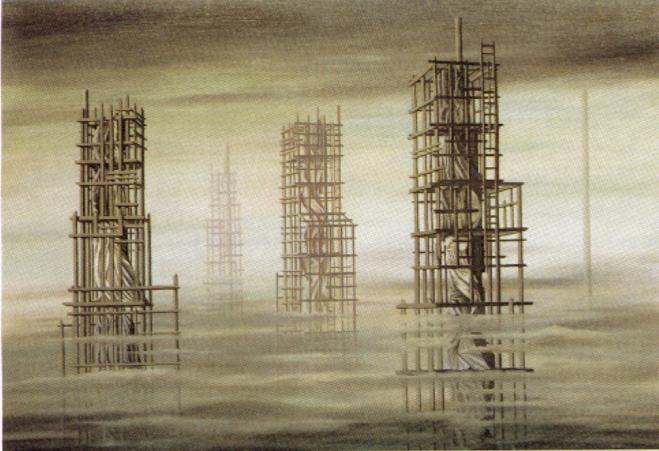
 (Kay Sage)

Atmosphere in art

Historically it is entirely due to Chirico that atmosphere assumed such a central role in surrealism. Chirico was crucial for the direction of several of the pioneers of the surrealist adventure in pictorial art; Tanguy, Magritte, etc. But note also how strong this tendency is in some of the other immediate sources to surrealist pictorial art; Atget, Rousseau, Moreau. Or? In surrealist art, this is clearly one, but still only one, of the main tracks.

But in the beginnings of surrealism, literary sources were more frequently acknowledged and cited. Only through these we can say that atmosphere is a topic in the manifesto of surrealism of 1924. Of course concerning the image, in the already mentioned orchestration of Reverdy's thoughts and the cultivation of the autonomous and dynamic image, but even more with the launching of the specifically surrealist sense of the Marvellous. This is actually introduced with a discussion of the gothic novel and especially Lewis. So here we find support that atmosphere has an affinity for the gothic, for the fairy-tale-like, immense, occult, for romanticism, for grandiose nature and grandiose decay. But the early surrealists also took part in the exaltation of modernity, and not in its most plain and disgusting forms like the machine, war, the factory, commerce, money; but in its most profoundly and dynamically contradictory or ambiguous aspects. More than anything, atmosphere resides in certain zones where the gothic coincides with the modern in a dismissal of time, or continue wrestling in raging contradictoriness, of a kind actually becoming a lever for the spirit: natural science, the fleamarket, adolescent-boy-literature adventure, film, criminality, utopia, revolution. And of course not everywhere in those.

But we were still in the origins and constitution of surrealism. Equally interesting is to see how the "Chirico track" in pictorial art continued to be productive, and now finds two prominent representatives, magicians in staging such spatial scenery, in my own closest environment in John Andersson and Niklas Nenzén.

But also that other main tracks in surrealist artistic struggles has come to revolve in relation to the very same questions and mechanisms; psychological morphology – as it expressed the eagerness to abandon all the conventional (in the sense of art history) representation of projecting three dimensions onto two, momentarily framed selection, central perspective, middle-sized objects represented by contours and coloured surfaces; preferring an investigation of a realisation inspired by modern physics of an inner space beyond kantian categories and realistic school tricks, – also becomes atmospheric in how it associates to dramatic and threatening weathers and thereby atrmospheres in every sense of the word, and equally much by generating an ambiguity in scale and in the spontaneous interpretational efforts in spatial terms, staggering moving from microscopic worlds over oceanic and atmospheric systems all the way to galaxies, nebulae and other cosmic entities, and back again. Abandoning the compulsion to represent opens a manifold of possibilities, not the least in how we in the appropriation still expect representation, and spontaneously interpret by means of representing potentialities, and then since all unambiguousness on that level have been abandoned in the abandoning of the convention, the spectator is actually forced to real productivity in this sense.

Two modes of visions. Two classes of suggestions. And there are no sharp dividing lines. Not the least as the common usage of architecture as a structural element in the chiricoan tradition to raise a frame for the invoked spatiality to take place in, or between or beyond, also fills the function of establishing a grid addresing the basic questions of space through resembling the architectural organisation of the sponge or the coral, or the arrangements of vertebral columns on the submarine cemeteries. And not the least since the slowly condensating atmosphere becomes pillows of clouds and then a landscape of shrubs and crowns of deciduous trees and rocks and waterfalls (remember Gainsborough's tricks when painting a landscape!) and that particular uncanny opening in the forest. And the very creeping-thronging of organic shapes from here and there turns out have a growth algorithm and an interactive chaos factor, and is in itself a jungle as well as a simple city scene. We wil expect something to be coming down this particular street. The street vendors barricaded in the monumental flowerpots today are offering the ingredients of a completely new disease. What an absurd bathing suit, what an interesting sky of stars! It was for that reason the window was left ajar, but the rat trap remains suspended, while the neighborhood is quickly decaying and sea birds are recolonising.

But why are we talking about art? Atmosphere as a phenomenon is, just like other allegedly aesthetical phenomena, even more relevant for an offensive approach to life than specifically for art. Recognising, deepening, creating atmospheres in everyday life. Which isn't isolated from artistic activity. Maybe it is just a matter of what kind of artifacts one leaves behind. Pictorial art is one of several useful ways of generating and investigating atmospheres.

So atmosphere belongs in surrealist aesthetics, whenever the word aesthetics is taken in the wide sense necessary in order to not make surrealist aesthetics a contradiction in terms.

Surrealism keeps confounding morals and aesthetics. Refuses not to. Entirely focused on poetic effects and their deeper content and connection with everything else. Inseparable from a moral perspective and a whole-generating framework. The part which is actually subordinated is the formal, superficial, stylistic aspect – since this is merely the means of the particular individual, or the particular experiment, and couldn't have a central role. They are means for sensibility, sensibly chosen and sensibly exercised, regardless of whether experimentally or calculatingly, incidentally or insistently. The little tools of the spirit and the small ingredients in an alchemical recipe for conjuring an atmosphere. Not to be ignored.

And let's skip the discussion of the spirit here.

Yes a pictorial creativity with a core point in the sensible realisation of atmosphere generated by the presence and sensitivity of the spirit. A series of unheard of suggestions of bubbles in which it would be possible to breathe. Uncanny thought.

MF?


(Thomas Gainsborough)