Showing posts with label meteorology. Show all posts

Monday, April 23, 2012

Third lecture on atmosphere


"A midnight´s visit is grand. The paint shop nothing."

Hypnagogic phrase and image.

/ Christofer Dahlby

Saturday, April 21, 2012

First lecture on atmosphere


Atmosphere one

Let's hear a tale about the primordial atmosphere. Or, if that is taken specifically as the original atmosphere only, then rather the atmosphere during those emblematic prehistoric days, and then most emblematically that of the Carboniferous era, the rich and intoxicating air at the time, when dense warm forests covered earth, gigantic insects were flying around, bizarre reptiles and amphibians were crawling around, long before the dinosaurs. The transformations of the primordial atmosphere is largely the story about the cycles of oxygen levels.

Oxygen is a lethal substance. Very reactive, and therefore threatening for anything that wants to remain. For us, painfully adapted to life under these directly life-threatening oxygen levels, the very process of life consists to a large extent of spending very much energy on hindering and redirecting the amok of the inflammable oxygen on cellular level. We eat to cope with oxygen, to be able to retain physical integrity, to keep our body, and as soon as we fade or die we start disintegrating.

Just to make a long story short: For some reason we received water on earth (the reason is not clear); water is one form where oxygen is strongly bound and largely passivised. But in the water life emerged, bacteria that commenced photosynthesising and thus releasing the oxygen that had been bound in the water. Free oxygen, very reactive, then was bound largely by iron, forming massive layers of iron oxides all over the earth. After long times then more or less all available iron was bound with oxygen, and then free oxygen started accumulating in pure form in the atmosphere. This was quite dangerous, and the original bacteria were retreating to hidden, oxygen-poor environments. But then came the animals. Animals were a new, quickly evolving lineage that survived oxygen, and not only survived but were net consumers of it. But on a geological time scale the respite became brief: after the animals came in the Cambrian and made the earth far more pleasant, then already in the Silurian the plants came, incorporating photosynthesising bacteria offering such bacteria entirely new habitats and a new scale in their previously largely microscopic life; oxygen levels were increasing again. Especially during the Carboniferous, oxygen levels rise dramatically: plants form forests spreading out to cover all land. Hot, wet, oxygen-rich, thronging, crawling; the emblematic vegetation type of the period is a magnificent, infernal and uterine jungle; a grandiose fever hallucination. Huge animals, thick prosperous vegetation (tree ferns, giant clubmosses, cycads), massive forest fires on a continental scale; an immense supply of nutrients, incessant green growth, incessant biological production, dramatic increase in oxygen... But then a similarly drastic decrease during the Permian! This was mainly for reasons of plate tectonics; the continents drifted together to form a super continent, Pangea. This includes an increase of the proportion of land on earth, when all the shallow continental shelves are dried up. The warm parts of earth are more land than sea so much less water is evaporating into the atmosphere. The global air masses get drier, less land is situated close to the coast; the climate becomes dramatically drier: deserts replace jungles. During the Permian, oxygen levels in the atmosphere decrease from 30% to 15%! Then, during the mesozoic era, those more well-documented times when flowering plants, dinosaurs and others diversified, oxygen rose slowly again, and has for a very long time now been around 21%.


Atmosphere two

But let us begin in another end as well. If atmosphere can be taken in a strictly chemical-meteorological sense it can just as easily be taken in a phenomenological-spatial-existential. It is one of the characteristics of poetry that it generates atmospheres, and that this easily can become an aesthetic criterion: an image which does not generate an atmosphere is a lifeless and flat image, which is perceived as arbitrary or cerebral, mechanical or constructed; while an image which generates an atmosphere animates the senses and imagination, invites to revery and co-creation.

An atmosphere is a charged spatiality. It is generated by a presence. A presence which takes occupancy of a place and erects a sense of room. This presence is a trigger of psychic dynamics and thereby in some sense an image. But whatever becomes a poetic image is also a matter of flexible categorisation, and completely dependent on its effectiveness in concrete mental terms. It may even be the very currency of spiritual exchange...

So, we often have reason to return to the formulation of the poetic image as defined by Reverdy and examplified by Lautréamont from Breton's manifesto onwards. Maybe some people haven't heard them to boredom or learned them by heart. It's about the image as "a creation of the mind /arising/ from the rapprochement of two more or less distant realities /.../ the more /.../ remote and accurate /.../ the greater /.../ emotional power and poetic reality"; "beautiful as the chance meeting on a dissecting table of a sewing machine and an umbrella". This concerns the spritual dynamics in a suggestion of an unusual relationship, an unusual displacement, an unusual constellation. On the one hand it has a polemical side, the dynamics of freedom itself, the width of the field of possibilities as soon as one abandons those relationships dictated by utilistic concerns, by realistic assessments and by old habit. On the other hand, not everything is poetic and it concerns very specifically those concrete connections, intercourses and possibilities that are revealed in the specific suggested relationship, which might be able to take us somewhere or not. It is this latter aspect that makes the criterion functioning as a criterion. Atmosphere is a field of possibilities, but not only in the formal, technical sense, but it is also a substantial part of the explanation why an atmosphere is poetic, that it is a sensorily tangible condensaiton of the field of possibilities, moving us with the weight of its yet unrealised dynamic. It is not just the case that we don't know what will happen, but unusual things will also feel tangibly possible; while the outcome is notably uncertain the very act of opening is so directed that the climate prevailing in this beyond entangle ones face with sticky tentacles, poking and blowing on the spirit. And this presence, which in some sense is an image, does not need to be ab image in the classical sense with two separate identifiable elements being connected; it could also be an image emerging from some more metonymical suggestion: a self-reference becoming a vicious circle, a very distinct absence, or something. Anything that is capable of generating an enigma. Because actually it is only when an enigma, only when there is a certain measure of spiritual fuel in a place, and then also a tendency to not be exhaustible by all the interpretations and guesses it gives rise to, and this elusiveness in itself becomes tangible; only then does this producitivity reach its actual gas generation and creates a real atmosphere, a concrete measure of room on its own conditions.

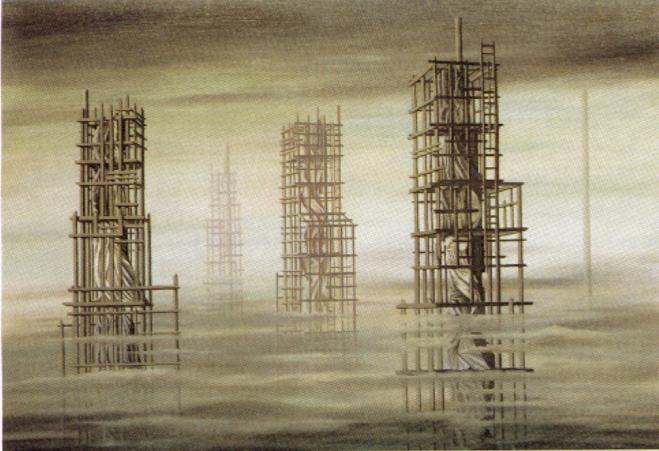
Etymologically an atmosphere is a "breathing ball". A circular room where we could possibly live and breathe. A bearable environment. A poetic bubble. The visualisation of this point where things can start happening, the sensorily tangible extension of the field of possibilities, the charged spatiality, is actually the alpha and omega of a substantial part of surrealist art.

 (CO Hultén)

 (Kay Sage)

Atmosphere in art

Historically it is entirely due to Chirico that atmosphere assumed such a central role in surrealism. Chirico was crucial for the direction of several of the pioneers of the surrealist adventure in pictorial art; Tanguy, Magritte, etc. But note also how strong this tendency is in some of the other immediate sources to surrealist pictorial art; Atget, Rousseau, Moreau. Or? In surrealist art, this is clearly one, but still only one, of the main tracks.

But in the beginnings of surrealism, literary sources were more frequently acknowledged and cited. Only through these we can say that atmosphere is a topic in the manifesto of surrealism of 1924. Of course concerning the image, in the already mentioned orchestration of Reverdy's thoughts and the cultivation of the autonomous and dynamic image, but even more with the launching of the specifically surrealist sense of the Marvellous. This is actually introduced with a discussion of the gothic novel and especially Lewis. So here we find support that atmosphere has an affinity for the gothic, for the fairy-tale-like, immense, occult, for romanticism, for grandiose nature and grandiose decay. But the early surrealists also took part in the exaltation of modernity, and not in its most plain and disgusting forms like the machine, war, the factory, commerce, money; but in its most profoundly and dynamically contradictory or ambiguous aspects. More than anything, atmosphere resides in certain zones where the gothic coincides with the modern in a dismissal of time, or continue wrestling in raging contradictoriness, of a kind actually becoming a lever for the spirit: natural science, the fleamarket, adolescent-boy-literature adventure, film, criminality, utopia, revolution. And of course not everywhere in those.

But we were still in the origins and constitution of surrealism. Equally interesting is to see how the "Chirico track" in pictorial art continued to be productive, and now finds two prominent representatives, magicians in staging such spatial scenery, in my own closest environment in John Andersson and Niklas Nenzén.

But also that other main tracks in surrealist artistic struggles has come to revolve in relation to the very same questions and mechanisms; psychological morphology – as it expressed the eagerness to abandon all the conventional (in the sense of art history) representation of projecting three dimensions onto two, momentarily framed selection, central perspective, middle-sized objects represented by contours and coloured surfaces; preferring an investigation of a realisation inspired by modern physics of an inner space beyond kantian categories and realistic school tricks, – also becomes atmospheric in how it associates to dramatic and threatening weathers and thereby atrmospheres in every sense of the word, and equally much by generating an ambiguity in scale and in the spontaneous interpretational efforts in spatial terms, staggering moving from microscopic worlds over oceanic and atmospheric systems all the way to galaxies, nebulae and other cosmic entities, and back again. Abandoning the compulsion to represent opens a manifold of possibilities, not the least in how we in the appropriation still expect representation, and spontaneously interpret by means of representing potentialities, and then since all unambiguousness on that level have been abandoned in the abandoning of the convention, the spectator is actually forced to real productivity in this sense.

Two modes of visions. Two classes of suggestions. And there are no sharp dividing lines. Not the least as the common usage of architecture as a structural element in the chiricoan tradition to raise a frame for the invoked spatiality to take place in, or between or beyond, also fills the function of establishing a grid addresing the basic questions of space through resembling the architectural organisation of the sponge or the coral, or the arrangements of vertebral columns on the submarine cemeteries. And not the least since the slowly condensating atmosphere becomes pillows of clouds and then a landscape of shrubs and crowns of deciduous trees and rocks and waterfalls (remember Gainsborough's tricks when painting a landscape!) and that particular uncanny opening in the forest. And the very creeping-thronging of organic shapes from here and there turns out have a growth algorithm and an interactive chaos factor, and is in itself a jungle as well as a simple city scene. We wil expect something to be coming down this particular street. The street vendors barricaded in the monumental flowerpots today are offering the ingredients of a completely new disease. What an absurd bathing suit, what an interesting sky of stars! It was for that reason the window was left ajar, but the rat trap remains suspended, while the neighborhood is quickly decaying and sea birds are recolonising.

But why are we talking about art? Atmosphere as a phenomenon is, just like other allegedly aesthetical phenomena, even more relevant for an offensive approach to life than specifically for art. Recognising, deepening, creating atmospheres in everyday life. Which isn't isolated from artistic activity. Maybe it is just a matter of what kind of artifacts one leaves behind. Pictorial art is one of several useful ways of generating and investigating atmospheres.

So atmosphere belongs in surrealist aesthetics, whenever the word aesthetics is taken in the wide sense necessary in order to not make surrealist aesthetics a contradiction in terms.

Surrealism keeps confounding morals and aesthetics. Refuses not to. Entirely focused on poetic effects and their deeper content and connection with everything else. Inseparable from a moral perspective and a whole-generating framework. The part which is actually subordinated is the formal, superficial, stylistic aspect – since this is merely the means of the particular individual, or the particular experiment, and couldn't have a central role. They are means for sensibility, sensibly chosen and sensibly exercised, regardless of whether experimentally or calculatingly, incidentally or insistently. The little tools of the spirit and the small ingredients in an alchemical recipe for conjuring an atmosphere. Not to be ignored.

And let's skip the discussion of the spirit here.

Yes a pictorial creativity with a core point in the sensible realisation of atmosphere generated by the presence and sensitivity of the spirit. A series of unheard of suggestions of bubbles in which it would be possible to breathe. Uncanny thought.

MF?


(Thomas Gainsborough)

Wednesday, March 18, 2009

NATURE AND ITS DOUBLE

Auch das ist nur eine Wolke

Art often looks organic. The analogies between the weavings of the human unconscious and natural forms have often been noticed and is indeed a longstanding theme among others in surrealist art.

For some, this analogy is a funny coincidence, for some it has deep spiritual connotations proving the human potential to tap into the springwell of the ways of nature, and for some it is an interesting field of investigating universal characteristics of morphogenesis. These can be approached by way of psychoanalytic/structuralist/phenomenological studies, or through basics of biochemistry and other chemistry, neurology, embryology and biological evolution; similar senses of architecture, analogy, cladistics, fractals, chaos, cybernetics etc apply both ways.

But we must consider also the differences, among forms of the unconscious, between those which really are mental images and those which are the chance products of gestural automatism, and among the forms of nature, between those which are products of genetically or structurally controlled growth and movement and those which are the chance products of large-scale or extremely complex processes. They may all be similar but the processes are quite different. In a sense everything is chance and even the most perverse planning struggles vainly to produce something substantially dissimilar.

For surrealism, this is indeed an older topic than surrealism itself. Take alchemy, which indeed established the concept of "art" as something involving the entirety of knowledge and the transformation of man and nature rather than a sphere integrated into the mainstream of social structure, be it majoritary or minoritary, central or detached, immediately utilistic or ideological-aesthetical. In alchemy, the ways of nature are to be intimately studied, imitated and also challenged or broken, in order to make nature reveal its secrets and for oneself, or rather the processes one is instigating, to become part of its fundamental workings. Presurrealist and late alchemist August Strindberg, in his text about automatism (which he himself practiced in painting and music rather than in the writing he became more famous for), advocated: "Imitate nature, sure, but imitate in the first place nature's way of creating!" At the same time, Strindberg's (and mine!) idol in evolutionary biology, Ernst Haeckel, a specialist in jumping to conclusions and defending controversial positions, who was working hard with replacing idealist superstitions everywhere, took this struggle - among elsewhere - to the point of publishing albums with beautiful shells, medusas, microorganisms etc, in order to prove how superior nature was, as art, to art!

However, even though the animals, plants, stones, landscapes and weathers are indeed often extremely beautiful and rich in connotations, ambiances and associations, and of course enjoyable in the same way art is (and certainly to a far greater degree than the majority of art!), this does not actually make it art or make it suitable to actually replace art, except in very particular senses or circumstances. Art is indeed still fundamentally about human experiments with the whole of the sensory field, with the whole of experience and knowledge, and thus primarily about changing man and investigating the conditions of changing reality. Natural objects are possibly not about that, and that is one of the many fascinating things about them, which indeed makes them useful for those very purposes too.

All the while, some of our output looks like unintentional creations of nature to the point of confusion (and are proud of it). The other facet of the same analogy is that certain natural objects and certain views of landscapes etc will seem obviously to coincide with a particular kind of poetic sensibility which we, for relative lack of imagination, may associate with a particular artists', group's or method's work. Though a creator in surrealism is just the tool of poetry, of a particular aspect of poetry, sometimes cultivated-incubated through long hard work and sometimes immediately accessible by chance, experiment or whim. That mediumistic experience is at the core of the surrealist experience. Seemingly it is not identical with, but has a close relation to, the experience of discovering the poetry in the natural objects, same - as poetry is in an important sense one and indivisible - and quite different in another sense. The categories of artifacts and natural objects will not confusionally merge, but the objects will meet and start playing with each other and with us on the arena of poetic experience, where their origins, and the often so ridiculous questions of the purpose or intentions behind them, will not be their most relevant determinations.

I am not talking here about natural sciences, even though a scientific or parascientific exotism and fetishism as well as a scientificoid methodology are often present in the way surrealists deal with the natural world, but only of the direct relation to the natural objects, the everyday-curious-amateur-enthusiast-naturalist approach which is the poet's. I have been talking elsewhere about surrealist zoology. Someone else will have to speak about surrealist botany and surrealist mineralogy. Surrealist landscape appreciation enters into the works with psychogeography and with this recent enigmatic concept of exteriority. Another popular habit among surrealists is metereology. Poets, dreamers, idlers, utopists and vagrants everywhere look to the sky, of course including the surrealists. Some organise in the "Cloud appreciation society". Not too long ago (2006), the organiser of that society, Gavin Preton-Pinney, published a popular introduction to the subject, "The cloudspotter's guide". It is indeed a rich book, presenting all the major types of clouds and their various conditions, and presenting a wealth of anecdotes and small explanations; physics, art and history of science, sundogs and Carmen Miranda sprites, the history of military research in weather manipulation, the story of the magnificent "Morning glory" cloud in Australia, the story of lieutenant William Rankin who spent 40 minutes riding up and down the winds inside a raging cumulonimbus on his parachute... Indeed, the book has a tiresome populistic rhetoric and keeps making elaborate excuses before every single time it introduces a scientific explanation, but the things it has to say are still so fascinating, and as far as I can judge solid, so all that whining can be excused, even by someone like me who really hates it, and I suppose for many others it will present less of a problem. In fact, there is much of the complex morphology, the morphogenic processes, and perhaps even the ontology itself of clouds, that seems to adress the very basic notions of surrealist conceptualisation of nature. For those purposes, it would indeed seem that further reading is required, but Preton-Prinney's book serves as a fine introduction to the field.

Clouds themselves are indeed a topic dear to surrealism from before surrealism. First of all we have of course Hamlet's often cited dialogue with Polonius, in which the changing shapes of cumulus clouds as projecting screens for images of the human imagination present the first clear illustration of the paranoic-critical method. And then in the immediate forerunning of surrealism, continuing into the middle of it, we have Arp's fantasies of the machinery of "die Wolkenpumpe", the cloud pump, and its products. Then in the middle of surrealist imagery and thinking, Magritte stands out as an enthusiastic cloud invoker, but there are also significant clouds in early Tanguy, in Dalí, we have Paalen's umbrella, Noguchi's sofa, the mists of Toyen and others, Bachelardian speculation, and so on. And many of us have already noticed with Dalí how clouds are among the elements of non-conventionally-realistic figuration in painting from earlier centuries, soft forms, to the point of incarnating phantoms and concrete irrationality. But nevertheless I put even more hope to the usage of clouds in speculations of the origin and development of forms making sense, the perverse science of what Haeckel called "Generelle Morphologie".

MF