Showing posts with label sexual politics. Show all posts

Thursday, July 9, 2015

A lighthouse of what?


Not quite already from its inception but at least from the mid-30s, surrealism has held forth actions of women amidst it and not just the bodies of women. And at least since the 60s, in many quarters earlier, many of us have been emphasising the importance of that shift, the importance of criticising a mere sexual optimism that goes all too well along with the continued exploitation of women as well as the commercialisation of desire, the importance of recognising issues of sexual politics in everyday life, and to develop new and noncomformist alleys of erotic exploration, and all of this in order to emphasise and deepen the emancipatory and exploratory potential of surrealism, to prove them wrong who make a career out of claiming surrealism to be fundamentally sexist, yet to remain vigilant of all complacency in these respects among ourselves.

Now, the Brazilian surrealists apparently want to put the clock back and ignore the insights of the last 50 years, and return to the good old late 50s when it was daring to use foul language and show nude female bodies, at least within high culture. In the recent, massive, issue #3 of A Phala, a massive part of the overwhelming number of pages are devoted to conventional female nudes, and a good deal of the remaining stuff is modern porn collages and nostalgic reminiscences of 1959 when the surrealists devoted the international surrealist exhibition to the theme of Eros (and managed to remain just a little bit more playful, a little bit more dark, and a little bit more high-strung than the rest of the optimistic liberal ”sexual revolution” disenveloping at the time). It feels more like one more of these fashionable coffeetable books of yesterday’s ”erotic photography” than a surrealist journal.


Female breasts, female breasts, stocking fetishism, female breasts, some titillating sadism, and some optical and geometrical distorsions of female bodies. This is just so stuffy, so nostalgic, and so utterly conventional, while many of us was expecting surrealism to be imaginative, radical, perhaps even intelligent and innovative…

Now, in these 2 tomes there are 93 pages of conventional nudes by non-surrealist photographers (yes, 93), most in 60s style by nude photographer André de Dienes (and including a number of optical/geometrical puns with nudes) but also by more recent standard fetishist Günther Blum plus some anonymous ones picked from random softporn mags and advertising, often placed side by side with Bellmer’s pictures (or occasionally Malet’s, Dalí’s, Molinier’s and Mariën’s) in a layout that is perhaps intended to show some continuity but mostly gives a pedagogic demonstration of the obvious difference: these ever-present conventional nudes have nothing particular to do with surrealism.

Then, of contemporary collage, which there is also quite a lot in here, and which is generally in a rather poor state, one can note that more than 50% have porn cutouts (recognisable female bodyparts, usually breasts) (so then I’m not counting Sauvageot’s classical nude statues who also display their breasts…) Wait, wasn’t a point with collage to show something unexpected? Considering that the abundant retrospective material in these tomes is also very much focused on the 50s sense of eroticism, and that a lot of the contemporary drawing, painting and photo has a lot of female body parts in it too, regardless of the fact that some of this art is in fact very powerful, imaginative or poetic; there is basically tits, and women in uncomfortable positions, staring at you from almost every spread as you flip through these tomes. So monomanic, so strange, so unexciting, so oldfashioned!

And from the more serious point of view: what a massive step backwards, to disconsider the entirety of emancipatory sexual politics, to still ignore women as subjects rather than just objects, and to reduce eroticism (which had a thorough dynamics in surrealism) to fetishism of the female body!

The editorial (short English version in the second volume) does indeed invoke the dark 50s of surrealism as an esoteric golden age. It does hold forth female surrealist contributions during the period, so they are not denied – but it is really a pity that they are not reflected in the editing, nor are any concerns connected with them…

There is very little if any evidence of an ongoing collective activity in Brazil among these pages (unlike the previous issue of A Phala from just two years ago), and in this connection a particular lack is notable of the remarkably many female surrealist artists in the country (eventually, three of them do eventually turn up with some pages of images at the very end of the two-volume work).

Some things within all these pages are obviously worthwhile: some documentation of recent activities in France, Canada and Portugal (while it is notable and slightly weird that the West Coast Surrealist Group is being presented as an active surrealist group, and that the American ex-groupings presented in the massive Invisible Heads anthology is presented as an active group too including new adherents), playful contributions from Recordists and SLAG, Merl’s important essay on mythology (circulated some time ago but for the first time in print), a bit of useful historical info on Sampaio, Cirlot and Malet, and several remarkable pictures such as Kathy Fox’s uncanny material Freud fantasies, Seixas Peixoto’s intense brutish drawings, Virginia Tentindo’s beautiful and hilarious sculptures with partly erotic themes, Enrique Lechuga’s strangely effective chaos/junk-collages (just to pick a few of my favourites) - others are probably very good too but either reproduced very poorly (so many small imagefiles have been blown up to fullpages and ended in blurred pixliness) or just too cramped up within this nostalgic sauna of tits to have a fair chance. Texts are of course mainly in portuguese and largely inaccessible to me (some chunks are in English, French or Spanish). Some very interesting poetic texts in English by above all relative newcomers Bill Wolak and Paul McRandle, well-known great poets Will Alexander and Beatriz Hausner, and relative veterans Ribitch and Graubard, are notable.

There has been a series of remarkable big anthologies of international surrealism recently: first came the small-sized but packed What Will Be from Brumes Blondes, the most inclusive of the lot but still well edited and with an edge; then the beautiful and dark La Chasse catalog from Montreal; after that the big Hydrolith #2, which suffered badly from a few really bad editorial decisions but also included very much interesting material (especially from Madrid, who don’t write in English too often), and now finally A Phala #3 where the scattered little pieces of interesting content are difficult to find in the 500 pages mire of bad editorial decisions…


MF

Hymenopteran pace


Just after I wrote the text about Peter Dubé’s anthology I happened to read a book of poetry by Swedish author Leif Holmstrand, which I had picked up at a secondhand poetry sale just for its beautiful title (”stekelgång”, which is the walk of a wasp, but also the wasp’s route, a wasp tunnel, and a wasp iteration). The author’s name was at most vaguely familiar. But the poems were beautiful and very fascinating. Just as I’d been asking, again, whether there are particular imaginational forms in the phenomenology of homosexual desire, this was now a powerful love poetry which focused on concrete sensual detail (which is metaphysical in the framework of love poetry) without pronouns and without explicit gender markers also in the bodily descriptions. Eroticism in a weirdly universal guise?
It turned out that the author was an established name in alternative side of the cultural market, quite active in sexual politics and famous as a ”queer artist”, and also a visual artist. While in visual art, this was mainly about ”addressing topics” and therefore usually not embodying poetic spirit, also the more recent poetry published was quite powerful and with a relentless poetic focus. Chance signs keep showing us many of the best poets when we can't be bothered to keep track of the literary field...
Paper wasp dismembering a stick insect

Tuesday, June 3, 2014

Madder Love


In surrealism it has been relevant to talk quite a lot about sexuality, but many of these discussions has a lot to benefit from paying attention to discussions elsewhere about it in the past decades. For example, the concepts of "queer" are a bit of a revelation to the discussion about sexuality, which highlight certain things that are innate in the dynamics of desire and which are traditionally addressed but in a largely intuitive way in surrealism. Thus, I think the conjunction of surrealism and queer is crucial nowadays. Queer theory and the queer movement have made explicit several issues that were always essential to surrealism, sometimes in a way which clearly deviates from the more surrealist potential of the topic, sometimes in a way that has radical implications that surrealism might need to learn as new. Surely, surrealism and queer are natural allies in the struggle against neoconservative-christian core family ideology, sexual obscurantism and sexual hypocrisy, and in the exploration of the vast field of possibilities beyond normality, convention and fixed identities. Many concerns are shared or analogous, others divergent or simply irrelevant to each other. At the crossroad of these various concerns, I think that Peter Dubé's anthology Madder Love, about the conjunction of surrealism and male queer fiction, is highly interesting already from highlighting the conjunction it claims to explore.

 
Dubé himself is the only author in the book with anything like an active involvement in surrealism and a good knowledge about surrealism, and his introduction is the only text in the book which is not fictional. It is not a surprise then that this introduction provides the most useful clues to the sense of overlap between queer and surrealism, being one of the texts in the book that felt most original as well as most personal; bringing up all the basic motivations and concerns and complications, offering the example of himself as a case study along with certain necessary distinctions and reservations. There are definitely many questions which are still just breached upon ever so lightly, but it is more easy to identify them standing out between questions that have been discussed. Dubé emphasises the way in which surrealism and queer both are faithfully founded in and emphasising desire, both as a point of departure in itself and as the arena or watchword for the transformation of the self and the world alike, processes that go hand in hand, and not the least through the cultivation of heterogenity and nonconformism, beyond conventions and against family, religion, law and order.
    Rather too easily Dubé admits and echoes any criticism of prejudices on Breton's behalf, though, as a surrealist, only to get on to the point that the radical core of Breton's thought lies elsewhere and is what matters in the end (many of these issues of prejudice are real and should be recognised, but the superficial and categorical form in which the accusations are part of art history "general knowledge" today are very misleading, and anyway primarily used as arguments against surrealism or Breton on the whole, rather than as examples of contradictions with particular historical reasons within the manifestations of surrealism, which may have planted some obstacles but hardly affected the general direction of the inner dynamics of the movement).
    One thing which Dubé does not bring up, as he bases his comparison on his personal example, is the fundamental ground shared between surrealism and queer on the theoretical level, not just through the emphasis on heterogenity and transformation, but on the problematisation (or deconstruction, if you will) of normality: there is nothing naturally given and obvious about what is considered normal, the normal is always just a chosen narrow portion of the spectrum of possibilities, which always has its specific causal origins, its specific historic circumstances, and its ideological reasons for being emphasised. Concerning sexuality and love, on the theoretical level, it was definitely Sigmund Freud that provided concepts and explanations for much of how this occurs. After him, surrealism investigated one level of the consequences of this, while remarkable empirical studies cementing the foundations were provided by enquiries as diverse as that of Alfred Kinsey and that of Michel Foucault. Nowadays, the more philosophical formulations by writers like Georges Bataille and Gilles Deleuze are very popular.
    Then the stories. Interesting, with good and bad surprises. Taken all together, neither answering my questions nor all that convincing. But still unusually interesting for a literary anthology, of course... Indeed a lot of the included texts were very readable, fun and enjoyable, but very few I percieved as immediately moving for the spirit, and most added little or very little to highlighting particular possibilities of the conjunction of the two terms of the theme.
    The exceptional piece of the book was Stephen Beachy's, which succeeded in establishing a very strange atmosphere in a loosely coherent odd world of certain associative connections that seemed a bit random but obsessive; an un-pre-meditated poetry emerging from the weaving of the fantasies, in a way that I perceive as immediately surrealist and trust as undoubtedly productive. There were some elements that were recognisable as traditional gay fetishes, but they seemed to be mere associations that had been internalised as parts of the rules of the games in the personal mythology governing this strange world, rather than identity markers or (sub-)cultural markers. The way this personal mythology assembled all kinds of elements that seemed unexpected or random to the reader but absolutely necessary according to the unusual inner logic of the story, gave it a certain "suchness" of the special kind usually found in outsider art...
    I also much appreciated the ambitious experiments of Tom Cardamone and Craig Laurance Gidney, who determinedly set out to investigate certain particular regions of the imagination – much more convincing in the beautiful miniature by Cardamone (an instructive exercise in bachelardian material fantasy), less convincing but commendable and fun in Gidney.
    Of the remaining contributions, though different in terms of formal/stylistic genre, and in quality, I was very surprised to see so much convergence. It just seemed to me that most of the contributions in the book were based in a particular approach in terms of method: they were all built on a certain kind of exaltation of memory fragments of sexual encounters, disconnecting rather than connecting individual strong images of strong sensual/sensory details, mixed with scattered stream-of-consciousness associations and with a battery of usually unsurprising metaphors highlighting the erotic content, musing over these memory fragments with an obvious feeling of nostalghia (often combining tough attitude with sentimentality), and with a definitive collage aesthetic, sometimes very filmic and sometimes more literary-proustian.
    Of all the different stories that I roughly group as displaying these characteristics, Dubé's own was the one I liked best, and it had a bit of coherence-generating mechanism going in the metonymical pulsating between the photograph and the memory images around it, with some strong and/or unexpected images providing flaring beacons. Others like the manneristic porn of Sven Davisson (or the softer variety of Shaun Levin), or the pretentious rhetoric of Jeffery Beam, and others, I was completely unimpressed by.
    Ok, Boyer and Killian do not conform to this at all, and were really fun, but it's not obvious to me what they have to do with either of the terms of the theme (perhaps it's just something I miss...).
    Nevertheless, this particular angle that I find so many contributions coming from, seems very Beat to me, and, like Beat, in general very urban, American, masculine, posturing, verbose, self-conscious, rather deliric, underground, streetwise, dirt-containing, sex-focused, at best lyrical, associative, sensuous; ok I see how this can be one relevant idiom for writing gay fiction. But wherein would the opening towards surrealism lie? The general points made in the introduction are relevant. But based on these particular examples, I see less of such obvious surrealist aspects. Ok, there is something that makes you think of Bataille about it all too. The themes of transgression, of erotic overdetermination, of expenditure, of celebrating low materialism. Is this the connection with surrealism? Bataille is a rich and ambiguous writer whose approaches can be used from very different viewpoints; a surrealist Bataille is a particular Bataille. (Swedish radical-conservative gay catholic anarchist publicist Bo Cavefors – a hero in his publicist deed but quite confused theoretically and politically – once wrote about the "cock" in Bataille's writings, and I almost wondered whether he had read Bataille at all, I know of few writers with so little "cock" as Bataille, who keeps on his eternal celebration of the wound, the pain, the abyss, the existential exaltation of everything before this abyss, the masochist vertigo of letting everything go but in the sadean manner of staying at the edge and talking ceaselessly about it, and thus metonymically if you will then perhaps the ass, but hardly cock...) And what about Burroughs? Is he an important figure in these connections or not? I was personally into industrial music before I turned to surrealism so sure, I'm an old fan, and I do see surrealist aspects of Burroughs, but far more in his paranoia, especially the paranoic-critical image transformation series (often with a certain focus on sexual images) but probably also in his mindboggling metaphysical paranoia, than in his "low materialism" or his eroticism. Beat is clearly not surrealism, and very few (such as Ted Joans) have managed to bridge the gap, Bataille was a surrealist but most of the contemporary use of his theories and of his name is from clearly other viewpoints than the surrealist one, Burroughs was not at all a surrealist but is relevant to surrealism if we emphasise the surrealist aspects.
    And reading the authors presentations (indeed a small section of the book) feels, admittedly far more than reading the stories themselves, as the regular bundle of common misunderstandings of surrealism, gratefulness for spontaneity and weirdness to have released a productivity in purely literary terms. Is it only the uneducated general public who still equals surrealism with Salvador Dalí, while younger people who are into culture nowadays usually cannot distinguish it from collage aesthetics in general, William Burroughs, David Lynch, John Cage, psychedelic indie, sexual excess, odd Science Fiction? and so will not be able to distinguish surrealism from any pop-culture extremism, or twisted beat-style, or western mysticism, or industrial music/extreme-goth aesthetics, or retro-modernism, or whatever they are already doing? And by distinguish I'm not saying it is some specific boundaries of surrealism that need to be guarded, but a distinctness in overall aims and above all atmosphere that can't be compromised without missing the point, perhaps above all the trust in poetry to emerge from the unknown...
    But I really wonder, this particular pattern that I've been seeing in the stories, is it something significant of a common strain within the established field of "gay fiction" in general, or is it on the other hand specifically what writers in the gay fiction scene come to think of when they think about surrealism? Is it what they usually do, or is it a specific phantom that has emerged? Of course, I'm quite clueless here as I don't really have a notion of what is going within this gay fiction field; surely an established field, it surely has a bunch of conventions and a bunch of inner contradictions and a bunch of diverging or aberrant tendencies... It makes me really curious as to how the anthology was assembled: were the individual works themselves chosen, or a certain number of writers invited to contribute whatever they chose, or was an invitation circulated in a wider circle?
    On the other hand, much of my consternation with this material may have little to do with the particular context, and it may be various things that I feel baffled about merely since I read very little contemporary on-the-cultural-market prose whatsoever, and this is perhaps the only anthology of contemporary short stories outside the surrealist movement that I will read this decade... It is not just propaganda but probably very often true when the surrealists say that it is easier for "ordinary people" to grasp and practice surrealism than it is for people who come from cultural circles. Surrealism is dependent on that particular abandonment , that particular break with the concerns of the literary purpose. Otherwise it'll easily become mere exercise in style, perhaps focusing on nostalghia for a particular Paris interwar sense of urbanism and adventure, which easily becomes a facet of postwar American beat sensibility...
    Yet, in the restatement of the existence/potentiality/urgency of this particular field, and perhaps also in the unseen atmosphere ripe with fetishistic constellations of an opaque personal mythology in Beachy, and suggestions of certain particular movements of the imagination in Cardamone, or emerging from a distance after having read and reacted to all the text on the petty level of being texts... a reply of sorts, after all, to my questions, or kindred questions.


M Forshage

Thursday, May 19, 2011

The image, collage and eroticism

The Madrid surrealist group sparked a well-needed discussion within the movement about the function of the image, a discussion which nevertheless coagulated in a polarised situation, where the simplest sensible statements may seem like major revelations against the background of some of the polemical simplifications reached.


So, one: let's not shy from critically looking at the ambiguous function of the image, but two: let's not jump to totalising rational conclusions which go against the poetic dynamism of our project. In fact, the conclusion that the image is after a certain point in time completely a vehicle of oppression is just an expression of a certain figure of dynamism in thought which combines a deep longing for total pessimism with a deep anti-empiricism and a complete faith in discursive reason, which are typical for a certain major 20th century french thinker named Debord and constitutes his perhaps most seductive and most destructive side as well as his personal twist to the most distortable aspects of Hegel's philosophy.


What maintains a poetic content is not decided by reason but by poetic phenomenology. It works or not, simply by the capacity/probability to establish a particular kind of dynamic relationship with an inflammable mind. Subversive content on the other side is a completely different thing. Even more, it too will consist of its potentiality and be tested only in hindsight, but it will be investigated by careful assessment of the relationship between the temporary objective conditions and the psychic dynamism of the content. Thus: will not be a matter of principled beforehand certainty.


Let's compare with an analogous case; eroticism. Let's acknowledge how the Frankfurt philosophers, some poststructuralists and various brands of radical feminists demonstrated in the 60s that the then so-called "sexual revolution" was a sham, a partly commercial and partly ideological development, and that contemporary eroticism, definitely in its public exposure but also in its domestic applications, was indeed used as a force and a vehicle of psychic oppression and of human hierarchies, injustices, bondage etc. Nevertheless, only a very small minority concluded that this means eroticism has inverted its historical meaning and must from now on be abandoned. There was still a whole lot of human aspirations and human sensibility which needed to be expressed in the field of eroticism. And which managed to do so in places where such actual necessities were distinctly stronger than the contemporary conditioning.


But let's take a step back here and talk about something else: Art production in surrealism. There is in fact a whole lot of bad art being produced in the name of surrealism, even by the most honest adherents. And why not? Typically, good and bad art is not the primary concern in our activities. We all produce images as products of the collective poetic investigations which lie at heart of the surrealist adventure. This is a means of investigation, of inviting chance and objective poetry, of exercising some of our means of imagination and sensibility. It is not necessarily good art. Well, it is in a sense, since we can expect it to betray an honesty, playfulness and investigative spirit that will look fresh in comparison with much of the nervously or cynically careeristic bullshit of the professionals and wannabes. But this argument is polemics not proof. It only says that a great part of creativity outside the narrow confines of official art is of course better art than a lot of what is produced inside this sphere with its prestige hunt, cultural trends, conformity-teaching art schools etc. This is obvious. But generally it means that the hierarchy which places official art above non-official art is invalidated, not that it is thereby automatically inverted, which is a completely different thing.


So from the earliest days of surrealism there was an obvious, and valid, point that the results of our games are often better than the oh-so-seriously manufactured oeuvres of who want recognition as artists. Nevertheless, that simple polemical point is not always the most relevant aspect, and doesn't mean that what we do is necessarily valid also in comparison with recognised art. Often one gets the impression that surrealists circulating some mediocre results of experimental investigations as artworks perhaps resort to some aprioristic reasoning of this kind. When not faced with any actual criteria, the grounds for evaluation very often again becomes frenzied voluntarism, identity politics, ghettoism: and in the end the grotesque over-evaluation of conscious intentions and opinions of the artist over real manifest poetic dynamism of the work. Who's done it and what aspirations it can be seen as having come out of, not what it actually contains itself and what it has the potential to produce.


And, I would say, this becomes acute especially in collage. Everybody can make collages, which is one of the things conditioning their very attraction from the surrealist point of view. But playfulness, openness to the dynamic paths of chance, or particular sensibility, is necessary to make collages that go beyond what we've already seen, to make the new combinations into real suggestions for the imagination rather than mere variations. We accept hundreds of collages as passable for quite superficial reasons. This could be because they remind us vividly enough of classical collage of Max Ernst or others, and may possibly create a fruitful ambiance in the tapping into that very world, or because they are effective simple puns. Another possibility is that they look interesting because they include single elements that are visually forceful and stimulating to imagination on their own, such as animals, body parts, certain landscapes. And here I'm not talking about the more "brut" type of collage where beloved objects are kidnapped and made into worshipped fetishes with mythological qualities, and therefore not standing on their own but in fact stand out in their new poetic functions as integrated into a living personal mythology. No, what I refer to is those more traditional casual collage compositions whose visual appeal rely solely on a particular beautiful integrated object.


So, in neither of these cases the collage itself has really managed to create something. But still, they may be, in some sense, good collages. Far worse are those that are mere vehicles for quotations or allusions to emblematic components in the surrealist tradition. A little Breton or Lautréamont or Magritte, or the titles of their famous works. Indeed variating the contexts and constellations entered by such emblematic elements is a mechanism of selfmythologisation, which in this particular form more than anything else fulfills the function of identity politics, of reinforcing a canon, and strengthening the identity of belonging to it and the mutual recognition of those who have chosen to do so. And usually completely uninteresting on the level of imagination or poetry.


In my opinion, it sometimes gets even worse. And, to start tying threads together here, I'll claim that erotic collage is the worst. As a lasting theme in surrealist art, eroticism did have a peak in the 50s and 60s, and since then, I could claim (at the risk of upsetting some friends) that erotic surrealist art has been weak on the whole (anyone digging deep enough will find some exceptions, of course). In erotic collage we see the most obvious examples of creators feeling fully content with having put together a witty or fully banal sexual joke, or an artistic excuse for an exciting nude portrait or a mere bodypart. If erotic elements naturally draw our attention for biological reasons, and even more so due to the conditioning from the commercialisation of the erotic and the erotisation of the commercial, it seems like their uninspired use in art is itself a mere recognition on the artists' behalf of that uninteresting capacity of such images and the further conveying of the same function in a slightly altered context of the artists own, without the integrity to transform them into something different, something related to the unknown. Marcel Mariën's work is perhaps emblematic for this, largely consisting of a boyish "daring" complacency with crude sex jokes, the banality of which is only occasionally overshadowed by their entertaining silliness.


Then, drawing is, in my experience/opinion, not in an equally poor state as collage. Drawings too range from often inconsequential large quantitity exercises to inspired or unexpected real poetic visions. But an uninspired drawing still needs a little effort, a little imagination, probably far more than a bad collage. The sexual component has different implications too. Resorting to sexual puns and ever-returning genitals in drawing is less a further-conveying of a conditioned overexposure, and more of a recognition and interpretation of a particular element in ones actual creative processes – an interpretation that may perhaps often be a somewhat hasted rationalisation (turning certain shapes into genitals instead of letting them remain in the uncertain to see if they will transform into something unexpected), but it is far from a lack of or belying of real imaginative content. It is returning it to a possible source quickly, which is not untrue to it, just missing some other possibilities.


If we should in some connections take care before releasing images, without adhering to a ban on pictorial production, we should at least especially think twice before disseminating poor collage (which devaluates our intentions) and superficial eroticism (which objectively takes place in current ideological and sexist offensive against women and against emancipatory potential of eroticism). It's worth trying, but it's worth trying not as a concession to purely external concerns, but rather to halt and make sure that our attempts are in fact objectively different from the trash noise they will take place in so that they will actually retain some subversive potential.


M Forshage


(Sex joke – rather funny)

Friday, February 26, 2010

feminism and fence posts


There has been a certain amount of discussion around the recent Manchester exhibition of surrealist artists "Angels of anarchy". Kenneth Cox of the Leeds Surrealist Group has written a good and interesting piece of criticism posted here. I must note that most of Kenneth's observations and several of the points he makes are ones that I'd have liked to make myself; the old mill of internal discussion went slowly as it often does and it seemed somehow reasonable that I'd fail to write a huge criticism of an exhibition I had not been able to go and see myself. But there are also some points I'd like to raise in the context, which are not criticisms of things expressed in or necessarily implied by Kenneth's text, but clarifications and modified emphasises I'd like to make to the surrounding, implicit and issuing discussion of these issues.


Kenneth takes this as a pretext to restate surrealism's case against those academics that live off it. This is not new and not very exciting but it is perfectly legitimate and potentially informative to pull it when getting access to a particular new forum, as it seems to be in this case (and sure, uninspired polemics, even on this site, often takes the shape of repeating long available metacritique that remains valid against all kinds of new attacks as long as they are unimaginative and predictable). But the superordination of that particular aspect seems to imply an assessment which I'd like to point out could turn out differently. I mean, what actual power does the academic or artlife frame has to actually disarm and neutralise the subversive content of surrealist painting? Can't the remarkable artworks just as well falsify the ideological framing in the presentation rather than the opposite? Here, Kenneth remains open to this possibility but still emphasises the negative view.


But connected with this, what power does the actual discourse of curators and academics have to neutralise the actual questions they're adressing by presenting ideological answers? Don't they continue to itch, spur and challenge people's own thoughts and potentially provoke individual radical conclusions, regardless of how ingeniously they are raised in the service of an irrelevant, domesticating or parasitizing rhetoric?


I also cannot let go this occasion to readdress the relationship between surrealism and feminism. In this, I am not specifically addressing standpoints made in the text: Kenneth does not put the two in any necessary opposition nor denounces the latter as such. But as this is an old discussion between ourselves and the Leeds group, as well as between others in the surrealist movement, I will repeat some arguments. I certainly agree with the actual specific critical points Kenneth makes, but I'd like to emphasise that this critique of particular strategies among feminists does not imply a dismissal of feminism but could be equally valid from within a feminist framework. There is also the possibility that misunderstandings arise due to semantic questions not just as products of different political experiences but of actual historical differences between the women's movements, and the labels its different branches utilise, in different countries. I am here employing a very broad sense of feminism (further explicated in the following).


If we immediately consider a real opposition to the struggles and aims of the women's movement as obviously absurd and antisurrealist ("there is no such thing as partiarchal subordination or injustice between the sexes anymore" or "there is nothing wrong with a little patriarchal subordination or injustice between the sexes"), there are still a few not uncommon ways of expressing strong reservations against feminism among some surrealists.


One is the ultrasituationism of considering "feminism" as necessarily an ideology and as such necessary diametrically opposed to the struggle of women and to any emancipatory struggle. Such paranoid apriori-assessments is not what we need in surrealism. If we consider what feminism is, it is a very broad international cluster of different groups struggling in different arenas, with different methods and with different political perspectives but largely united against structural injustices, against wage differences for men and women, against violence towards women, against confinement to family-raising and household chores, against everyday depreciation of women's desires, opinions and interests, against sexual coercion and manipulation, against patriarchal ideology, against prostitution and pornography industries, etc etc. Some of these questions are even more straightforward than others, and they will all be given different emphasis in different foci of struggle depending on the historical particulars, the class base of the activists, the local experiences, the general level of democracy, the social structure, and the intensity of other specific confontations and general class struggle. Indeed some people will toss up an ideology based on it, and indeed some people will make a career out of it. But does that make the actual questions, and the actual confrontations brought about by addressing them, less meaningful? Does that mean that the entire field is contaminated and must be abandoned and never spoken about again? I do not think so. For example, we didn't abandon surrealism in the face of an overwhelming international opinion knowing it to be an inconsequential direction in art, as it has repeatedly been transformed into by individuals making ideology and carreer out of it...


The second line of reasoning that would make it meaningful to dismiss feminism is the generalising argument; since we are in favor of the emancipation of all humanity it does not make sense to support the emancipation of a partial set of humanity. This is indeed principled ultraradicalism to the point where it becomes entirely abstract and apolitical. First of all, excuse me a simple analogy; because we are in favor of the emancipation of all humanity, we couldn't give a damn about the struggles of immigrants, of blacks, of children against their families, of the sentenced, mad and troubled against the institutions confining them, of the insistently imaginative against forces censoring and disciplining them, and we would have no interest whatsoever in the action of the working class? That does not seem to go well along with surrealism as hitherto manifested. Any political reasoning will want to identify questions and fronts of struggles which have a potential of organising people and help them to take action against the current order in any way which seems temporarily or generally effective to radicalise people and deepen conflicts and eventually claim actual progresses and victories. Even if we refrain from the sectarian left's beloved game of betting on for example various states and national liberation struggles as potential strongholds against imperialism, it seems obviously meaningful to somehow support (rather than speak against) the most obvious broad currents of resistance, reevaluation and challenge of the current order in our immediate environment, based on an spontaneous solidarity as well as an assessment of their general direction and particular potential rather than necessarily on a complete agreement with their temporary forms of organisation and positions.


It just doesn't seem to make much sense to us for a surrealist not to be a feminist. As we pointed out in a recent addressal of the question of surrealism politics issuing from Leeds, we do consider feminism one of the most immediately relevant fields of current political application of surrealism.


And, a flawed, poorly informed and ideologically pointed presentation of female surrealist artists' works, and a flawed, poorly informed and ideologically pointed addressal of questions of the conditions and conflicts surrounding women's voices, creativity and participation in emancipatory movements, have a great potential of sparking fruitful real experiences and real thoughts and is therefore not just better than silence but actually very welcome from a strategical perspective too.


M Forshage


Thursday, November 5, 2009

On the shoulders of giants

I always figured that the old scholastic notion of "standing on the shoulders of giants" was a way to describe accumulated learning and express an indebtedness towards tradition. On closer inspection, though, there is no lack of written sources that belie this metaphorist interpretation. Isidore of Sevilla - to name only one - informs us that "just as, in individual nations, there are instances of monstrous people, so in the whole of humankind there are certain monstrous races, like the Giants, the Cynocephali, the Cyclopes, and others." In his Etymologies, in which he attempts to collect all the knowledge of his age, we find peoples in the most varied sizes with organs redistributed in the most striking fashions. Faces on the stomach, a one legged people habitating distant parts of the world, asians without noses - the variations of medieval man shames the monotony of the contemporary human body. And to still think in metaphors? What a cretinizing way of turning flesh into mere words.


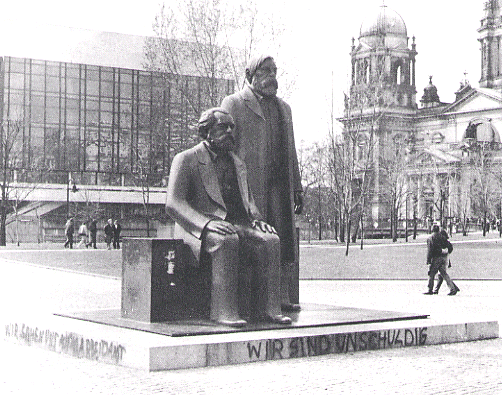
East Berlin worked as an important corrective to such lifeless abstractions. During our trip, M and me went to visit the Marx-Engels Platz and were confronted by the gargantuan stature of earlier generations of men. Standing on M's shoulders, I still would not be able to reach the head of Engels. One of the virtues of socialist realist art is how it expresses material truths through scientific-aesthetic techniques. Instead of "translating" Marx and Engels into men of a present-day size, it lets us experience the wonder of human variation. The finger nail of a 19th century man is the size of my palm! His feet like my thighs and his torso the thickness of a recycling igloo. Instead of trying to comfort us by making dwarves of giants, the sculptor forces us to take stock of both a historical distance and the slumbering possibilities within our present, cookie cut limbs.


Confronted by these statues of the labor movement's great thinkers - as well as by the nameless workers of a similar height that surround the Platz - one understands the urgency which must have inspired works such as "The Housing Question" and the investigation of the living conditions of English workers in that island's great industrial cities. I cannot begin to fathom how those early-industrial giants managed to fit into apartments smaller than those we live in today. After a 12+ hour working day, they had to crawl their way through narrow corridors only to be forced into fetal position, packed like herrings in what passed for a home. The ever new editions of Swift's Gulliver's Travels (a perspective that is often lost sight of today) - what a clever intervention into the great 19th century struggles over social space. The books - no larger than today - must have been the perfect size for a worker to build his own coat library.


But however remarkable the size difference is, what really got our attention was the variations in the actual composition of the human body that the statues hinted at. Specifically: the genitalia of giants.


Concerning the crotches of giants


Socialist Germany apparently tried to make a clean break with bourgeois sexual morals, at least when it came to the variations of genitalia over time. I was aware of how the introduction of a "two-sex" system replaced an aristotelian performative-misogynist theory of sex with a biological-misogynist one in the early-modern period. But just as the political ideology of the day tends to reduce (political) history into a teleological story about the progressive realization of representative democracy, I have taken for granted that today's sexual organization has been present - at least biologically - throughout human history with only slight variations. Changes, even revolutions, in sexual practices, family structures and theories of reproduction and pleasure - sure! But the biological "substrate", the actual genitala, has always seemed to be an invariant which the purely social variations connects and disconnects to in different ways.


The findings of historical materialism tell us otherwise. Because the German artists where not held back by prejudice or political agendas, they could represent the genitalia of our predecessors without resorting to mystifications. The representations, limited to Marx and Engels, are however very limited. I only wish that they had been accompanied by Luxemburg or some other woman - if that is not an altogether too inexact expression - so as to give some kind of hint as to the extent of the variety of genitalia (and other organs) in those early days of the labor movement. With this limited selection in mind, this is what I managed to observe and deduce about the genitalia of giants:


Marx' genitalia corresponds closely to what is referred to as a "penis" today, at least as far as I can tell. The artists, though working with scientifically developed techniques, were not primarily interested in early capitalist anatomy but in creating a homage to two very important theoreticians of the labor movement. Thus, they are both clothed. I do however get the feeling that the sculptor is making a point of the mentioned correspondence by giving the author of Capital a slight erection that shows through his cast iron pants. Apart from his extraordinary size and immense muscles, he is eerily similar to you or me. (A small note: Marx is depicted as sitting, which hints at the possibility that the "boils" that he presumably got as a result from long hours at the British Museum might be a code of sorts.)


At first glance, Engels seems to completely lack sexual organs. But as you move closer, you see fine silver threads extending from his absent crotch towards other parts of the statue as well as to its immediate surroundings. The "web" hosts a number of small black and brown organs that only connect to the main body by those thin milk-like threads. The organs have eight jointed appendices. As far as I can tell, their function is to allow the organs to move along the libidinal strings when the slightest vibration signals the presence of a potential "sexual goal" (to borrow a term from Freud). One of the organs seem to limit its movement to a triangle formed by Engel's ear, collar and shoulder. The threads in the triangle are particularly plentiful, and the density allows one to spot certain patterns in the seemingly anarchic way in which the lines of communication are drawn. Recording and shivering at the slightest tremble in the strings (they are made from some kind of extremely elastic bodily fluid), the organ moves back and forth in the triangle but always to return to a site at the statue's ear lobe. From this base of operation it whispers into the seemingly attentive hollow just above it.


It would be easy to see a certain tragic dimension in this neverending murmur into the ear of a mere representation of man, and the connected rythm of frantic activity and motionless wait of these caressing-communicating organs awake a suspicion: they may not be part of the statue at all. What if this residue of sexual organizations wiped out by the enforced primacy of reproduction ("normality" in the technical sense defined by Dr Freud) somehow managed to survive, attempting to form symbiotic bonds with new bodies? Trees, signposts, window panes, dreaming animals and humans? It must have encountered several difficulties: the unresponsive window pane which refused to stir even when told about the most delicious connections made, the animal suddenly awake - unaware of the perverse possibilities offered - might shrug, move a bit too violently and undo an entire night's labor of love.


But to find tragedy would likely be no more than a relapse into anthropocentrism. It would be presumptous to assign consciousness to such organs, at least any remotely similar to our own. Rather than a project leaving a trail of heart breaking disappointments, it might be better defined as a constant attempts to attach and calibrate itself to more than a century's worth of potential hosts. Then, finally hitting on the very forms and proportions of the host it has attempted to replace, it finds a certain functional "contentment" in the replica of a man. In a reversal of the way that the dreamer's hand searches for and finds its crotch, the organs searches for and find their resting place.


Freud may have kept clear of biology when formulating the object of his science for obvious both practical and theoretical reasons. The "limit"-concept of "drive" is a practical demarcation necessitated both by differences in method and the actual structural conditions of the psychic apparatus (which appears to be dissimilar to those of biological science). This construct of strings and miniscule organs seems to allow for sexual activity in the forms of caressing, strangling, exploring, corresponding. Such functions are not unknown to psychoanalysis: on the contrary, they are perverse elements present in all kinds of sexual organizations and the building blocks of the pregenital configurations. What is striking though, is that the variation of sexual organizations that today are confined to the psyche are here given an immediate, physical form. Engels' libidinal web is highly original in both its relative autonomy towards any given body (both in its ability to make and maintain connections and structures whose connections with a body can be disconnected and reconnected according to chance and optimizations of functionality - and in its ability to if necessary change host) and in the functional, more or less immediate correspondence between biological and sexual organization. While the tongue or the dick or the cunt today varies its significance according to the demands of the psyche (within the material boundaries given by its physical shapes and capabilities), the libidinal web might be proof of a period in human history when this variation rather than shifting significances and practices was actively remolding and reforming organs according to the demands of desire.


This obviously has a great significance for the historical validity of both anatomical studies and the present configuration of the psychic apparatus. A more modest area of research might be to analyze in what ways these arcane strings and organs of Engels' are connected with his great communicative efforts in the service of the labor movement. Is there a connection between his immense web of correspondents and confidants and his immense web of delicate, ever growing milky lines? Or between this elastic secrete and his preoccupation with proteins in his Naturdialektik and Anti-Dühring?


PS. It might be noteworthy that the sculptor's arrangement with a sitting Marx and a standing Engels is reminiscent (or possibly the other way around) of Max Ernst's Capricorn (also present in Berlin at the time); compare ME & M&E.

PS 2. We might owe much more than is readily apparant to our gigantic forefathers. Take wages for example: Marx himself tells us that the wages of the working class tend towards a level where it can simply pay for that which is necessary to reproduce its labor power. But he also tells us that that which is considered "necessary" is to some extent decided by the culture and traditions (and demands of capital) in any given society. This "inertia" coupled with the likely very rapid shrinking of man during the few generations leading up to the 20th century might very well have produced a favorable situation for a number of generations. The level of wages was decided with the physical needs of immense bodies in mind. So, as the bodies shrank, an ever greater part of the wage could be used for other purposes. Imagine the riches available to a working class the size of rats!


Appendix 1: City planning as class struggle in the sphere of anatomical science.


Living on Rosa Luxemburg Strasse, we visited her Platz in the belief that we would find a place of a similarly thought provoking nature. What we found was at first glance very disappointing - the most boring kind of conformism. The genitalia is as present in the activities of the city planners of Berlin as in the preoccupation of artists: it might have permeated the whole intellectual life of those days and produced unforseen effects in the most diverse fields of work. But the contradictory ways in which we find it at Rosa Luxemburg Platz might force us to reevaluate the perhaps all too one-sided, positive way in which we appraised the tendency's presence in regards to Marx-Engels Platz. For where the artists seem to have made a clean break with narrowminded prejudice, the city planners seems to be trapped in it. This should be obvious from a schematic overview of the place: a triangle, and under it two orifices. And as an unwelcome bonus: in the triangle (representing pubic hair) an advertisement for a "Hooters" restaurant near the Zoo. Thus, the present rulers of Berlin try to humiliate the dead, as if to say: "Go ahead workers, suck on the teets of the dead sow of insurrection." Depressing, really, until M points out that their order might very well be built on quicksand - or paving-stones.


For in contrast to the surrounding streets, the triangle is made of cobble stones of a size suitable for throwing. Having thus exorcised the feelings of defeat, we realize that just as the triangle differs from what you might find on a police woman so too does the orifices. Not only eggs, urine and shit, but a whole system of tunnels spanning a city of millions. One might be tempted to make use of one of the pet problems of Trotskyism: how do we define the "socialist countries": As "degenerate workers' states"? As "state capitalism"? And what forms do class struggle assume in such social formations? A triangle and two subway entrances may give us an idea of how one aspect of this struggle took shape in the fields of urbanism and anatomical science. Within the confines of the given order, the primacy of reproduction and sexual conformism is mutated; someone (perhaps a sleeper agent from Sex Pol? Hard to imagine that Reich's comrades would all just disappear or abandon their common project) makes pubic hair take part in the preparations for a renewed insurrection, and develops the two-way street logic of orifices into a ever-growing series of possible destinations. And, ironically enough, enlists the unaware city planners of today in forever expanding and modifying these series.


Appendix 2: Die Toten Mahnen Uns: Michael Jackson, the Paris Commune and the Beach Volley Ball of Reaction.


(to be added)


/Erik Bohman

Wednesday, December 24, 2008

To the question of surrealism and women

polemical

No doubt the question about surrealism and women is not one but several questions. A widespread academic view, which was very popular in the 80s and still is to be seen in many places, is that surrealism is unambiguously misogynist, which shows both in the works of surrealist artists and writers, in their temperaments, and in how women have "been treated" in the surrealist movement.

Others are capable of partly separating these different questions and imagining alternatives; in terms of ideology and ideas, are the aims of surrealism misogynist, passively sexist, naïvely wellmeaning or radically antisexist? what about the imagery, the fantasies, the mythology and the creative tools? what about the organisation and daytoday practice? and in terms of practical frameworks for real women; is it primarily disciplinary and isolating, or primarily revealing, inspiring and contact-knitting?

That old academic standpoint, the misogyny thesis, might perhaps not be that hot at many universities anymore, but remains a consensus in many places where it is mostly repeated by teachers and newspaper critics and others whose job it is to have opinions without investigating the matter. Several current academics have moved on to more fruitful lines of enquiry.

The tendency among many sympathetic academics and critics, as well as many surrealists themselves, to regard this standpoint as absurd and not confront it, is unfortunately indistinguishable from the outside from not regarding the question as interesting or legitimate, which indeed would be a case of ongoing sexism. While other sympathetic commentators have formulated different views, in general terms or in case studies of single historical surrealists, and the surrealists have usually dismissed the critique as reactionary and careeristic, and slightly more rarely, openly discussed the questions themselves. Our most important sources here, at least in the english language, are Nancy Joyce Peters's benchmark essay "Women and surrealism" in Arsenal #4, 1989, and Penelope Rosemont's bulging anthology Surrealist women of 1998 (also including the former; and indeed a necessary read for anyone who wants to approach the problematics, and who wouldn't?).

In these sources, the deeply-felt and well-argued defense of surrealism as a radically antisexist endeavour in its aims and methods is combined with a certain propagandistic eagerness for legitimation including a reluctancy to adress many complicated questions and admit any weaknesses or faults, at least regarding modern activities. The achievements, the consistency and vehemence, and the poetical and theoretical qualities of the works of women surrealists are very consistently praised in Rosemont's anthology. In this book, all women are intelligent, original, strong and sensitive (while it is attacked as totally irrelevant when Whitney Chadwick and other academics mentioned their beauty). All writings of women have remarkable poetic power. Every woman who ever wrote an article, regardless of the subject, is an important theorist. Every woman whom we don’t know anything else about than her name under a single isolated text is an important comet in the movement and a major mystery. Every woman who is repeatedly present in the source material is one of the movements' leading organisers and militants. This lack of objective assessment is obviously a conscious propagandistic choice, and certainly a minor weakness compared with the great merit of holding them forth and making them visible and available in the first place, but nevertheless something that might prove counterproductive in that it might make us refrain from posing certain critical questions.

Now some of the questions are in fact available for investigation with the crudest empirical methods. Rosemont has counted the women contributing to journals and exhibitions for each decade, but for some reason she does not seem to have counted the male contributors in the same way to be able to make a comparison. She has not studied any other comparable (whatever that should be) movement to establish that their share of women is actually smaller. And she has not taken the step to ask women who are not longer active in the movement why not.

While the academic standpoint is not just a rather poor standpoint, but very often this specific feminist-surrealismology is a rather poor strand of research, in most cases (with some notable exceptions) resting almost entirely on secondary sources and very little on original empirical research, the only effort involved being that of "critical reinterpretation" which all too often just means a comparison with another preconceived ideology and, even worse, imagining how historical women "must have felt" according to some standard popular psychology and an obvious lack of imagination and lack of understanding of the phenomenology of life in a radicalised context.

historical

So let's once again cast a glance down the decades of the history of surrealism. From the outset, it is no doubt that there was sexism in the surrealist environment and examples of it can easily be found. Even Rosemont admits this, but, as she argues too, one important question here is whether there was more or less sexism within this environment than within society in general (probably far less) or within other broadly vanguardist movements (probably less than in most, but perhaps more than in a few). In spite of this manifest sexism, there was obviously something attracting women in this environment since they in fact gathered there.

So what did 20s women look for in a vanguardist social circle such as surrealism? Some suggestions:
a) collaborations and mutual inspiration in their creative work
b) careeristic networking, from recognition/coaching to concrete publication and exhibiting opportunities
c) a general sense of adventure and play and intensified life as opposed to available lifestyle alternatives and capitalist society in general
d) friendship, entertainment and fun in an innovative and radical environment
e) particularly intelligent, creative and radical male partners.

The feminist-academic critics here usually believe that women came looking for a) and b) only, which were supposedly denied them, and so settled for e) as an alternative. On the contrary, I would guess that all these five alternatives have been important, for many integrated into a sense of general curiosity-affinity, for others clearly focusing on one or the other point, sometimes even explicitly (quite obviously, a) and c) are the motives which make more sense from a surrealist perspective and would be expected to be the dominant forces driving the most engaged women in surrealism). It cannot be denied that many women of the so-called "liberated" varieties; dropouts and weirdos, frustrated heiresses, widows and rich-man's-daughters, communist activists, artists of all kinds; in fact were attracted to surrealism.

During the 20s, their role in surrealist life was largely a significant but not significantly acknowledged one. Within the surrealist environment, everybody writes and draws more or less, at least as part of games and experiments. And texts, drawings and collaborations by women do appear in journals and exhibitions, but not regularly and their contributors are obviously not considered equally important as writers and artists as many of their male friends. Even more significant, the regular signing of tracts and collective declarations, one of the rituals keeping the surrealist community together, is not done by women at all during this decade; obviously they are simply not officially recognised as members of the group.

But as the journals show, and as Rosemont and many others argue, their contributions are significant and in no way confined to being muses and lovers, which the feminist-academics claim are the only roles assigned to women in surrealism. In the pictures of the 20s surrealist group, Simone Breton (Kahn) has a central position. She was one of the main activists of the group and, with a talent for typing, also a sort of secretary. (This voluntarily adopted role seems like an early resignation to a traditionally feminine role, but I am not sure how much of a standard role the female secretary actually was at the time, and it definitely ascertained her place at the very center of the group.) Her cousin, Denise Levy (Kahn), did not live in Paris and so wasn't a part of everyday life in the group, but a very important correspondent as she spoke fluent german and so was the mediator of a lot of german litterature. Of other women in and around the group at the time, Nancy Cunard was an organiser type, Lise Deharme an independent type, Fanny Beznos and (from the south) Valentine Penrose had an ongoing poetic production internally fuelled, while in many others their participation in games and contribution of texts and artworks seems perhaps a little more passive and more a product of their being around for adventurous, social and romantic reasons (but often no less serious and sometimes even important contributions still); Renée Gauthier, Suzanne Muzard, Gala, Nadja, Jeanette Ducrocq and many others. With these, the feminist-academics are entirely right that they were not recognised and encouraged as artists by their fellow male surrealists, but the reason is simpler than misogyny: they were not recognised as artists because they were none in any other sense than their participation in the shared creativity.

And the situation changed. In the 30s with an intensified politicisation and with in some senses a modernisation of society in general, women became officially members of the group as shown by their signing tracts and declarations, and their contributions to exhibitions and journals was more in proportion with their presence. If we confine the discussion to french surrealism to start with, a few later more or less well-known female writers and quite a number of artists made their first or major public appearances within the surrealist community (such as Gisèle Prassinos, Valentine Hugo, Meret Oppenheim, Leonora Carrington, Remedios, Kay Sage, Claude Cahun, Lee Miller, Dora Maar, etc, of those who became famous; in surrealism but less in the outside world, many others are regarded as equally important such as Alice Rahon, Jacqueline Lamba, Mary Low, Isabelle Waldberg etc). Only as theorists are the female participants in the movement almost nowhere to be seen: the only significant female theorist in surrealism in france during the 30s is Claude Cahun (the mere writing articles on political and litterary subjects does not necessarily make for example Nancy Cunard and Mary Low surrealist theorists). Cahun is in many ways an exceptional character, and one which is usually not spoken very much about by the standard feminist-academics since she does not conform to any pattern, being one of the leading political activists and theorists of the group, and a homosexual and therefore not having affairs with male participants, she is simply one of these very complicated and unique truly surrealist characters who are difficult to use as a mere examplification of a polemic point.

The feminist-academics cultivate a version where the male surrealists always tried to suppress the creativity of their female comrades. Judging from catalogues and journals this does not make much sense. But then, there are circumstances which do not readily show in such sources. Obviously, in some ways circumstances were not all that easy for female artists-writers-activists-adventurers seeking collaborations on equal terms. Particularly not since their presence in the community very often also included, as an essential part among others, amorous-sexual ties, which sometimes gave the women themselves, and even more the men, opportunity to end up in dilemmas dictated by double moral standards, remaining bourgeois prejudices, jealousy and egoism. There are some nowadays rather well-known cases where the famous husband/lover expected the wife/lover not to spend that much time with the group or with their creative work since she should care for the household/children etc (Jacqueline Lamba (Breton) being the most famous one). There are probably far more cases where the same result was acquired by a more spontaneous division of labor which wasn't conceived as problematic by either part.

And then there are a couple of well-known cases where an ambitious female participant dragged her male lover out of collectivity into both a more close family life and a more intensely pursued individual career (primarily the two mythic russian femmes fatales Elsa Triolet and Gala encouraging their husbands Aragon and Dalí that surrealism was to small for them). Obviously, the collectivity which is fundamental in surrealism is something which provides some obstacles to both the traditional confined family life and to spectacular marketing of individuals in careerist terms. Probably this is one of the fundamental things that the feminist-academics fail to understand about surrealism. For them, the way female artists may be expected to remain parts of the collective just like everybody else, appears merely as a will to deny them their rightful artistic careers and/or their rightful urge to set up conventional families. In this respect, it is clearly the academics and not the surrealists who are forefighters of conventional sexist bourgeois morality.

During the 30s, the surrealist movement became truly international, and in the various different countries where surrealist activity implanted itself there is of course a large range of variation in terms of females' conditions. We can easily list many important names (Toyen, Iréne Hamoir, Frida Kahlo, Grace Pailthorpe, Ithell Colquhoun, Franciska Clausen, Rita Kernn-Larsen, Elsa Thoresen, Sonia Ferlov, Eileen Agar, Edith Rimmington, Maruja Mallo, Ida Kar is a selection) but what about their situation? In famously liberal England and Denmark, half of the groups' activists and artists were women (but still none of the principal organisers and only one of the theorists, the psychoanalyst Grace Pailthorpe), and the fashionable idea of surrealism as being misogynist has perhaps never been applied to those local histories. On the other hand, in all of surrealism's extraeuropean distribution, in the Canaries, in Egypt, in Japan, and - to begin with - in the whole of Latin America, there was only a very small number of female participants, not given much exposure at all (the significant exception being the complex case of Frida Kahlo), and apparently without much significance to the activities (though mostly we don't have information enough to assess the real situation).

historiographical

One point of controversy is to what extent female surrealists have been properly acknowledged. The thesis pursued by the feminist-academics was that while there is a conspiracy of silence against female artists in general, this was even worse within surrealism because of its misogyny. Nevertheless, the artists they pick as examples are all rather well-known, both within surrealism and within art history. The responding surrealists (such as Rosemont) claim that female surrealists are all well-known within surrealism and it is only in the outside world the conspiracy of silence reigns, and the tendency of the feminist-academics to stick to the already famous can be regarded as a part of that conspiracy. This question is available for empirical enquiry. And I have to say (perhaps a bit boring, yes) that the real situation seems a little bit more complex than to be sufficiently explained by one or two monumental conspiracies.

No doubt women artists in general have had to work much harder to be recognised than their male counterparts. This has probably been far less the case in surrealism, both because of its esteem of somehow "feminine" viewpoints and even more because of its insistence on collective activity, collective exhibitions and collective publications which always makes men and women, famous and non-famous appear side by side. For many female surrealist artists, fame has arrived late, more in spite of their local recognition within surrealism than due to their internal reputation.

For some, recognition has been larger in official art history than in surrealism, typically in those cases were the artists' association with the surrealist movement was brief and ambiguous, like Frida Kahlo and Leonor Fini. For many, recognition outside surrealism has not yet been widespread in spite of their being agreed on within surrealism as central figures, such as with Toyen. While for even more, enquiry into their works and lives comes only slowly in both camps. Claude Cahun was for a long time just a name of a participant among others until her extremely powerful works and personal example became famous in recent decades, among surrealists and among some queer-minded academics but not among the standard feminist-academics. Penelope Rosemont seems to imply that the vast collection of female surrealists in her own book are unknown only to the official art and litterature history while surrealists themselves would know them all. This is not the case. Within the movement, I would guess there was only a handful of active feminists, biography freaks, or both, who could say they knew the majority of the names in the anthology. With these rhetorics, it seems Rosemont is in fact diminishing her own great achievement of discovering, finding biographical data, finding and translating valuable and often great texts of this impressive number of non-famous, rumor-famous, sub-famous and sometimes really famous women surrealists.

And of course a very important point is the width in time and space; academic students of surrealism usually are entirely uncapable of seeing surrealism as a living international thing with groups and individuals active in several different countries all the way back from the classical days to the present; sometimes they explicitly circumscribe their study to one or two particular decades in France or possibly some other country, but more often they do it out of mere ignorance that there is a lot more or of one or the other type of blunt denial. This is actually changing now in many places, where academic surrealism studies are starting to cover even recent times and peripheral countries. (For good and bad.) While for Rosemont, the internationalism and the actuality are part of the starting point. I would say this is a book of monumental importance, not only for being a fantastic anthology which could be opened at random for a strong poetic reminder, and reread over and over, but also for being a dictionary of biographical and historical information, and finally for implicitly posing a large number of questions on how to deal with gender issues within the current movement, questions that she on the explicit level denies need to be posed...

mythological

The fact that the position of women changed for the better in the 30s does not mean however that women since then have been on equal terms with men within surrealism and sexism was left behind in its entirety long ago (as it seems Rosemont is arguing in her book, but I know she is not actually thinking). Of course the sexism of society does not simply end at surrealism's door, and of course the traditional surrealist mythologies concerning desire, love, sexual identities, sexual practices etc are ambiguous. Nevertheless, the idea that surrealism is primarily misogynistic is a strangely misconceived one. Usually it rests on a simplified interpretation that the only place for real women in surrealism is as muses and lovers, as inspiring incarnations of the two mythical characters of the femme fatale and the femme-enfant.

First of all, the active participation of women as co-players, co-adventurers, co-activists, writers and artists everywhere quite simply falsifies that they would be tolerated as mere muses and lovers. Secondly, while surrealism indeed has been cultivating a mythology involving woman and the feminine, there are several things to keep in mind about such a mythology. A myth, in a creative connection, is a vehicle of thought confirming a system of associations and correspondences in order to reveal and create anew epistemological and sensory possibilities and opening up avenues for new enquiry. Myth is thus a tool and has primarily a conditional function depending on its productivity. This is indeed different from the sense of myth which we have in ideological myths of society, where myth is a good-enough non-rational justification of certain social conditions, and thus functioning by halting enquiry and independent thought insteading of forwarding them. The whole function of myth in the creative connection is then to facilitate the invention of new modes of thought and new possibilities of behavior and new senses of life, and not to explain or expect anyone to conform to the already known patterns.

Partly as a result of this and partly as a very simple logical fact, as a very important disclaimer, which seems rather obvious but which the academic-feminists don't trust the surrealists to be aware of, there is a difference between woman in myth and women in reality. Within surrealism, men and women alike, are supposed to be inventing new ways of life together, not conforming to standards or myths.

And then, the surrealist mythology concerning woman and the feminine cannot be satisfactorily reduced to the two tropes of the femme fatale and the femme-enfant. Indeed the classical source which is most explicit on this topic, Breton's Arcane 17, dwells on the mythological character of Melusine and on the role of woman as universal mediator-peacemaker-glue-secretskeeper-magician-naturekeeper-loveinspirer. This is in parts close to the essentialist feminism of most of his contemporary feminist movement (particularly the stresses on the bonds to nature and love and the demand that women's greater influence in society is by all means necessary among other things to end warfare). This idea complex may seem very politically outdated today, but for one thing it can not be satisfactorily accounted for as the choice between femme fatale and femme-enfant.

A lot of the imagery in surrealist art and literature by women and men alike focuses on women as independent erotic agents harboring magic secrets as well as strange bonds with animals and plants, sometimes tender and sometimes cruel - perhaps this is what art historians stuff into the category of femme fatales, but it is obviously something strong and independent, an attractive trope for poetic investigations for many women and many men alike. Then a lot of the imagery in surrealist art and literature by women and men alike focuses on women as beautiful dreamers, slightly elevated from petty worldly concerns while having developed the epistemological organ of intuition into something hypersensitive making them balance on the edge of madness, scatter their whims around them as oracle words, experiencing and arousing adventure wherever they go - perhaps this is what is considered the femme-enfant but it is obviously something very dynamic as well, an attractive trope for poetic investigations for many women and many men alike.

Obviously this mythology in terms of the feminine makes it necessary not to confine such a feminity to individuals of feminine gender. In mythological terms, the image of the poet or the artist is itself a feminine type of character; oversensitive, creative, harboring secrets, empathising, feeling other humans and animals and plants and landscapes etc etc. So obviously, the female mythic images are not someting which solely women may take part in, it is obviously equally possible, and to the same extent desirable, for men. In that sense, all images of magi, of diabolical lovers, of dark strangers, also when males, could be sorted as femmes fatales; and all of the borderline sensitives, instruments of chance, automatists, edge bohemes, lucid savages, psychonauts and psychedelics, could be sorted as femme-enfants. Most of the attractive tropes of mythology for surrealism are obviously on the traditionally female side of the spectrum. But, the determination of such images in terms of feminine or masculine is not the interesting part about them, and from a poetic viewpoint is at best a traditional background to better discern the transgressive qualities of poetic thought as such while leaving such a polarity as a mere temporary aspect distinction immediately giving rise to mediation and sublation and new oppositions and new constellations. If there is in one sense something which might be called "eternally feminine" in surrealism, this is something that one should be careful to draw simplified sexual-politic conclusions from since a) there is nothing eternally masculine, and b) there is nothing interesting with the eternally feminine except as an eternal starting point, the whole point with it being not what it is, but all that which it not yet is and may be on its way of becoming, and c) it is in no way distributed in an exclusive way in terms of sexes. Again, mythologies are not correctives but projections, points of experimental identifications, startingpoints of adventure, so there is clearly nothing which makes the obvious differences problematic between myths and psychological and social truths; the possible autonomy, independence, power, needs, demands, dynamism, refusal, unreasonableness, fallibility, undecidedness, unfinishedness etc of real female human beings are not constrained by cultivating poetic myths but by concrete power relations between people. If certain female participants often feel inclined (pushed or not) to make themselves all too well at home in one or other role, then this is a problem of communication, comfort and inspiration impairing the general dynamism of behavior within that group, and not primarily a problem with the myths they are conforming to.

Nevertheless, there is an obvious danger in myth thought to analogise all kinds of possible dual polarities with the two sexes and expect sexes to be eternally opposite and complementary. One aspect of this, that of the possible erotisation of the world and all kinds of categories, can often (not always) be very obviously dynamic and poetically fruitful, while other connected aspects are far less dynamical; particularly in those cases where its lazy application breeds an expectancy of the sexual behavior (and social behavior) of the two sexes to conform to those preconceived standards, to remain true to their categorisation, to not transgress. This is obviously something alien to the liberatory, transgressional and metamorphic spirit of surrealism; but it is always a cliché which remains seductive and easily fallen into by individual lazy, non-fervent, or aging practictioners, especially when combined with returning repressed taste for pornography and banal fetishism and with the often connected taste for occultist traditionalism and cultural pessimism. I would say this is a problem in surrealism, but not a problem with surrealism, as such prejudices are simply conservative and thus in effect antisurrealist.

pictorial

Perhaps something also needs to be said about the recurring presence of the female body in surrealist imagery. On one hand, this is something shared with the mainstream of art throughout history and especially every kind of art thematising love and eroticism (except perhaps strictly male-homosexual local applications). But it should also be admitted that it is something particularly significant in parts of surrealism.

While in pornography and advertising, female bodies are everpresent as commodities offered or as commodities advertising other commodities, in art the point of their exposure is to start addressing our basic concepts of beauty in their simplest form and push them to some sense of transcending experience. Of course, and especially nowadays, these categories are not well-defined and mutually exclusive, art may work perfectly well as advertising and pornography, while sometimes pornography can be disturbingly aesthetical. The different functions do remain distinct however, and when situationist- or postmodernist-minded intellectuals will say they are entirely merged, this is just a symptom of the lack of empiricism in said intellectuals.

Particularly in surrealism, bodies and particularly female bodies do have an important place simply because they do indeed seem to have that important place in imagination (so far based on manifestations predominantly by males in a patriarchal society but seemingly widely spread across groups there regardless of the real reasons for that quasi-universal apparent order of things), heavily invested with simple desire and utterly complex desire, with resistances, idealisations, fetishisations and tons of associations, reaching back to infantile concepts and forward to utopian wishfulfillments and sideways to our own most moving anecdotal experiences and to the ambiguity of the whole of pornographic imagery. It all seems dynamic for the imagination and that it the sole bottomline criterion.

But it should also be clear that surrealists are not interested in the nowadays common way of legitimising controversial representations (the strategy of so-called political art since pop) by pronouncing them to be "problematisations" of widespread concepts, neither "social documentary" nor "ironic" - regardless of whether this alleged problematisation intention is a post-factum-rationalisation or an honest admittal of lack of any real inspiration-dynamism in the original production, it does not help clichés from being clichés.

In opposition to this, surrealists tend to mean everything they say in a naïve way, because they are seriously investigating it themselves, everything presented in surrealist creation is research notes into the ambiances, dynamisms, fortunes and misfortunes of real experienced poetic phenomenology. In that sense, its fetishism concerning the female body is naïve, symptomatic, careless, libertarian and obsessed, but nowhere cynical, smug, calculated.

It is also noteworthy how similar this fetishisms of the female body in works of male surrealists is to that in works of most of those female surrealists who adress explicitly erotic themes; in the works of say Joyce Mansour, Nelly Kaplan, Rikki Ducornet, Marianne Van Hirtum, Mimi Parent, Leonor Fini, Dorothea Tanning, Jayne Cortez, Olga Orozco, Meret Oppenheim and Toyen, to still talk only about the famous. Here the perspective fluctuations also more often, naturally, encompasses the first-person perspective, and fetishism of the male body.

(The male body is obviously less a theme, and significantly less so for most male surrealists, in whom any fetishism directed that way will be interpreted as an indication of homosexuality. Of course there are many examples to be found of transgressive fantasies in these areas too. And of course a number of famous surrealists have been homosexual. While on the other hand parts of the movement have retained one or other type of homophobia (homophobia regarding males that is) based on a moral critique of "effeminisation" (such as Breton's much-cited 20s attitudes from the "investigations of sexuality"), on moral conclusions extrapolated from a bipolarising mythology, or on a certain misdirected sense of feminism (according to which male homosexuality denies women their rightful role as universal mediators of love). This indeed constitutes another challenge for the movement only rarely adressed.)

Let us in fact look at a few of those artists whose works are sometimes cited as prime evidence of surrealism's misogyny: Man Ray, Paul Delvaux, Max Walter Svanberg and Hans Bellmer.

Some idiots just can't grasp the notion of metamorphosis; so distorsion is then simply equal to violence; any representation of the female body diverging from realism corresponds to physical assault - such a refusal to think need perhaps not be seriously argued against. Much of Ray's work and perhaps most of Bellmer's are simply investigations of the metamorphic potential of the matter, and special way of being matter, of the heavily desire-infested female body; thus of erotic and imaginational phenomenology and not about social expectancies on behavior of women. The references to sexual violence in Bellmer are secondary to that fantasizing; obviously so in gory drawings or bondage photographs where uninhibited morphological curiosity simply doesn't recognise realistic restrictions, but in another way in some of the doll photographs, which integrate external associations to the forbiddenness of the particular type of fetishism and makes them part of the fantasy itself. "Irresponsible" and sometimes perhaps disgusting, sure, but still on the conditions of imagination and without implications for the real position of real women on the whole.

Delvaux is all about the capacity of the female nude to create or emphasise an ambiance of the unusual, his landscapes are neither erotic scenes projecting desire nor modern pornographic scenes where female nakedness has become a matter of course and something to pay for or get comforted or comfortably aroused by. (An isolated and significant artifact is the shortstory by Alain Joubert about the firsthand experience of being such a surrealising female nude as in a Delvaux painting.) It has indeed been claimed that the widespread exposition of female nudes in pornography and advertising has made Delvaux's art redundant, but those genres are usually neither striving nor capable of creating something unusual, dreamlike, dissettling rather than the opposite: recognisable, disarmed and exploitable.

Then Svanberg has a clearly more "primitivist" take on the subject as he adresses the female body as a sun in a religion, the eternally embellishable monstrous centerpoint to worship in a new sacred cosmology. The poetic attraction in such a recharged universe is obvious, but in Svanberg's world there is also more of an obvious risk of letting this vision stand as a substitute and an obstacle for seeing real women with their needs, dynamism, fallibility and unfinishedness.

But let us also note that the fetishisms of surrealism are fetishisms which may adress all kinds of sexual fantasies and perversions, all in accordance with their sense of truth and dynamism to the imagination, and neither of their moral aspects, practical recommendability nor simple effectivity. Some of it is indeed highly unrealistic in terms of possibilities of practical enacting, some of it is indeed cruelly or carelessly sadistic or masochistic, some of it is twisted enough not to be erotic at all for the casual audience, much of it is highstrung romantical; if some of this works sexually arousing under certain circumstances, that may be an interesting part of the reception or not, but its primary purpose remains a totally different focus: to be an investigation of the imagination on behalf of poetry. Some more or less pornographical works by surrealists indeed work on the level of scatological jokes or attempts at scandal and has not much bearing on the specific surrealist sense of the erotic (though I shouldn't deny that blasphemy and scandal probably was much more interesting several decades ago when it was not a very common marketing strategy). The significantly surrealist pornographical works are usually rather some of those which serves as beautiful documents of uninhibited fantasies, or those which reveal erotic possibilities in everyday life by hypersensitively suggesting fetishist focuses (adressing the immanence of the marvellous).

But let's not deny that a lot of (lesser) surrealist artists and writers have put forward a sad amount of boring psychological documents about banal fantasies of sexual aggression, a bouquet of banal sexual puns and dirty jokes of doubtful value, some outbreaks of not very exciting coprolaly, as well as many faltering compositions where introductions of naked women or just nude torsos are expected to do more or less the whole job of creating a sensation of the unknown and tickling where the unknown is very obviously lacking...


statistical

In the early 20s, women were less than 10% of the surrealists. This soon rose slightly over 10%, but it was only in the second half of the 30s it rose above 15%. And then it actually kept fluctuating around 15% (12-18%) all the way up to the 80s, when the 20% limit was broken. After 1981, the fluctuation has gone between 20 and 25%. Obviously, the proportions are very different in different countries.

In the early days, it was almost only in Europe there were any women at all in surrealism. This changed in the 40s, when women were becoming active in south and north america (but still to this day not in Japan!). In the present situation, there is on the whole a higher proportion of women in those countries with an active movement present (surrealist groups rather than associated individuals), but even among those with a wide span of variation. To just mention a few examples, calculations summarising individuals present in surrealist collaborations and publications after 2000 shows that women in France, England and the Czech Republic are somewhere near the overall means of 25.0% (like Sweden and Greece); while Argentina, Canada and USA are above a third, and on the other hand Chile, Spain, Portugal, Turkey and the Netherlands are around 15%. Of course my data are very incomplete, to some extent supposedly in a manner reflecting the very phenomenon under study, so that it would not be a major problem, but unfortunately this incompleteness is unevenly distributed and may cause artificial differences.

The recruitment of women has varied more in relative numbers than in absolute numbers, meaning that the flow of women into surrealism has been a lot more constant than the flow of men. Men are obviously more trend-sensitive. In certain old times, when surrealism has been a major center of attraction, such as in the mid-30s and in the late 40s, the proportion of women among the newcomers has dropped to 8-9% of the newcomers, but in hard times it was often around 20%. In recent times the rate seems to have gone up, after 1981 fluctuating wildly between 20 and 35%. That these figures are usually larger than the total figures for the same period, means that women stay a shorter time than men in the movement.

(These calculations are based on a population of 2633 sexed persons appearing in surrealist journals, exhibitions, games, declarations, organising and campaigns from the 20s to the present.)


contemporary

So, in the history of surrealism from the second world war on, there is a continued slow improvement of women's conditions - from "not bad" to "even less bad, but in some ways still not very good". In a movement with such a great interest in eroticism, both the possibilities and some of the problems of the so-called "sexual revolution" were addressed within surrealism already in the 50s, and even more so in the 60s when they were parallelled with some direct sexual-political questions arising from the resurrected-radicalised feminist movement of the day. Such questions have been regularly awoken since, in some surrealist groups more than others, but usually in one way or another emphasising the need to keep the discussion alive and to try to invent ways of making participation possible on equal terms and in a truly empancipatory vein.

Currently, the situation is different in different groups; female participation in current groups varies between less than a sixth and more than half. Many groups have a leading female character at its center. Some groups are explicitly feminist, some groups are eager to avoid that designation. Some groups regularly or occasionally face critical questions of sexism in their own organisation and activities, some hope to avoid them and to remain a relative freezone from gender-role impositions.

Many of the forefront theorists and organisers in surrealism today are females: Penelope Rosemont herself, Merl, Marie-Dominique Massoni, Lurdes Martinez, probably others. There is an abundancy of important surrealist creators who are women, important both in terms of the works in themselves and of their explicit placement within a collective radical endeavour; I certainly do not have the necessary overview here but will list only some of my own favorites, be they personal friends of mine or not, (and leaving out those already mentioned elsewhere in the text): of poets Emma Lundenmark, Eva Kristina Olsson, Beatriz Hausner, Mariela Arzadun, Josie Malinowski, of sculptors Virginia Tentindo, of painters Kathleen Fox, Sara Avila, Katerina Pinosova, Katerina Kubikova, Marie Wilson, Anasor ed Searom, and then in dance, in film, etc, while the most important still remains the field of surrealist everyday life, where it would be difficult to single out any specific guiding stars-

But on the whole, it is undoubtedly plainly wrong to see in surrealism an active reduction by men of women to their roles as mere lovers, muses, objects. There is instead a continuous thematisation/adressal of women as comrades/coplayers/coexperimentators/costrugglers, as artists/magicians/wise/truthsayers, as lovers/desire-objects/co-eroticists, as inspirators/mediators/muses, by men and women alike. If it is, in spite of this, not too difficult to gather a number of anecdotes where single female surrealists have been reduced to mere lovers or muses by single male surrealists or by their own lack of selfconfidence, there is nothing that seems to justify explaining this as an expression of something central and specific to surrealism, rather than of remnants of common sexist bourgeois morality.

While some of the basic practical social problems remain even in their original form. As the responsibility for household and childcare are still everywhere women's to a larger extent than men's, so whenever heterosexual pairs are organised as surrealists together (either because they join surrealism together or because they meet in surrealist activities), the males will typically have better opportunities than the females to participate as much as they like. And whenever such pairs are broken up, the male typically remains in the group while the female feels a pressure (or a need) to leave. This is quite obvious, and on the whole there is a significant difference between the average duration of the surrealist involvment between females and males. This quite obviously has to do with the fact that women are traditionally encouraged to prioritise commitments to relationships while men are encouraged to prioritise commitments to tasks and interests. This is a problem that still demands solutions, not necessarily in order to try to increase the sex rate in surrealism to even figures at any price, but rather to create possibilities for all those attracted by surrealism to be able to participate with their desires, innovations and sensibilities on equal terms, and particularly not to let passive acceptance of ideological division of labor and ideological hierarchies in society obstruct the participation in the great adventure for some.

So, in spite of the propagandistic view that everything is fine, but even more in contrast with the 80s academic view that surrealism is essentially misogynic, there are a number of specific problems to face, which there are in some ways particularly good circumstances for...

And let's not be overprotective and rebuff all this critique before listening to it, there might be specific points in it which are very interesting for us and useful to get pointed out. But in order to make use of it, we will of course have to remove it from its academic context and put it into an active framework.


(Several people have contributed to this text, but as some opinions in the first person are kept in the final editing we could choose to attribute it, too, to its drafter/editor:)

Mattias Forshage