Tuesday, February 2, 2010

"The flora and fauna of surrealism are inadmissable"


When someone else has carried out ones ideas in advance, they reveal just how mad they are. I have referred here (the surrealist bestiary) to a concordance of animals mentioned in surrealism that I once began. Pursuing that idea in an unsystematic fashion, I stumbled upon a french PhD thesis doing the same (Claude Maillard-Chary: Le Bestiaire surréaliste, Paris 1994). Of course it was not exactly my idea, delimitations were different (the thesis dealt with occurences in text, in french language, in surrealist poets up to the second world war, only), and the academic context made that author focus more on quantitative details and less on critical and empathic evaluation of the function of different animals within surrealism, but still, many of the observations and most obvious conclusions were neatly parallelled.


Of course this duplication makes me more satisfied that I will never finish this project, and that I never pursued it in a very completist or quantitative way. In fact, being a zoologist very soon determined how I was pursuing it, and I focused on two questions which were less accesible to the non-zoologist and non-surrealist:

1) considering the width of the animal kingdom to suggest large amounts of animals with a great surrealist potential according to both inner criteria and the totemic-imaginal-fetishist-poetic patterns established by surrealist use of animals so far,

2) detailing the relationships between what is conceived as "kinds" of animals in surrealism (and in poetic imagination in general) on the one hand, and zoological concepts on the other hand; which is a case study in terms of comparison between classification philosophies and methodologies of scientific classification and folk classification.

These two aspects will be pursued in one way or another, and at least in the latter aspect, it remains possible that I will find a way of presenting my results.


MF


Surrealist and situationist superheroes


Superhero groups are rather similar to surrealist groups. Both are egregoric-dynamic collectivities that embody something completely different than the sum of the individuals, both live in worlds where everything is possible and personal problems are intertwined with matters of life and death and the future of the universe, both are organised based on the unusual powers of individuals. I have once written a comprehensive essay comparing surrealist groups and Marvel superhero groups, and will not go further into it here. But I recently had reason to ponder upon the work in this area by Grant Morrison, who famously designed both a surrealist superhero group and a situationist superhero group within the confines of ordinary commercial superhero comics.


Grant Morrison is a typical comicbook writer of the type that became popular in the late 80s and early 90s; an academic bum with a fetishist thing for popular culture, thus preferring to scatter the fruits of his reading as if it was his own ideas in new commercial forums before writing essays and theses. That part of the comic-reading audience that is made up of similar intellectual bums will be enthusiastic about catching all the allusions and references, that part which is uneducated teenagers will think its unitelligable but very original and perhaps great. Morrison is skilled and knows how to develop a captivating storyline.


Grant Morrison wrote DC's Doom Patrol 1989-92. This group is already of the arguably more surrealist variety of weird super hero groups (consisting of monsters, madmen, robots, mythological beings, animals etc; held together by ad-hoc forces while their asociality, depressivity, misanthropy or unruliness makes the centrifugal forces far overtrump the centripetal forces; not consciously striving to save the world but ending up by chance fighting with an extremely weird rogue gallery - just like Marvels 70s Defenders, and, to be sure, the original Doom Patrol which started already 1963). But then Morrison adds to his already blazing ambition to be as weird as possible his whole baggage of 20th century art history, popular occultism and conspiracy theory, Illuminati, jungian psychology, postsituationist psychogeography, etc etc. A wealth of references to the more well-known aspects of surrealist art and poetry, to dreams and automatism, to alchemy and hidden traditions, etc. And strangely enough, it works. It works by creating an interesting dynamic with a life of its own between the weird characters, and between them and the weird plots they make up och end up within; just like superhero comics do when they work; experimental mythology. The rather shallow play with general textuality, psychopathology, fiction structure, metadiscourse, deleuzian machines, hidden truths and altered states, are put to work in a nice way in the confrontations between these pathetic cosmic schemes and the weird normality. Even the laborously construed simulations of surrealism, in automatic speech and dalinian landscapes, are actually quite effective.


Somewhat later, he drew more heavily on the conspiracy themes and created a postsituationist superhero team put into a pandemonium of references, with DC/Vertigo's Invisibles 1994-2000. Here the dynamics of the story were more hampered by the wealth of references, and it turned out largely uninteresting except as a symptom and possible test case of the situationist notions of recuperation; when a major company were willing to sell a new title mainly on its hyperradical image, this was obviously a negation of these very ideas, but perhaps they could also turn the boards again with providing a platform for genuinely radical misunderstandings of these radical signs turned commercial signs? I can't say if The Invisibles ever worked that way, and I find it in general disappointing, and of course it turned out that the systematic oppression that this insurrectional group was fighting was a machination of an extremely powerful evil conspiracy and not the product of a certain economic system called capitalism...


Doom Patrol works better since even simulated surrealism sometimes has a tendency to orchestrate surrealist mechanisms. Parodies of surrealism are sometimes excellent surrealism. For many, if intending to produce a line of supposedly automatic writing, it might be easier to just write something quickly and in the absence of rational control and aesthetic and moral concerns than to elaborately make something up... And even in the latter case, as methods employing overdetermination show, images resulting from the most elaborate systems of disorientation and self-challenge have a tendency to end up similar to products of the automatic overdetermination of dreaming and poetic creation...


Tools, animals or islands


So, here I am sitting, struggling to follow my thoughts hoping them to carry me away somewhere, while stile hoping to get something useful out of it all in the end. Thinking must be an adventure. And as all games it has its techniques, its tools and its criteria. Recently I stood before the oneway alley of considering "the concept of the concept" and it actually seemed to open somewhere. Laboring to complete this text, I realised this was an illusion, but some of the minor points still made me want to display this somewhere rather than throw it in the dustbin immediately.


Why, yes, I am totally bored with semantic discussions and definitions, and it seems inexplicable that I have often during the past few years ended up in them, particularly in the process of trying to apply some rigor to talking about surralism (as seen on Icecrawler) but also in more or less fruitless and sometimes painful quarrels with friends over the mere concepts of for example anarchism, utopianism, aesthetics, metaphysics, religion, male/female, metaphor/metonymy etc.


But to begin with, I accept an instrumentalist view of concepts as a bottomline; I consider them basically tools. It is POSSIBLE that they represent a potential underlying pattern of the world contributing to making it meaningful in employing them while talking about it, but that is not necessary in any strong sense, and it is certainly not the case that concepts are there to reveal a logical order of the universe and provide a universal classification of what there is. It is also POSSIBLE that they are some sort of immaterial beings, units of thinking and communication (perhaps like memes?), but that is not necessary in any strong sense and it is thinking and communication in themselves that are vehicles of passion, curiosity, refusal, desire and poetry and therefore weapons of surrealism.


(Some people may laugh when I talk against universal classification since I am professionally and passionately a biological systematist and I am enthusiastic over analytical procedures. Ok, let's get this straight. The reason biological organisms can be meaningfully and universally classified is that they are all historical products springing from the same unique lineage, which makes it possible to approach their diversity with particular and very distinct techniques and criteria, and it clearly delimits the sphere within which such an approach is meaningful. While conceptual analyses are just exercises of thought, experiments to see if something is substantially clarified or not, and can be fun.)


I repeat, I stick to an instrumentalist view and am happy to revive Breton's image from the 1942 Prolegomena of the surrealist toolbench. There is no need to feel obliged to reconcile on an analytical level those different conceptual framework which are operative in different particular spheres, separated by arbitrary historical divisions as much as the distinct diversity of the phenomena themselves - when choice of method and choice of theoretical vocabulary are connected to the sense of coherence of our task as brought about in the explicit historical tradition we're placing ourselves in as well as in the concrete totality of the project from the viewpoint of the spirit, this is still the opposite of eclecticism. (Eclecticism I consider as hotchpotch assemblages of viewpoints unconnected by historical or deep subjective necessity, patched together arbitrarily to fit the superficial whims and compromises of an individual personality, or a coreless organisation, or any project striving desperately to be contemporarily relevant rather than have an inner coherence.)


Of course some alternatives are better than others. And it is not a mere pragmatical question of doing the job; it must be possible to pin down criteria. And from the viewpoint of surrealism, it is not necessarily the logical criteria which are the important ones, such as complete consistency, explicability, non-contradiction, exhaustiveness...


First criterion: operativity - we need a concept only for something that we want to talk about, something interesting enough, and in this sense our population of concepts are determined by our collective and individual desires. The concepts are there as means for our bewonderment, thought, imagination, communication and action visavis the desirable, and therefore subordinate to our purposes in a wide sense. Concepts which do not interact dynamically with our real curiosity towards the unknown, or our moral and political needs, are poor concepts.


Second criterion: explanatory power, predictiveness. In order to apply a concept meaningfully to real phenomena those phenomena must actually have something in common, something which it interesting for us to note, and something which makes it possible for us to assume (predict) with some (statistical) precision other properties of the same phenomena. Strictly ostensive concepts, referring only to the particular aspect we define them to refer to, make up formal languages (mathematics, logics, computer languages) and will usually not have something to say about the world. Some people will defend such a view from a philosophically realist standpoint, but such metaphysical commitments are not necessary; a better rationale for it is purely methodological: if properties are unevenly distributed in the world and not showing a complete finemeshed chaos, then it will be interesting to group phenomena in this way. It is because of this that when concepts are fitted into an effective theory they will be able to reveal hidden or latent properties; they will be symptomatic - not due to an apriori valid theory but due to the testable predictions based on empirical observations about the covariation of properties integrated into such a theory. The best concepts are actually themselves theories, broadly applicable and usually (but not always!) revelatory, such as many of the psychoanalytical concepts, or one of the all-time favourites, the marxian concept of "ideology", suggesting that anyone rigorously defending a rigid system of personal opinions will have invested a lot of their hopes and disappointments in the system to the extent that it will replace and oppose the actual struggle for emancipation...


Third criterion: precision. To be useful (and indeed to be accurately predictive) a concept must have a defined range, it must have criteria or diagnostic characteristics which allows us to choose when not to apply it. This is to avoid arbitrariness as well as to keep at bay any possible urges to universal classification that will squeeze all available phenomena into a limited set of categories, that will be either rigid and thus inadequate to cope with all the heterogenous phenomena, or extremely flexible and thus loose their meaning. Sure, schematic designations can sometimes be revealing and sometimes open up imaginative possibilities, but then as temporary tools to provoke contrast, exception and flight.


Fourth criterion: historical sense. Even though the preceding three criteria could be fulfilled by temporary or individual constructions that bear little resemblance to what others might use the same concept for, such a conceptual arbitrariness will be confusionist and serve only to circumscribe an eventually dogmatic circle of "enlightened" or else to make communication and historical continuity difficult on the whole. In order to be a part of a broader project of increasing knowledge, concepts must be used in a sense which is in continuity with its historical use, considering the various distinctions and developments made over it during the time leading up the present. Of course concepts can be refined and developed, and of course various deviations can be pointed out by acknowledging contradictions with the sense of the concepts themselves, but it must not be denied that the usage made in history is a part of the operative sense of the concept (the "experience" of the concept is founded in the experiences of its defenders) and therefore of the concept itself, and cannot be disregarded without approaching one or other sense of idealist ahistoricism.


MF

Thursday, January 7, 2010

Diary from a journey in my chamber

(soluble locus 2)

There has been some travelling going on in my apartment lately. A remarkable apparent chance chain of distinct little forest glades, hills, parks and squares. When writing this, I just noticed that Breton referred to surrealism as a new way of travelling in "Lettre aux voyantes" 1925. The story is, I've been digitizing a few longer texts (more or less mindless keyboard work) and so had an occasion to notice not just how but where my thoughts are straying when in an extended absentminded state. In such work, focusing on some actual lines of explicit thoughts would make the smooth execution of the work difficult; following the text mass that should be copied is in fact rather close to hypnotic suggestion; one is supposed to let the present text flow through oneself and out in one's fingerwork without reflection. I suppose a lot of what people are getting paid for doing is such systematised mindlessness and it is one of the standard modes of wage labor... There is a certain interval of intensity of associations where work goes smooth and chain of associations is entertaining – whenever it becomes more subjectively involving than just entertaining (practical worries and neuroses just as much as exciting stories or sexual fantasies or new solutions or poetic momentum) it slows work; and the opposite, the actual focusing on the task at hand or the actual extinguishing of thought seem just too boring, seem like voluntary death. To me, at least this time, basically three lines of "neutral" enough imagery presented themselves, images of some past periods in life, images from comic books (actually read or similar to those actually read), and more interestingly, images of places.

I have been travelling some, at least in recent years. Thus, there is a selection of views and ambiances from at least some hundreds of cities and towns that has been fed into my memory. Even more importantly, as I have been systematically checking out biological habitats as well as wandering environments within public transport distance of wherever I have been staying, as well as in many places where educational and explorative interests have taken me, producing is a plethora of several thousands of forest views, thickets and glades, ponds and beaches, etc etc. All fed into the system of memory and there left to associate with each other according to whatever internal associations might be established while being preconsciously "treated".

An obvious trivial application is the associative cascade every new place triggers: - Oh, I've never been here before. It reminds me of this, and this, and this, like a twisted version of this, has a similar ambiance to this, has identical vegetation to this, the light is similar to this... etc. However, an even more common application (every night) is the synthesis of dream geography. All dreams take place somewhere. Often in a significant sequence of different places, spatially distributed according to the narrative of the dream, ordered and in fact often overlayered in significant patterns that merit analytical response, both in the poetically realist (surrealist) way of mapping this landscape, and in the psychoanalytical study of the origin of the images.

I have been having, through the years, a recurring, paranoid, very interesting compulsory thought. Just because there are so overwhelmingly many similar "natural sites" that I am acquainted with and feel just as home in as the city streets I'm walking down – but significantly differing in the sense that they have no street signs, no other people, and almost no other obvious artifacts whatsoever that could provide quick information of location; I keep imagining what would happen if I suddenly lost short-term memory. I'd know all the places I know, all the techniques of reading the landscape I know, I'd only not know where the hell I was and how the hell I got there. Would I be able to deduce the location or are there just too many places that are too similar? Would I want to deduce the location and return to my life or would I grab this handy opportunity to "disappear from the world" and keep hiding under spruces from the searching helicopters?

I have been trained in available methods for reading landscapes: geomorphology, soil, vegetation types, species assemblies, small-scale climate, agricultural history etc, so that landscapes are objectively classifiable. Not that I do keep consciously sorting geographical images. It just helps me orient when I'm there, and to interpret the image when it resurfaces. In fact, it seems impossible to make a comprehensive and user-friendly classification of places, because so many of them are objectively and subjectively equivalent, differing only in that part of the "spirit of the place" which is the surrounding associations, the musings over the name of the place, its purely geographical relationships to other places, the particularities of the way there and the way back, previous experiences and expectancies. In fact, such associations that involve all previous knowledge can easily be argued to be a major part of the "spirit of the place". I'm not denying that there are places which are objectively depressing, exciting, enthusing, calming etc, (remember the beach episode in Breton's "L'amour fou" , I had a similar experience on the island in Budapest) but this is a very crude spectrum of basic emotional responses and all the subtleties of geography are dependent on the interaction between the totalities of associations and observations and thus dependent on conscious knowledge of location.

Of course I didn't write down the actual chain of places; I was busy. I could pick a few examples and start interpreting them, but for now I'm happy with having written this introduction.


Mattias Forshage

Thursday, December 31, 2009

Hypnagogic organisational suggestion

We are three persons; we'll have to split up. Three persons go into the kitchen, and three persons go into the imaginary room.

/MF

Film criticism

There was at some point I was giving a presentation of the major surrealist interest in film in the 50s:

"In this decade, not so much film was produced by surrealism. Far more was being done with developing the surrealist interest in cinema-going, with many surrealists specialising in film criticism, applying more or less surrealist principles. In fact, film criticism based on the bretonian formula that "criticism must be a form of love" is a very distinct genre. To begin with, it brings the viewers subjectivity into the stew by way of desire, through emphasising the romantic, fetishistic and atmospheric. Through this it also sheds light on cinema-going as a poetic ritual and as an analogue to dreaming. It assumes a certain love of lowbrow popular genres, especially horror but also all kinds of boyish adventure and including science fiction, eroticism and sometimes pornography, absurd slapstick comedy, etc. It keeps looking out for the, in fact rather common, elements of mad love and everyday revolt. Then in the process, it also assumes a sharply polemical edge against its contemporary pretentious auteur cinema and formal avantgardism (and the criticism hailing such cinema and technical mastery of the craft) - while also in advance disarming the future tendencies of preferring high-budget hollywood commercial cinema for the sake of its technical skilfullness, as well as the "turkey" nerdism favoring obscure lowbrow genres for being obscure and technically poor rather than for their actual content."

This made me eager to state my own thoughts about a surrealist attitude in the area in a letter to a friend:

Film has to show something interesting. It simply has to have a counterpart in, intervene with, act reciprocally with, a visual-imaginative desire. Film is there for visualising fantasies. From a certain viewpoint, a lot of Hollywood film thereby is founded on conditions which can be fully shared from a surrealist viewpoint. In order to be worth showing on film it has to be somehow "unheard of". It has to show something unusual, preferrably even never seen before, it has to be attractive, terrifying, beautiful in an unusual way.

Therefore there is nothing to object against the overflow in cinema of grand effects, strange landscapes and constructions, odd monsters, wish fulfillments, ingenious mutilations, attractive women and men. I cannot understand how some people can deny that horror film (at least from german expressionism to contemporary ghost drama and uppdated monsters) and super hero film (at least from Fantômas and Douglas Fairbanks to contemporary Marvel heroes etc) would be surrealist genres due their own internal dynamics, since they are there for showing unseen fantasies. (One argument against myself there is using fantasy and science fiction as counter-examples – they are exactly as promising from a theoretical viewpoint, but in practice more often than not just bore me...) The problem is of course that these elements are often used in a purely conventional way, as signs for a conventional content, rather than for something unusual that they could become left to their own power.

This is particularly acute regarding the attractive women and men, the stars, which from a surrealist viewpoint do have a strong fetishist interest, and in certain films are allowed to live out the concrete ambiances that their looks may give rise to, but in a larger number of films are mere clichés, either as naive sandwich signs or as smart self-referring signs. Surrealist interest in film has traditionally not had reason to avoid wallowing in the fetishisation of actors with different types of interesting emanation, stars that really have been able to become mythological creatures, but whether this is a still useful route today is certainly worth a critical discussion (we've had some inconclusive rounds of discussion about this in the Stockholm group).

Another aspect where reserves are necessary is action. Yes, strange courses of events and exaggerations are interesting, but usually speed is used merely as a tool to catch attention, and in that function usually does not therewith correlate with a corresponding dynamism (in the sense of importunate richness in possibilities). And dynamism are often entirely lacking also in the musical meaning, as meaning-generating variations in tempo and volume.

On the other hand there is no need for us to dwell too much on the issue of ideology. Everybody knows that the film industry is a immense industry and a key aspect of american ideology export, this is self-evident but also so general that it can be disregarded. It is simply rather uninteresting that it is possible to decode a reactionary message from more or less every single movie on the repertoire. Messages on that particular level are everywhere around us, and have no immediate importance for that which is the main points of the appropriation of such products. For what is interesting is whether it realises and challenges real desire constellations, or if you will "popular needs", in a dynamic way, whether it generates unusual ambiances and emancipatory fantasies, in the process. (Possibly with an exception for the most idiotic genres of all, like military- , college- and family movies that very eagerly serve to concretely legitimise, sentimentalise and humanise unbearable human conditions, and could be dismissed in their entirety. Or else there might actually be concretely dynamic moments even in them to find for those who were able to withstand it.)

I also don't believe in fantastic realism. Or, hell, why not, just pour it on. Whatever is it anyway? Is it simply Kusturica? Fellini? Hasse & Tage? Anything with colorful characters and much noise? Isn't this just to pick up Buñuel at his most predictable and remove any conventional or unconventional controversial ingredients? Isn't this the particular moment when the desire for the unusual is tamed, is hitched to the cart of reconciliation, when it all becomes "goodtime"? (This is another part where I disagree with myself; in most cases nothing makes me so furious as "goodtime" does, but sometimes I'm enthusiastically pulled along too.)

But the everyday fantastic, or perhaps situational poetic, that is much of the point with film on the whole. Finding visual expressions of the unusual moments in life. The abysses. The fields of possibilities. The trembling atmospheres. Quite a lot of this is found in romantic films and conventional "drama", but just as much or more in east european film and in many famous west european directors works from the 60s and 70s, displacing genuine old romanticism in modern and at first sight trivial environments, with a wide awake eye, the compulsory creativity of errant desire always hinting at the immanence of the marvellous. (One of the points here is to get to my fascination with early Wenders, which I was surprised to find controversial in my circles.)

Unusual characters, unusual environments, unusual courses of events, unusual atmospheres. Strange constellations of objects. Suspension, emphasising the formlessness and tangiability of desire.

I would also like to emphasise that the surrealist perspective does not have any preferences regarding such genre designations as documentary, feature film and art film; is obviously interested in them all and often finds it very difficult to distinguish between them at all. If from a schematic representation of the general consensus view documentaries are supposed to aim at being pedagogical, feature film to be entertaining and art film to be aesthetical; surrealism entirely lacks respect for these ambitions and will expect from all of them to be just as much poetical rather than aesthetical, wondrous rather than entertaining, and investigative rather than pedagogical.

The surrealist film critic perhaps simply acts as a hedonist; is bored by brilliance, is impressed by unusual atmospheres and unusual fantasies, is unhamperedly fetishist in the appropriation of the situations, objects and human beings that are exposed, as if they were mere elements in one's one dream. Which they, methodologically speaking, in fact are.

/MF

Thursday, November 5, 2009

November

Our friend Eugenio Castro of the surrealist group in Madrid noticed that the post "the surrealist bestiary" here had several points of convergence with a very interesting old text of the Madrid group, which we here present in a slightly revised english translation. The original text was published in Salamandra 1993 (reprinted in the anthology Los días en rojo 2005), while an english translation was circulated among surrealist groups.

Another new post deals with perspectives on statues and history.

Note also that certain items of theoretical significance are being posted in english on Kormorantrådet/ the Cormorant Council rather than here as long as they concern imaginative geography and spatiality in dreams.

THE FABULOUS CONTINENT

A PROPOSAL FOR THE CREATION OF A SURREALIST BESTIARY

Simultaneously with the contemporary approach to the animal from an ecological perspective, a perspective that proclaims the animal’s excellence as a living being (this necessarily implies the protection of animals from one of the worst human diseases: slavery), another attitude imposes itself as it seeks to exalt and perpetuate the animal, once again, as a real space of emanation and intervention of the marvellous.

The animal is a great unknown, and this transforms it into a geography of the unexplored. In the relationship with the elements and its analogues, through its rituals and games, in all its ways of behaviour, the animal contains an act of inspiration as well as being inspiring.

We condemn the paralysing and despicable inclination due to which the animal is presented with human attributes. The recognition of the animal goes inexcusable through a recognition of the beauty that the animal projects: the song of the whale, the love declaration of the penguin, the headlong flight of a kingfisher, the 180-degrees head turn of the eagle owl, the ‘innocent’ ardor of a nocturnal moth and the luminous trail left behind by the firefly during its courting dance. The animal generates a magnificient succession of alternative currents, ‘true emblems of all its splendour.’ (1) On the one hand, these currents constitute an example of generosity towards itself, an authentic demonstration of ‘passional attitude’, but on the other hand, they challenge every human logical system of relation, including that which complacently passes for human sensitivity. In any case, the animal denotes the notion of the particular and the concrete, which in the universe of the perceptible by the senses – and in its relations with every operation of recognition – configures a paradigm of the revealing.

In this sense everything indicates that the operations of extinction and appropriation performed on the animal, cause, simultaneously with the animal’s eradication, a kind of taming of our emotions, or in more brutal terms, a kind of castration of the human emotional capacity and disposition towards the ‘inspiring’. The criminal activity directed against the Amazonian rain forest and countless other actions perpetrated on a national, regional or local level, monstrously and hypocritically by all States of the world, without exception, leads to the gradual disintegration of an infinitely sensitive space of reality, where the intervention of the marvellous could be found in an unadulterated state. Therefore such operations implacable tends to deprive us of that which, inseparable from every activity of our spirits, corresponds to a horizontal and vertical dynamic of knowledge. Because the animal is wisdom! Its forms of existence include an authentic expression of an intuitive, emotional and passional life, which, as we enter into contact with the poetic thought, opens the true path of sailing towards that island which some beings agreed to call, after resting on its shores, the island of wisdom.

This attitude is not, in any way, that which appears in the Article 2, Section B of the Declaration of the Universal Animal Rights: ‘Man is obliged to put his knowledge into the service of the animal (sic).’ Such an appreciation – the ‘good will’ of which does not suffice – characterises the pathetic nature of general approach of man towards the animal being, exposing openly and unashamedly his determination rooted in a system of rationalist thought that places the faculties of the animal onto a lower existential plane. Far from resuscitating a new sensitiveness that would reactualize and reorientate our relationship towards the animal onto a plane of reciprocity, it continues to express the same obscure presumptions by which man strives to establish, now through declarations, the human capacities as superior to that of the animal. And nothing seems to indicate that in order to aspire to this reciprocity it is necessary to be in the field, or that its recognition would pass for such reciprocity. The contemporary difficulty is obvious of a recovery, under the present form of contact, of a relationship that existed as a result of an everyday contact with the animal in tribal, ‘primitive’ or entirely rural societies, and brought a form of knowledge of the animal being. It will have to reconcile the scientific information (which presupposes – principally objective – the absence of such a contact) with an attitude of longing and passion towards the animal, an attitude that responds to an incipient and fundamental recognition, transcending and overriding, at the same time, the limits installed by a restrictive and socially dissociating form of life (inseparably on the mental and the physical level). Moreover, the absence of practical conditions for the concrete recognition of the animal ‘is not incompatible with theoretical recognition, nor would it be incompatible with feelings.’ (2) What is proposed is a necessary change of disposition as a first step towards the breaking of the equivocal: a recognition of the animal? yes, by our recognition of the wisdom of the animal. Only by giving the latter a paramount significance we can place our knowledge at its service and thus establish the coordinates of a reciprocal relationship. As Mariano Auladén affirms, ‘this would require the placement of the operations of relationship between humans and the animal on the same level as the relationships which humans attempt to establish among themselves. Only a human effort departing from such a premise, independently from the result which we can obtain with our present strength, would enable us to leave the trite path of routine and mental lethargy towards the animal.’ (3)

In all its categories, the animal awakens an intricate web of correspondences in their highest degree of transparency. The poet will make them his own; surrendered to a state of metamorphosis the poet will establish with the animal, ‘in contrast with the scientist and his methods of enquiry based on plain descriptions of the animal’s physiology and his habits’ (4) a relationship animated by a dialectic between the unknown-marvellous-revealing that leads him to a new magic recreation. The poet will employ means of analogy and poetic imagination as a vehicle for translating his knowledge of the animal, from a perspective which would exalt, once again, the animal’s totemic and symbolic role. The animal has not lost its fabulous essence seen by travellers in past times, an essence confirmed by the tradition of the imaginary. Similarly, the image of the animal as an instructor and inductor of his wisdom has not disappeared. This role surfaces in indigenous cultures (‘…we have been here for thousands of years and long time ago the animals instructed us.’) (5) It is the modern and the contemporary man who has rid his spirit of the awareness of these phenomena that were traditionally consubstancial to him. The reestablishment of relationships based on the principle of the marvellous entails an attitude by which the faculties of the animal are to be recognized.

As an eagle over the forest, as a sheldrake on a female shelduck, the animal accelerates a reunion with the lost mythogenic consciousness of life. This will become the foundation stone in a construction of a bridge, the determination of which implies that the desire of Joseph Jablonski that one day man should know, again, how to identify the animal world as his totem, will begin to be fulfilled. In any case, such a provision does not cease to incite a form of reconduction towards that being (it remains to us to place and contemplate that day in our time). In this way, the end of the false fascination expressed in the condescending vision of the animal, a vision that predominates at the present time, would begin; the end of a vision that turns against him ‘the double stigma with which the modern man tries to defend his enslaved reason: the useful-the harmful.’ (6)

Neither a perverted action (appropriation, murder) nor an obscene one (the animal as entertainment for the masses, i.e. circuses, zoos, art exhibitions…) can lead, in spite of man, to a decimation of the animal. At the same time, no such actions can prevent us from seeing in the spiral of its forms of life a space of enchantment from which to reenchant what we vaguely take as the Human Condition.

As Mariano Auladén asserts, ‘…the animal is not property, it is a REVELATION. It is not a cultural object, but a CREATOR OF ACTS.’ Such manifestations will open for us the source of a true recovery of sensibility regarding the animal world. In their critical consideration, these manifestations proclaim the absence of awareness that the modern and contemporary man holds of the animal world. The repercussions of such an absence are omnipresent: man projects his base condition on the animal and extends it over the animate and inanimate continent of new references. To this attitude we, surrealists, would like to respond with a formula to convert the historical time that restricts it to a mythogenic time that would transcend it.

The creation of a Surrealist Bestiary corresponds to these ideas. As long as the surrealist thought will demand a mythogenic perspective of life, it will communicate an attitude of exaltation and recognition of the animal’s behaviour (way of life) and its own morphology from the view point of a dialectic of imagination that would transmutate it onto a totemic level.

The animal, a being whose existence is inseparable linked with a total sense of the marvellous, and whose majestic presence fabulously completes and presides the universe of the imaginary, contributes here to the realization of the immanent attraction that exists between the desire for a myth and its satisfaction. It offers to our sensitivity and knowledge an invitation in a way of challenge:

Let the flight of thousands hummingbirds create through the agitation
of their wings an equal number of air currents which will surround man
and erase him, return to him his absolute presence that would irreversible
identify him - this was for Marianne Van Hirtum already a practical condition -
with the perennial image of the Enchanter.


The Surrealist Group in Madrid
Madrid, 1993


Notes:

1. The Anteater’s Umbrella. A Contribution to the critique of the Ideology of Zoos, The Surrealist Group in Chicago, 1971.
2. Claude Levi-Strauss, La Pensée Sauvage
3. Mariano Auladén, “Quiyi-yi-yi-yi-yi-yi-yi-yi”, Luz Negra, Comunicación surrealista nº 2, Gijón, 1981, p 5.
4. Mariano Auladén, ibid.
5. Claude Levi-Strauss, ibid.
6. Mariano Auladén, ibid.

On the shoulders of giants

I always figured that the old scholastic notion of "standing on the shoulders of giants" was a way to describe accumulated learning and express an indebtedness towards tradition. On closer inspection, though, there is no lack of written sources that belie this metaphorist interpretation. Isidore of Sevilla - to name only one - informs us that "just as, in individual nations, there are instances of monstrous people, so in the whole of humankind there are certain monstrous races, like the Giants, the Cynocephali, the Cyclopes, and others." In his Etymologies, in which he attempts to collect all the knowledge of his age, we find peoples in the most varied sizes with organs redistributed in the most striking fashions. Faces on the stomach, a one legged people habitating distant parts of the world, asians without noses - the variations of medieval man shames the monotony of the contemporary human body. And to still think in metaphors? What a cretinizing way of turning flesh into mere words.


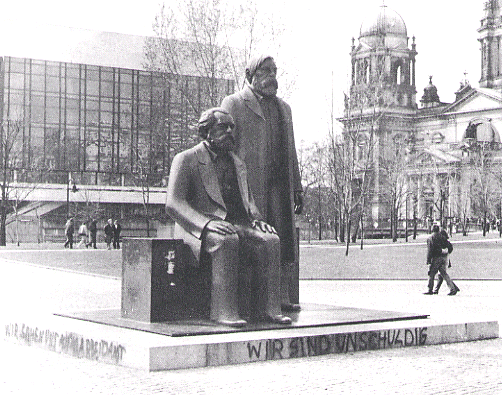
East Berlin worked as an important corrective to such lifeless abstractions. During our trip, M and me went to visit the Marx-Engels Platz and were confronted by the gargantuan stature of earlier generations of men. Standing on M's shoulders, I still would not be able to reach the head of Engels. One of the virtues of socialist realist art is how it expresses material truths through scientific-aesthetic techniques. Instead of "translating" Marx and Engels into men of a present-day size, it lets us experience the wonder of human variation. The finger nail of a 19th century man is the size of my palm! His feet like my thighs and his torso the thickness of a recycling igloo. Instead of trying to comfort us by making dwarves of giants, the sculptor forces us to take stock of both a historical distance and the slumbering possibilities within our present, cookie cut limbs.


Confronted by these statues of the labor movement's great thinkers - as well as by the nameless workers of a similar height that surround the Platz - one understands the urgency which must have inspired works such as "The Housing Question" and the investigation of the living conditions of English workers in that island's great industrial cities. I cannot begin to fathom how those early-industrial giants managed to fit into apartments smaller than those we live in today. After a 12+ hour working day, they had to crawl their way through narrow corridors only to be forced into fetal position, packed like herrings in what passed for a home. The ever new editions of Swift's Gulliver's Travels (a perspective that is often lost sight of today) - what a clever intervention into the great 19th century struggles over social space. The books - no larger than today - must have been the perfect size for a worker to build his own coat library.


But however remarkable the size difference is, what really got our attention was the variations in the actual composition of the human body that the statues hinted at. Specifically: the genitalia of giants.


Concerning the crotches of giants


Socialist Germany apparently tried to make a clean break with bourgeois sexual morals, at least when it came to the variations of genitalia over time. I was aware of how the introduction of a "two-sex" system replaced an aristotelian performative-misogynist theory of sex with a biological-misogynist one in the early-modern period. But just as the political ideology of the day tends to reduce (political) history into a teleological story about the progressive realization of representative democracy, I have taken for granted that today's sexual organization has been present - at least biologically - throughout human history with only slight variations. Changes, even revolutions, in sexual practices, family structures and theories of reproduction and pleasure - sure! But the biological "substrate", the actual genitala, has always seemed to be an invariant which the purely social variations connects and disconnects to in different ways.


The findings of historical materialism tell us otherwise. Because the German artists where not held back by prejudice or political agendas, they could represent the genitalia of our predecessors without resorting to mystifications. The representations, limited to Marx and Engels, are however very limited. I only wish that they had been accompanied by Luxemburg or some other woman - if that is not an altogether too inexact expression - so as to give some kind of hint as to the extent of the variety of genitalia (and other organs) in those early days of the labor movement. With this limited selection in mind, this is what I managed to observe and deduce about the genitalia of giants:


Marx' genitalia corresponds closely to what is referred to as a "penis" today, at least as far as I can tell. The artists, though working with scientifically developed techniques, were not primarily interested in early capitalist anatomy but in creating a homage to two very important theoreticians of the labor movement. Thus, they are both clothed. I do however get the feeling that the sculptor is making a point of the mentioned correspondence by giving the author of Capital a slight erection that shows through his cast iron pants. Apart from his extraordinary size and immense muscles, he is eerily similar to you or me. (A small note: Marx is depicted as sitting, which hints at the possibility that the "boils" that he presumably got as a result from long hours at the British Museum might be a code of sorts.)


At first glance, Engels seems to completely lack sexual organs. But as you move closer, you see fine silver threads extending from his absent crotch towards other parts of the statue as well as to its immediate surroundings. The "web" hosts a number of small black and brown organs that only connect to the main body by those thin milk-like threads. The organs have eight jointed appendices. As far as I can tell, their function is to allow the organs to move along the libidinal strings when the slightest vibration signals the presence of a potential "sexual goal" (to borrow a term from Freud). One of the organs seem to limit its movement to a triangle formed by Engel's ear, collar and shoulder. The threads in the triangle are particularly plentiful, and the density allows one to spot certain patterns in the seemingly anarchic way in which the lines of communication are drawn. Recording and shivering at the slightest tremble in the strings (they are made from some kind of extremely elastic bodily fluid), the organ moves back and forth in the triangle but always to return to a site at the statue's ear lobe. From this base of operation it whispers into the seemingly attentive hollow just above it.


It would be easy to see a certain tragic dimension in this neverending murmur into the ear of a mere representation of man, and the connected rythm of frantic activity and motionless wait of these caressing-communicating organs awake a suspicion: they may not be part of the statue at all. What if this residue of sexual organizations wiped out by the enforced primacy of reproduction ("normality" in the technical sense defined by Dr Freud) somehow managed to survive, attempting to form symbiotic bonds with new bodies? Trees, signposts, window panes, dreaming animals and humans? It must have encountered several difficulties: the unresponsive window pane which refused to stir even when told about the most delicious connections made, the animal suddenly awake - unaware of the perverse possibilities offered - might shrug, move a bit too violently and undo an entire night's labor of love.


But to find tragedy would likely be no more than a relapse into anthropocentrism. It would be presumptous to assign consciousness to such organs, at least any remotely similar to our own. Rather than a project leaving a trail of heart breaking disappointments, it might be better defined as a constant attempts to attach and calibrate itself to more than a century's worth of potential hosts. Then, finally hitting on the very forms and proportions of the host it has attempted to replace, it finds a certain functional "contentment" in the replica of a man. In a reversal of the way that the dreamer's hand searches for and finds its crotch, the organs searches for and find their resting place.


Freud may have kept clear of biology when formulating the object of his science for obvious both practical and theoretical reasons. The "limit"-concept of "drive" is a practical demarcation necessitated both by differences in method and the actual structural conditions of the psychic apparatus (which appears to be dissimilar to those of biological science). This construct of strings and miniscule organs seems to allow for sexual activity in the forms of caressing, strangling, exploring, corresponding. Such functions are not unknown to psychoanalysis: on the contrary, they are perverse elements present in all kinds of sexual organizations and the building blocks of the pregenital configurations. What is striking though, is that the variation of sexual organizations that today are confined to the psyche are here given an immediate, physical form. Engels' libidinal web is highly original in both its relative autonomy towards any given body (both in its ability to make and maintain connections and structures whose connections with a body can be disconnected and reconnected according to chance and optimizations of functionality - and in its ability to if necessary change host) and in the functional, more or less immediate correspondence between biological and sexual organization. While the tongue or the dick or the cunt today varies its significance according to the demands of the psyche (within the material boundaries given by its physical shapes and capabilities), the libidinal web might be proof of a period in human history when this variation rather than shifting significances and practices was actively remolding and reforming organs according to the demands of desire.


This obviously has a great significance for the historical validity of both anatomical studies and the present configuration of the psychic apparatus. A more modest area of research might be to analyze in what ways these arcane strings and organs of Engels' are connected with his great communicative efforts in the service of the labor movement. Is there a connection between his immense web of correspondents and confidants and his immense web of delicate, ever growing milky lines? Or between this elastic secrete and his preoccupation with proteins in his Naturdialektik and Anti-Dühring?


PS. It might be noteworthy that the sculptor's arrangement with a sitting Marx and a standing Engels is reminiscent (or possibly the other way around) of Max Ernst's Capricorn (also present in Berlin at the time); compare ME & M&E.

PS 2. We might owe much more than is readily apparant to our gigantic forefathers. Take wages for example: Marx himself tells us that the wages of the working class tend towards a level where it can simply pay for that which is necessary to reproduce its labor power. But he also tells us that that which is considered "necessary" is to some extent decided by the culture and traditions (and demands of capital) in any given society. This "inertia" coupled with the likely very rapid shrinking of man during the few generations leading up to the 20th century might very well have produced a favorable situation for a number of generations. The level of wages was decided with the physical needs of immense bodies in mind. So, as the bodies shrank, an ever greater part of the wage could be used for other purposes. Imagine the riches available to a working class the size of rats!


Appendix 1: City planning as class struggle in the sphere of anatomical science.


Living on Rosa Luxemburg Strasse, we visited her Platz in the belief that we would find a place of a similarly thought provoking nature. What we found was at first glance very disappointing - the most boring kind of conformism. The genitalia is as present in the activities of the city planners of Berlin as in the preoccupation of artists: it might have permeated the whole intellectual life of those days and produced unforseen effects in the most diverse fields of work. But the contradictory ways in which we find it at Rosa Luxemburg Platz might force us to reevaluate the perhaps all too one-sided, positive way in which we appraised the tendency's presence in regards to Marx-Engels Platz. For where the artists seem to have made a clean break with narrowminded prejudice, the city planners seems to be trapped in it. This should be obvious from a schematic overview of the place: a triangle, and under it two orifices. And as an unwelcome bonus: in the triangle (representing pubic hair) an advertisement for a "Hooters" restaurant near the Zoo. Thus, the present rulers of Berlin try to humiliate the dead, as if to say: "Go ahead workers, suck on the teets of the dead sow of insurrection." Depressing, really, until M points out that their order might very well be built on quicksand - or paving-stones.


For in contrast to the surrounding streets, the triangle is made of cobble stones of a size suitable for throwing. Having thus exorcised the feelings of defeat, we realize that just as the triangle differs from what you might find on a police woman so too does the orifices. Not only eggs, urine and shit, but a whole system of tunnels spanning a city of millions. One might be tempted to make use of one of the pet problems of Trotskyism: how do we define the "socialist countries": As "degenerate workers' states"? As "state capitalism"? And what forms do class struggle assume in such social formations? A triangle and two subway entrances may give us an idea of how one aspect of this struggle took shape in the fields of urbanism and anatomical science. Within the confines of the given order, the primacy of reproduction and sexual conformism is mutated; someone (perhaps a sleeper agent from Sex Pol? Hard to imagine that Reich's comrades would all just disappear or abandon their common project) makes pubic hair take part in the preparations for a renewed insurrection, and develops the two-way street logic of orifices into a ever-growing series of possible destinations. And, ironically enough, enlists the unaware city planners of today in forever expanding and modifying these series.


Appendix 2: Die Toten Mahnen Uns: Michael Jackson, the Paris Commune and the Beach Volley Ball of Reaction.


(to be added)


/Erik Bohman

Saturday, October 10, 2009

Inflated flounders revisited and multiplied

NN's question about the strange sea creatures he was dreaming about a while ago (inflated flounders?) seems to have got an answer with a piece of recent news from National Geographic. Now, does this mean that the acronym SOMS means Semi-solid Obese Marine Sentiences?

This might also be a good opportunity to point out to those that haven't noticed that the Icecrawler has increased its circle of sibling blogs. The terrestrial cephalopod cites the blob news too, and the Biografier åt okrossbara hälleflundror is named after the unbreakable halibuts. These two have a similar focus on poetic investigations, the one in english and the other in swedish. A third sibling, Kormorantrådet or The cormorant council, seems to be eventually switching to english for most of its dream geography enquiries.