Showing posts with label pansexuality. Show all posts

Thursday, November 5, 2009

On the shoulders of giants

I always figured that the old scholastic notion of "standing on the shoulders of giants" was a way to describe accumulated learning and express an indebtedness towards tradition. On closer inspection, though, there is no lack of written sources that belie this metaphorist interpretation. Isidore of Sevilla - to name only one - informs us that "just as, in individual nations, there are instances of monstrous people, so in the whole of humankind there are certain monstrous races, like the Giants, the Cynocephali, the Cyclopes, and others." In his Etymologies, in which he attempts to collect all the knowledge of his age, we find peoples in the most varied sizes with organs redistributed in the most striking fashions. Faces on the stomach, a one legged people habitating distant parts of the world, asians without noses - the variations of medieval man shames the monotony of the contemporary human body. And to still think in metaphors? What a cretinizing way of turning flesh into mere words.


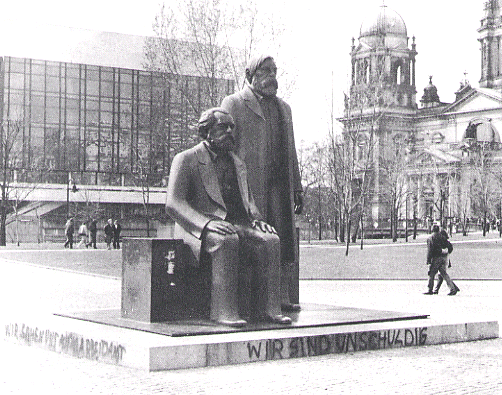
East Berlin worked as an important corrective to such lifeless abstractions. During our trip, M and me went to visit the Marx-Engels Platz and were confronted by the gargantuan stature of earlier generations of men. Standing on M's shoulders, I still would not be able to reach the head of Engels. One of the virtues of socialist realist art is how it expresses material truths through scientific-aesthetic techniques. Instead of "translating" Marx and Engels into men of a present-day size, it lets us experience the wonder of human variation. The finger nail of a 19th century man is the size of my palm! His feet like my thighs and his torso the thickness of a recycling igloo. Instead of trying to comfort us by making dwarves of giants, the sculptor forces us to take stock of both a historical distance and the slumbering possibilities within our present, cookie cut limbs.


Confronted by these statues of the labor movement's great thinkers - as well as by the nameless workers of a similar height that surround the Platz - one understands the urgency which must have inspired works such as "The Housing Question" and the investigation of the living conditions of English workers in that island's great industrial cities. I cannot begin to fathom how those early-industrial giants managed to fit into apartments smaller than those we live in today. After a 12+ hour working day, they had to crawl their way through narrow corridors only to be forced into fetal position, packed like herrings in what passed for a home. The ever new editions of Swift's Gulliver's Travels (a perspective that is often lost sight of today) - what a clever intervention into the great 19th century struggles over social space. The books - no larger than today - must have been the perfect size for a worker to build his own coat library.


But however remarkable the size difference is, what really got our attention was the variations in the actual composition of the human body that the statues hinted at. Specifically: the genitalia of giants.


Concerning the crotches of giants


Socialist Germany apparently tried to make a clean break with bourgeois sexual morals, at least when it came to the variations of genitalia over time. I was aware of how the introduction of a "two-sex" system replaced an aristotelian performative-misogynist theory of sex with a biological-misogynist one in the early-modern period. But just as the political ideology of the day tends to reduce (political) history into a teleological story about the progressive realization of representative democracy, I have taken for granted that today's sexual organization has been present - at least biologically - throughout human history with only slight variations. Changes, even revolutions, in sexual practices, family structures and theories of reproduction and pleasure - sure! But the biological "substrate", the actual genitala, has always seemed to be an invariant which the purely social variations connects and disconnects to in different ways.


The findings of historical materialism tell us otherwise. Because the German artists where not held back by prejudice or political agendas, they could represent the genitalia of our predecessors without resorting to mystifications. The representations, limited to Marx and Engels, are however very limited. I only wish that they had been accompanied by Luxemburg or some other woman - if that is not an altogether too inexact expression - so as to give some kind of hint as to the extent of the variety of genitalia (and other organs) in those early days of the labor movement. With this limited selection in mind, this is what I managed to observe and deduce about the genitalia of giants:


Marx' genitalia corresponds closely to what is referred to as a "penis" today, at least as far as I can tell. The artists, though working with scientifically developed techniques, were not primarily interested in early capitalist anatomy but in creating a homage to two very important theoreticians of the labor movement. Thus, they are both clothed. I do however get the feeling that the sculptor is making a point of the mentioned correspondence by giving the author of Capital a slight erection that shows through his cast iron pants. Apart from his extraordinary size and immense muscles, he is eerily similar to you or me. (A small note: Marx is depicted as sitting, which hints at the possibility that the "boils" that he presumably got as a result from long hours at the British Museum might be a code of sorts.)


At first glance, Engels seems to completely lack sexual organs. But as you move closer, you see fine silver threads extending from his absent crotch towards other parts of the statue as well as to its immediate surroundings. The "web" hosts a number of small black and brown organs that only connect to the main body by those thin milk-like threads. The organs have eight jointed appendices. As far as I can tell, their function is to allow the organs to move along the libidinal strings when the slightest vibration signals the presence of a potential "sexual goal" (to borrow a term from Freud). One of the organs seem to limit its movement to a triangle formed by Engel's ear, collar and shoulder. The threads in the triangle are particularly plentiful, and the density allows one to spot certain patterns in the seemingly anarchic way in which the lines of communication are drawn. Recording and shivering at the slightest tremble in the strings (they are made from some kind of extremely elastic bodily fluid), the organ moves back and forth in the triangle but always to return to a site at the statue's ear lobe. From this base of operation it whispers into the seemingly attentive hollow just above it.


It would be easy to see a certain tragic dimension in this neverending murmur into the ear of a mere representation of man, and the connected rythm of frantic activity and motionless wait of these caressing-communicating organs awake a suspicion: they may not be part of the statue at all. What if this residue of sexual organizations wiped out by the enforced primacy of reproduction ("normality" in the technical sense defined by Dr Freud) somehow managed to survive, attempting to form symbiotic bonds with new bodies? Trees, signposts, window panes, dreaming animals and humans? It must have encountered several difficulties: the unresponsive window pane which refused to stir even when told about the most delicious connections made, the animal suddenly awake - unaware of the perverse possibilities offered - might shrug, move a bit too violently and undo an entire night's labor of love.


But to find tragedy would likely be no more than a relapse into anthropocentrism. It would be presumptous to assign consciousness to such organs, at least any remotely similar to our own. Rather than a project leaving a trail of heart breaking disappointments, it might be better defined as a constant attempts to attach and calibrate itself to more than a century's worth of potential hosts. Then, finally hitting on the very forms and proportions of the host it has attempted to replace, it finds a certain functional "contentment" in the replica of a man. In a reversal of the way that the dreamer's hand searches for and finds its crotch, the organs searches for and find their resting place.


Freud may have kept clear of biology when formulating the object of his science for obvious both practical and theoretical reasons. The "limit"-concept of "drive" is a practical demarcation necessitated both by differences in method and the actual structural conditions of the psychic apparatus (which appears to be dissimilar to those of biological science). This construct of strings and miniscule organs seems to allow for sexual activity in the forms of caressing, strangling, exploring, corresponding. Such functions are not unknown to psychoanalysis: on the contrary, they are perverse elements present in all kinds of sexual organizations and the building blocks of the pregenital configurations. What is striking though, is that the variation of sexual organizations that today are confined to the psyche are here given an immediate, physical form. Engels' libidinal web is highly original in both its relative autonomy towards any given body (both in its ability to make and maintain connections and structures whose connections with a body can be disconnected and reconnected according to chance and optimizations of functionality - and in its ability to if necessary change host) and in the functional, more or less immediate correspondence between biological and sexual organization. While the tongue or the dick or the cunt today varies its significance according to the demands of the psyche (within the material boundaries given by its physical shapes and capabilities), the libidinal web might be proof of a period in human history when this variation rather than shifting significances and practices was actively remolding and reforming organs according to the demands of desire.


This obviously has a great significance for the historical validity of both anatomical studies and the present configuration of the psychic apparatus. A more modest area of research might be to analyze in what ways these arcane strings and organs of Engels' are connected with his great communicative efforts in the service of the labor movement. Is there a connection between his immense web of correspondents and confidants and his immense web of delicate, ever growing milky lines? Or between this elastic secrete and his preoccupation with proteins in his Naturdialektik and Anti-Dühring?


PS. It might be noteworthy that the sculptor's arrangement with a sitting Marx and a standing Engels is reminiscent (or possibly the other way around) of Max Ernst's Capricorn (also present in Berlin at the time); compare ME & M&E.

PS 2. We might owe much more than is readily apparant to our gigantic forefathers. Take wages for example: Marx himself tells us that the wages of the working class tend towards a level where it can simply pay for that which is necessary to reproduce its labor power. But he also tells us that that which is considered "necessary" is to some extent decided by the culture and traditions (and demands of capital) in any given society. This "inertia" coupled with the likely very rapid shrinking of man during the few generations leading up to the 20th century might very well have produced a favorable situation for a number of generations. The level of wages was decided with the physical needs of immense bodies in mind. So, as the bodies shrank, an ever greater part of the wage could be used for other purposes. Imagine the riches available to a working class the size of rats!


Appendix 1: City planning as class struggle in the sphere of anatomical science.


Living on Rosa Luxemburg Strasse, we visited her Platz in the belief that we would find a place of a similarly thought provoking nature. What we found was at first glance very disappointing - the most boring kind of conformism. The genitalia is as present in the activities of the city planners of Berlin as in the preoccupation of artists: it might have permeated the whole intellectual life of those days and produced unforseen effects in the most diverse fields of work. But the contradictory ways in which we find it at Rosa Luxemburg Platz might force us to reevaluate the perhaps all too one-sided, positive way in which we appraised the tendency's presence in regards to Marx-Engels Platz. For where the artists seem to have made a clean break with narrowminded prejudice, the city planners seems to be trapped in it. This should be obvious from a schematic overview of the place: a triangle, and under it two orifices. And as an unwelcome bonus: in the triangle (representing pubic hair) an advertisement for a "Hooters" restaurant near the Zoo. Thus, the present rulers of Berlin try to humiliate the dead, as if to say: "Go ahead workers, suck on the teets of the dead sow of insurrection." Depressing, really, until M points out that their order might very well be built on quicksand - or paving-stones.


For in contrast to the surrounding streets, the triangle is made of cobble stones of a size suitable for throwing. Having thus exorcised the feelings of defeat, we realize that just as the triangle differs from what you might find on a police woman so too does the orifices. Not only eggs, urine and shit, but a whole system of tunnels spanning a city of millions. One might be tempted to make use of one of the pet problems of Trotskyism: how do we define the "socialist countries": As "degenerate workers' states"? As "state capitalism"? And what forms do class struggle assume in such social formations? A triangle and two subway entrances may give us an idea of how one aspect of this struggle took shape in the fields of urbanism and anatomical science. Within the confines of the given order, the primacy of reproduction and sexual conformism is mutated; someone (perhaps a sleeper agent from Sex Pol? Hard to imagine that Reich's comrades would all just disappear or abandon their common project) makes pubic hair take part in the preparations for a renewed insurrection, and develops the two-way street logic of orifices into a ever-growing series of possible destinations. And, ironically enough, enlists the unaware city planners of today in forever expanding and modifying these series.


Appendix 2: Die Toten Mahnen Uns: Michael Jackson, the Paris Commune and the Beach Volley Ball of Reaction.


(to be added)


/Erik Bohman

Monday, September 7, 2009

The sense of milk bathing

1. Bathing

Bathing means three things: embracement, splash-dance and submerging.

Embracement is to be enclosed in a more dense, distinct, rather homogenous medium, the whole skin as an organ of touch, and all the various sensory organs concentrated in the face, and everything comes near and becomes more languid, intensely sluggish, and the sounds and the electric jolts and the temperature differences and the smells all move faster, and one becomes omniscient and oversensitive. An acute sense of nivellation, totalisation, as every limb, every inch of skin, I might be excused the siphonophoran analogy of saying every citizen of the body, is just as much wettened and just as much part of the waterworld. Everything is naked, feeling and tasting reaches everywhere simultaneously. And then there is the archimedean aspect; being enclosed in a denser medium has the consequence of relative weightlessness, related to flying in dreams and other distinct phenomenological states less conditioned or just less restrained by common gravity. Floating but not floating. Weighing but not weighing.

Splashdance concerns the medium as an extremely mobile and topographically complex interface, and a decrease in the effects of gravity, a wrestling, dancing and hugging which does no longer recognise up and down, which has more and simultaneously less of concealed and revealed, a perpetually changing surface of peaks, valleys, drops, slopes, coatings, connecting things temporarily and flashwise, is a frenzy and a cacophony.

Submerging focuses on the medium as a horizontal interface, a razorsharp limit, the difference in the world; and must be regarded as the central moment in the milk bath (leading for sure to embracement. In a submerging process there are three central structural elements; a) the suspension above the surface, everything is hanging, what tension, the gravity of that which rests in its restrained falling, endless waiting with aching muscles, b) the horizontal, razorsharp interface itself, and the transgression in the passage through it, c) the embracement and homogenisation of the life world beneath.

But living in this homogenous, this embraced being, what is that? Well it is living in the dream, there are all these strong images of falling when falling asleep, and of passing down beneath, or up above, a distinct surface, when moving from a hypnagogic state to a waking. Inside the medium, and thus inside the dream, everything is possible but also slower, softer, safer, more comfortable, more implacable, more necessary, without any arbitrariness. On a certain plane this is of course an intra-uterine existence (and the dream just like the bath is a womb).

And then we are already in that problematic chain of symbols in Róheim ("Gates of the dream") where all dreaming is transgression which is penetration which is longing to the womb which is regression; everything pointing forward points backward, and everything integrates conventional coitus and the crawling back into mother's tummy. The foremost problem is that it carries too far too quickly, synonymising most of what there is, risking missing the unique characteristics of anything. (I had already avoided to say "inbracement" rather than embracement, after CJL Almqvist's term for carnal as well as cosmic intercourse in his swedenborgian-erotic classic "Murnis".)

Back to our childishly stubborn concretion. The surface is a membrane to pass through. And since we don't have all that much feelings connected with this on certain levels such as that where molecules pass over membranes, we soon arrive at a more meaningladen level; that of mucus membranes. Human membranes are all water surfaces, delimitations visavis another world, warmer, more real and unreal, where that selfsufficient connectivity is abandoned, one's as it is called bourgeois body, in order to seek another equally abandoned human on that little island on the other side of the river of oblivion. But it is also obviously ambiguous: to penetrate, with a male sex which is a metaphor for the whole body or vice versa, penetrating a water surface equals being penetrated by a water surface, a body arching up against oneself stretching out into oneself, and vice versa, it is a totalising and multisexed embrace, permeates and is permeated, it is in fact something like a basal trope of the pansexual because it starts off exactly where the simplest sexual strategies becomes interchangeable and/or irrelevant.

And so what happens when we have arrived? Intrauterine existence. Yes who knows? There was a chapter about it in Breton/Eluard "The immaculate conception". And another chapter in the same book, about a walk on the bottom of the sea, where we stroll and politely greet famous serial murderers. There seems to be something unavoidably pastoral idyllic about it, a sunken little idyll, an atlantis, where everything is just a little condensed and jellyfish swim by and long hairs calmly wave and everybody move a little slower, octopuses with hats, mermaids, pennants from the towers, uncle Lenin standing waving in the aquarium. No I haven't got a clear image of intrauterine existence. It is an analogy with the dream, only without that firmness and compelling arbitrariness.

Speaking of firmness, if we now know that the water body is an intrauterine pansexual dream world which is out to get you, isn't it bizarre that the bathtub itself is made of china or enamelled tin; it is indeed a strangely hard uterus. Hence the blankets, the fat, the honey, with which it is robed or greased like a shock absorber. And such shock absorbers are potentially encompassing mediums themselves.

Blankets are a soft wrapping, tender grave shroud, the pupal chamber of a mummy, a bridal gown wanting to encompass in an insurveyable way which is directly comforting in the way it wrappingly embraces. Now we need to introduce the concept of thigmotaxy, which is the way earwigs, cows and often people cannot settle down to rest until such a large part as possible of the body is pressed against something, one puts oneself away in crevices, tunnels, somebodys arms, simple booths or coffins. A couple of days after the morning when I woke up at PJ Harvey's shouting I actually dreamt, depressedly, that I had a new apartment and preferred to lay wrapped in blankets in the bathtub, the dry and hard bathtub, in the firm conviction that it could possibly be warmer there, but I knew it wasn't, it was only the logical possibility itself that it could be that was enough, was something at all to grasp at in my existence devoid of happiness.

Fat is more homogenous than blankets, but it sticks everywhere, holds together, and repells water, it is itself a mucus membrane, but specifically a mucus membrane which suffocates. The sticky yellowness of fat is the evil water, which drug hallucinations and other fantasies of suffocation focuses on. Mountain ranges of fat tissue, where scolopenders rush around with their fifty poisonous legs, and all one's relatives stand lined up in a row for a photograph.

Honey, must be the good cousin of fat, just as sticky, adherent, alive, mucusmembranish, but so sweet and good, so beautiful and fragrant, it doesn't suffocate but gilds and embellishes, so wittily and playful, so luxurious and bizarre. And nevertheless so burningly sweet and stalkingly sticky.

We will have to introduce the third relative, mustard, still just as yellow and sticky, fresh and breathable like honey but without its flattering and mild character, yes well actually almost corrosively acrid, keeps the mildly flowing honey at bay with stabs and the maliciously flowing fat with counterfire, mustard is a miracle potion and nobody's friend. Maybe I'm on the track of something here, maybe fat, honey and mustard are actually the three tissue types of gold?

Because there has to take place at least some miracle, it's expected as the culmination of a stay in the uterus. Here the controversial rebirth comes in. (Controversial, as it was polemics over the meaning of rebirth in the interpretation of a dream that triggered writing this essay.) What is rebirth? I don't know. I thought it was nothing more than being awoken in the morning, the last swimming strokes up to the insistently light and noisy world where one keeps one's identity and lifestyle, where one stands naked since paradoxically outheld in an embracing clarity, embracing light. But why would it be rebirth if it does not lead to anything new? One tends to think it is new every single time.

2. Milk

The honey covering the inside of the tub as a protecting and softening fat layer is expected to interact with the milk. Milk and honey together, milk and honey are the two animal substances which don't seem animal, animal labor for the early schlaraffenland days of their offspring, the highest serum of offspring care in each of the two dominant animal lineages, in mammals among the deuterostomes and in bees among the protostomes. Joined, can they make anything else but simply more body? Isn't milk and honey together, after all, blood? Aren't they a metaphor for blood (like wine in christianity) already when you're supposed to bathe in it to stay young? Isn't that a vampiric act, resting on the same mythological, magical and infantile theory that the lifeforce rests in the blood, and bathing in it makes that lifeforce percolate through the membrane of the skin? And for that reason it is only logical that some would like to return the metaphorical praxis to its pure form, and prefer to bath in real blood instead of the symbolical milk of the blood. Blood gives life. Even medical science claims that today, in their campaigns for enlisting blood donors. Blood gives youth? Perhaps that rests on the calculation that the more life accumulated the younger once becomes. That's what vampires found their ideology and their mythological life on. If only one succeeds to collect incredibly much life perhaps it's even possible to transcend to being unborn? The sea lies still, without oneself to bathe in it.

Blood and milk are also similar on a concrete phenomenological level. These two traditionally lifegiving liquids are both vividly colored and sticky, very nutrious, rich and strangely thick tasting. Their analogous character is probably as distinctly exploited as possible, in a polarising form, in the wellknown division among the east african massai, into female food which is milkbased and male food which is bloodbased and never will the two meet.

So what is milk, perhaps we need to ask. Well milk is the primary offspring food in mammals. Milk is mothers milk. Our Ur-economy, as sketched by freudians-lacanians but not marxists. Then it is a different thing that milk secondarily, in certain cultures, has come to be associated with locally or commercially available cow's milk.

And we have several competing abstractions of the word, illuminating its concretion. Some would say that milk is anything milky, that is cloudy water (water with precipitated minerals), phenomenologically a water without clarity, without transparence, without merciless truth, a less watery water. Others would start talking about latex as milk sap, which is specific wound liquids in certain plants (blood again); you remember the taste of the bleeding white in dandelions, you know the rubber tree bleeding latex which is industrially used (the phenomenology of rubber probably has very little to do with milk though). Some would start talking about generalising milk on a consumistic level and pull in all kinds of milk substitutes (artificial dilutions of denaturalised protein from vegetabilic sources; soy milk, oat milk, almond milk) where it obviously parades as a commercial name for any white drink for meals whatsoever. Still others would get stuck in the dynamism of sexual metaphors and start nagging about, eventually confounding, milk and sperm, that isn't a very striking similarity, and probably not a very interesting path, but still probably contributes to increasing the expressivity of milk drops in certain locations in certain situations.

But, in elucidating the milk bath we must naturally give the primary conceptions the first place: milk is mothers milk, and everything else is one or another theory or metaphor for whatever ought to be sorted into the same category as mothers milk.

And nevertheless it remains cow milk, prepared as a commodity, homogenised, pasteurised, packed, sold and bought, which dominates the determination of the sensory concretion of milk for most people, or perhaps rather a projection of many of the original promises of mothers milk onto the commercially available perverse representation. But what characterises milk? Milk is fat and sweet, fresh and nourishing, selfcontained and contradictory, it is like a mixture of forest creek and whipped cream cake. And at the same time, through its rich content of enzymes, selfdestructive, bad smelling in itself, quickly putrid, gives extraneous mucus production and bad breath. (In the US there are still campaigns going on to make youth drink milk. The arguments that it contributes to skeletal construction, strength and health are not true; the argument that it makes young people less fat than drinking cocacola all day long may perhaps be true.)

So, there are actually certain cultures where it actually isn't a taboo to drink other animals' milk, where it has even been turned into culturally significant common social praxis, even for grownups, even commercially organised. Such a perverted society is Sweden where we live. The conspiracy theorists keep talking about the lactoconspiracy, about how the authorities forcefeed grownup men with cow milk in order to keep them dependent women-dominated easily-manipulated children. Forcefeed must here be taken in a non-literal sense, via internalised customs, for it's obviously not like among whales, where the mother simply tries to aim into the child's mouth whenever it is nearby, with a huge spray, almost like a high-pressure nozzle of uniquely fat milk. Well, milkdrinking in Sweden is as well known uniquely common. Thus, there is always a possibility to appear experienced, sophisticated, widely-travelled and cultivated by making faces at the provincially barbarian milkdrinkers with an supercilious shuddering. The population in Sweden does have one of the world's greatest frequencies of a genetic disease, the particular defect that makes childhood's ability to digest lactose NOT develop away in adolescence. All humans have those genes which switches off that temporary capacity to digest lactose, but some people, like the swedes, have a genetic reading error which keeps those genes from being expressed (the switching off is cancelled, double negation for the logician). Since locally most people have the disease, it's the opposite state which is defined as a disease: lactose intolerance. Do we here have a simple demonstration of the relativity of healthy/sick?

For it is not arbitrary to insist on association milkdrinking with its single universal form: suckling. No bottle-feds can deny the universal in this, not the least since their own neurotic insistence mythologises it even stronger via its biographical lack. And here we return to an adventurous regression of semi-Róheimian cut, and I, as a phenomenologist rather than a judging psychologist, would prefer to describe it as a non-static (flowing in all directions) and constantly ambiguous field being stretched out between pure regressional fantasies, conventional sexual forms, and pansexuality. On the other hand, I am not going to continue discussing it here. For it wasn't breasts that was the subject, it was bathing in milk.


3. Bathing as life environment and erotic future

But whoever bathes in a nourishing medium need not grope for teats, need not have an ombilic cord, is able to swim freely and metabolise through the skin; again the intrauterine in a certain (negative) utopian shape, how beautiful it would be to not need to bother, to universally not need to bother, a world where nothing is complication; dead boring, nirvana, intrauterine without all picturesque components. Usually I get upset by all these fantasies about not needing to bother to eat, because I spontaneously interpret them as rationalist-technologist-antisensory, but they are of course to an equal degree simply nirvana-directed, eating is after all an obviously very limited and insufficient way of assimilating reality (though one of the most sensorily concrete and beautiful we have).

Therefore it seems contradictory and hardly attractive to eat in the bath. In the bath, you live in a perfect world where no practical worries have a right to advance and reach you. But that's not the way it works after all. And all these small wishes start all over again. Drinking liquor in the bath is considered cosy by many. Smoking in the bath is pretty cool too. Cowboy fantasies. But what about sex in the bath? Is that an attractive thought? And now I am not speaking about the bad or good biographical experiences of individuals, I am talking about whether the thought is attractive. What does imagination say, is it possible to have sex in the bath? I cannot rid myself of demanding an answer to the question: with whom? Who would fit in the bath, who would appear sexually in that environment? There are a few classical bathers in iconography-mythology, often with one or another attractive attribute. I remember. There is Ofelia, there is Erszébeth Báthory, there is Marat, there is the biblical Susannah, there is the ghost Dana, there is Namor and Namorita, there are sirens in general, Jacqueline Lamba l'Ondine, the siren of Warszawa, but not all the true sirens, which are marine creatures, just like dugons and manatees, dolphins and large whales, Venus emerging from the sea, and many other bathers who demand vast space, large bodies of water, no confining tub walls. The ones that fit in a bathtub are a special category, gracefully relaxed in that vessel.

But all coplayers bring complications. It is difficult to imagine a shared exploration of intrauterine life. What do the naïads actually have to bring compared with the body of water itself, which is a crueler lover because more definitive and more totalising, because it is itself another world and a dream, regardless of whether it is seasoned with milk, honey or blood?

Back to the splashdance aspect, which is the collectivisable moment. A bathtub is small and hard for two people (even worse for more than two) and squeezing ones bodies into it is absurd and leads to the most elaborate difficulties of movement, it is incredibly funny how difficult everything is but it often seems more comfortable to sit by the side and investigate how the two bodies in the bath, the water body and the human body, separate and reunite, unite and glide apart, give each other meaning.

But sinking oneself into milk, so it is something ritual, sacral, it is the very sinking into the very milkness, it is a magnificent delusion, it is the proceeding with raw courage and elaborate slowness to shut the waking world out with its monumental, yes pettily monumental, worries, crouching in the soft embankment in the bark in the huge tree in the night when the owls are calling and the tigers roaring, it is quite simply a vantage point, a vantage point in the very beginning of eternity, and just like in a glacial landscape, everything is white.


Mattias Forshage

Tuesday, December 5, 2006

Volupte?

VOLUPTÉ?

Our notes from discussions on sensual pleasure
in response to an enquiry from the Paris group
the surrealist group in Stockholm 2005
(delivered long past deadline - as usual - and yet unacknowledged by the Paris group)

1° Comment décririez-vous la volupté ?

First of all, we ask ourselves: What is the point in analyzing sensual pleasure? The experience tend to dissolve in its bodily sensation. The difference between sexual gratification and pleasure is that in the course of gratification you are aware of
the need that you are satisfying so that you are ready to rationalise your experience, but in sensual experience - like vomiting - the experience is not rational.

We agree, however, that the sphere of sensuality is the privileged area for reconcilement of dual concepts. Some of us take the same pleasure in taking a shower as in having human relations. The hypnotizing effect of sensual pleasure can be an experience of fascination and openness to the senses, a bodily joy. Neither reflecting state, nor self-reflecting. A possible dissolving of the limits between self and other natural (unnatural?) processes in the world, a partaking in the weather. Shared sensual pleasure also temporarily making the contradiction between communication and non-communication disfunction. Silence. Sensual pleasure is in that sense a magical act, wherein the dichotomy subject-object disappears. Eating exemplifies this: Eating disgusting things but still feeling that it tastes good. Or the sensual pleasure in
humiliation, in vomiting: vertigo. Shared sensual pleasure: disappointments and the faith in the contradiction that exists between love and sexuality.

Some of us emphasize that sexuality (in acto) is a magnetic field, involving intuitive communication, a further increase of sexual desire, exhaustion, paralysis.

Some of us stress the imaginary aspects of physical contact. The seemingly intensified experiences of psycho-physical sensations within oneiric states; incubi/succubi, developing and exploring pseudo-corporeal states, "touching from a distance", hexed
glances, word magic.

Some of us stress also the undesired aspects of sensual pleasure: the restlessness and laziness that can be one of the trappings of a narrow hedonism. The attitude of (although not the typical behaviour of) consumerism. We don´t think that well-being has a given place as a normal state in our mental topography. General well-being is an old repressive myth that haunts us in the mechanisms of control of social democratic state versus its citizens, and of parents versus children. Wherever well-being is held up as a superordinate goal, justice, truth, passion and curiosity are sacrificed. Hedonistic pleasure and common-sense well-being may have appeared as conflicting forces before; but since the breakthrough of the market mechanisms regarding our physical bodies in the early 80s (exercise, fitness, skin-grills, spas, sadomasochism, hygiene) they≠ve successfully joined forces almost everywhere.

Some of us hold that labour can be sensual pleasure. Not labour in its dead, wage-dictated form, but the living labour of producing both mental and material objects. Depersonalization appears during sensual pleasure as well as during labour, where
the primary actor resides not necessarily in the consciousness, but in some bodily function.

Some of us entertain the idea of the experience of non-contradiction between the body parts inside the body.

Some of us call to mind the states where sensual pleasure fails to trigger a corresponding motion (emotion) in the mind and becomes some irrelevant or an absurd background, establishing a duality between mind and body of another order than the usual disengaged alienation.

Some of us stress the metaphysical aspects of sensual pleasure; as concrete experience of Heideggerean "outholdedness" in "being" and of the irrelevance of good and evil.

(Love and sensual pleasure are not the same thing. It's stupid to talk about psychology.)


2° Pensez-vous que, par delà le plaisir, l'orgasme et sa jouissance, il y a des conditions particulières pour que l'acte sexuel engendre la volupté ? Lesquels ?

We are interested in the dynamic relationship between desire and sensual pleasure, in the romantic sense. It's a form of desire where the actual movements towards the object of desire is more important than the object itself. This specific dynamic can be said to be essential when answering this question. The object of desire is unreachable. A stress on sensual pleasure often connects with a depreciation of the dynamic forces of desire. We
may crudely summarise the romantic method as postponing the fulfillment of desire, not in the Freudian sense of derouting libido for socially useful means, but in order to savour it fully and reenchant reality by impregnating every aspect of it with obsessive imagery (and paranoiac-criticism, mythologisation and objective chance). Some of us see this as a fundamental surrealist and personal strategy. But then again, only inasmuch
as it doesn‚t totally refrain from the dynamics of transgressive behavior!

The imperative is to strive to be perfectly visible.

Where distraction disappears. Peaks. That is, multiple peaks or general leverage instead of single peaks and linear regression. Pansexuality! Love, passion (confusion).

3°) Que nous dit-elle sur notre condition de vivants ?

The non-fourierian organisation of pleasure, the industry of simulation closely linked to the society of the spectacle, the scandalous physical laws of the universe as resembled by the market relation, social-democracy, the repressive sublimation, the repressive tolerance, the poverty of social relations, the organisation of misery and its rationalisation etc etc. And its dialectical transgression.

4°) Quel éclairage vous apporte-t-elle sur le sens de la vie, de la mort, et de leurs reproductions ?

The ephemary nature of sensual pleasure not only resembles, but is closely linked to the ephemary nature of life itself ˆ as exemplified by death.

5°) pensez-vous pouvoir la considérer comme un bien absolu ?

To accept the notion of sensual pleasure as "absolute good" we have to consider to what extent its "absolute" value would be intrinsical (demarcating for or against certain problematic forms of amoralism) or relative (as a part of a the whole of the human experience, which tend to be our general attitude). To reconcile these modes of the absolute is perhaps only possible by adopting an entirely practical point of view, being aware of the arbitrariness of the operation, as did, for example, Eckhart by splitting the absolute into God and Godhead. Are there any practical advantages in uniting a multitudinous field of esteemed experience under the monicker of "sensual pleasure"? Or would such an attitude become hopelessly entangled with the demoralizing atmosphere of logical formalism and celestial hierarchies? Our strategical answer to that question would be: yes. But in the realm of speculation, the idea that sensuality is the only fundamentally real and what characterizes reality actually raises a non-nonsensical onthological question, far from adhering to any onto-theological absolutism. Intuitively it´s hard to reject the hegelian notion that man could experience the absolute in sensual phenomena in line wih how he imagines it in art, conceptualizes it in religion and thinks it in philosophy. But isn't "good" mostly a secondary category which in specific historical contexts are ascribed to imaginations, inventions and initiatives; who needs it to make poetry and revolutions?

6°) Participerait-elle au centre d'une conscience et/ ou d'une inconscience approfondies, du point suprême de l'esprit tel que l'a exprimé André Breton.

On a philosophical level, we could agree to the proposition. But we are quite uncertain, and haven't discussed it enough.

7°) A-t-elle pu inspirer plus ou moins directement quelques civilisations, quelques traditions, quelques utopies ?

The political-economical organisation of keynesianism would probably constitute the most dialectical example of this. While reducing sensual pleasure to its consumistic, commercial base, it nontheless succeded in co-opting it to the incitament of increase of production and social peace. The model of the welfare-state and its organisation through socialdemocracy also implies this kind of structuring of sensual pleasure on a repressive basis for social peace. The current situation is however puzzling: while the industry of simulation have on its own basis succeeded in recuperating and producing the simulacra of pleasure as a means of diverting potential subversive desires into the world of commodification, it can nevertheless not withhold the standards of social peace that keynesianism so successfully could provide during the decades after WWII. Perhaps it doesn't have to. Perhaps the crisis itself is a productive aspect of capitalist recuperation. And thus, we might have to ask ourselves: on what terms is the crisis of pleasure today being founded? How is it used by the capitalist machinery as a means of not only producing commodities (and facilitating their circulation), but also of organising the libidinal desires of modern society. How might this be linked to the fact the sensual pleasure because of its direct, unreflected state of perception is a guarantee of authenticity, while at the same time being the most heavily guarded trophy of the industry of simulation? Can the contemporary crisis be written in the diverted, but yet authentic language of sensual pleasure?

8°) Pourrait-elle, sans pour autant être banalisé ou exploitée, être assumée par une société et à quelles fins ?

Every individual act is hostile to society. Therefore, the democratic organisation of sensual pleasure implies a banalisation of its potentials. True pleasure is undemocratic in
a simple sense. But again, the opposite might also be true. In the unrestricted operations of the pleasure principle during dreaming, a level of collectivity might be attained during waking-life that directly corresponds, or gets enhanced by this operation. By collectivity, we here mean a state of intersubjectivity, where the desires and extensivity of eachsubject is interlinked with others through channels that are not normally controlled by consciousness. However not under democratic control, the conditions for engendering or augmenting such a state might be improved by the collective and democratic efforts of society. In essence, you could say that democracy should be concerned with conditions rather than substance. The substance itself is a collective or individual adventure that could not be reduced to a democratic stature. In this respect, various utopian schemes often have very little to teach us in political terms, while on the other hand the attempts in the early soviet union (cf Reich: The sexual revolution) and in the practice of "radical psychiatrists" deserve to be further built upon.

9°) De l'infiniment petit à l'infiniment grand, concerne-t-elle les phénomènes cosmiques, dont nous appréhendons que la mécanique mais dont les mouvements forcent à l'analogie ?

Possible: However interested we may be in cosmic correspondences, we have nothing substantial to say about it apart from speculation and ephemeral poetic discoveries. The difficulty seems to be one of contexts, and of admitting real differences between separate disciplines of thought. Some of us tend to delve into the context of natural science. Others aremore inclined to intuitive epistemology. The accumulated "expertise" in each field represents of course not only complementary starting-points, but also partly overlap each other, and will do so even more after further research. Thus, we have yet to come up with a mythical scheme that neither vulgarizes scientific methodology nor discredits the scope of poetic sense. To begin with, both a Bataillian "general excess economy" and a model of cosmic passionate attraction (whether in its hermetical or Newtonian form) may be elaborated in both terminologies . Would the concept of sensual pleasure perhaps add something inbetween? Not at first glance, but perhaps we shouldn‚t rule out the possibility entirely.


left unsigned, but elaborated by Christian Andersson, Johannes Bergmark, Kalle Eklund, Jacob Emery, Jonas Enander, Mattias Forshage, Emma Lundenmark, Niklas Nenzén.

Conclusions from Dominant Image of the Day game of this summers London festival of surrealist games

Mattias Forshage

(...)


(simple intrapolation:)
There are numerous missing eggs, as so many of the sites are occupied by other sphere-shaped objects;
armadillo-like ceratocanthid beetles, drops of mercury, toy footballs
bouncing back and forth in the middle of the street avoiding the football goals on the sidewalks
But the brain tumor in spain rests safely,
watching three romani girls calling for Clas Livijn and other exotic names.
It is not one of them but the woman who guards the tower who wears this breast face with sunglasses on her chest, which is reflected in the setting sun.
Danvikstull bridge is lowered to bridge the gap and madmen rush forth.
Some of them are caught by the crouching cats or hidden mantises.
East Kungsholmen is a pigeons head, and everybody’s playing in the stairs.
You can’t tell anymore who are the madmen.
It may be one of them who is a stunningly beautiful chinese woman,
waking up in the smoking pavilion
almost touched by putrefaction and pinched by portability
she manages to climb onto the roof of the pavilion and sits there,
in, as the roof blocks the noise of the other madmen,
a euphoric silence


(the predictable psychological-sexual interpretation:
Most of the images in this series and a lot of the associative material deals with fertility (but even more infertility), freedom, play, putrefaction, beauty, rest, transgression. It’s possible that any longer series of images chosen would converge on something like that, since they are issues likely to trigger one’s attention.
The eggs and pigeons are the two recurring or significant elements that stand out as more unlikely and thus more informative. On the symbolic level, both relate to peace; while the egg is more on the holistic and productive side, and the pigeon represents an individualistic-irresponsible freedom. Egg is reproduction and mystery, pigeon is lack thereof. Of course both are also associated with the overheated reproductive behavior of most birds (extreme stress, extreme overproduction, extreme mortality rates), and both produce several different associations to circular patterns of nature (involving putrefaction or not).
The notions of infertility and freedom are part of the bachelor machine concept, but other parts of it, such as the repetivity, are here lacking. A (relative) sense of isolation is also to be seen here, but one obviously conditioned not only by a deliberate relative isolation of my general living (the bachelor state as such, the devoted researcher) but also by the specific relative isolation brought about my my hard regular-hours full-time work this specific period. It is remarkable that the imagery of abstinence/impotence (not only the isolatedness in itself but specifically the missing eggs, the two different bags of garbage, the carcass, the armadillo defensiveness) related to this state do not trigger masturbatory imagery to a larger extent (only in the games in the stairs and in the football game over the road). There is one image sticking out it a little where it triggers a triumph fantasy infantile in its banality (the cat suddenly striking out). But in most cases there is an imagery of sublimation, which is always open for interpretation in a selfdestructive sense (castration) or a communicative sense (poetry). If the smoking pavilion is an indication of isolated homunculus-making in the athanor, it is nevertheless one sending out smoke signals! The individualistic-hedonistic pansexual joys of taking pleasure in remarkable beauty, peacefulness etc must of course be taken in their own right, but in this specific connection also related to my wishes of producing good stories for the game account, and thus naively communicative too. Finally, the drawbridge, the communication from Italy, the adventures in Spain, the playing in the stairs, and the general frame of the festival itself, unambiguously point to the communicative and potentially pansexual aspect of this.
Applied on the series of general themes, I conclude the series of images to depict a vague bachelor machine working and its implied transgression into pansexuality.)


some observations on living:
My results in this game, as well as my determination in sticking to carrying it out, is of course connected to the two weeks of the festival being two weeks which I had scheduled in advance as weeks of intense labwork where I would be learning a lot of new stuff and, adapting myself to the office hours of our department lab assistant, having to go up early every day, like in a normal job. So in a sense, the determination is very defensive, to ensure life a share in spite of full-time work. My tiredness (which is accentuated by the heatwave) and my lack of free walking play a major role in conditioning the results, as so many of the images themselves are from the walk between my house and the station or from the train rides, either in the morning or in the evening (at two occasions even in the very last minute, just before entering my house and being succumbed by the relative death of being indoors…).
I think this is one of the most important aspects of surrealist games, but one rarely discussed; how they represent another organising principle of everyday life. We all arrange different types of compromises with the need to work to make money and the need to fulfill different social duties. Just by any means keeping off that dead repetitivity (masturbatory only in a macabre symbolic sense) represented by the determination in the last instance by work hours on the stress to create ”creative” solutions how to fulfill achievements at work and at the same time social achievements in the field of domestic happiness. And as several of us have experienced, bohemic non-planning is usually not a solution, definitely not in the long run, but actually often not in the short run either, by drawing on and strengthening laziness, sloppiness and personal prejudices, rather representing a Charbybdis to that Scylla.
The paradigm of a solution is of course falling in love, which forcefully replaces any other superordinate perspectives on life on the whole and in the tiniest details, producing meaning in the most diverse activities and making almost anything doable out of mere curiosity in the specific context.
Extended surrealist playing is the experimental application of these mechanisms. As the spontaneous driving force transforming the world is absent, it will usually be less forceful. But it operates in exactly the same way, most things will be interesting to do, merely to see what information they might provide in the specific context actualised by the themes and the association chains of the ongoing game. Thus most of the compromises represented by work or social demands will be doable, because they too might provide something interesting, while they are not allowed to set the general agenda, to become the superordinate organiser of things. And on the other hand, other such work or social duties will be undoable, because they are so ridiculous in the relation to the issues involved in the game and the seriousness it invokes (ideally, we should refrain from those things outside a game framework too, but often do we lack not only the necessary determination but actually any particular reason). Correspondingly, we will also grab more small opportunities than usually, of actually really investigating that unknown street, cellar, cave, glade, starting a conversation with that stranger, going along on senseless initiatives, following up that clue or association, looking into that found note or book, etc; things that are the well-known details of surrealist life in general but which, in practice, always have to compete with the counteracting forces of other concerns, of stress and laziness and boredom and of course some accumulated negative experience – in the game context the question is not raised in the first place. The epistemological imperatives of the game tend to set aside all those mere practical limitations, all these nervous objections, all these psychological obstacles, all these prejudices, which constitutes personality, (which are usually given free reign under bohemic circumstances!) and make us take part in the great game of enjoying another sense of civilisation.